Skipping governance is expediency — and expediency is a boomerang. See what the law expects →
Shadow AI governance,
six phases, twenty-seven weeks.
A structured competence-building series for mid-market CISOs, General Counsel, board members, CFOs, and IT Directors. Mission: educate security professionals on the fast-moving AI and agentic-AI governance landscape — the new tools, the new failure modes, the new regulatory obligations — and how the security stack you already run relates to a new governance category that did not exist eighteen months ago.
The sequence matters. Governance comes first — see your AI surface, understand the risk, produce the regulation-anchored documented artifact regulators, auditors, underwriters, and boards now require. Agentic-AI-powered controls follow downstream. Without the first step, the second has no map. Without the second, the first has nothing to act on.
Each article is short (about three paragraphs, 90-second read), factually grounded, primary-source cited, and ends with one specific next step. No marketing-first claims. No superlatives. Honest critique of every adjacent tool including SanctumShield’s own gaps. Every acronym defined inline the first time it appears, because the audience is decision-makers — not the security-vendor-conference circuit.
Read in order to build a CISO-grade mental model from Shadow AI awareness through documented sustaining program — or read individual pieces by topic. Each one stands alone.
The Governance Artifact Your Auditor Will Actually Read →
The 6,500-word foundational long-form behind the series. Why a checklist is not a methodology, why a human-eval certificate is not an audit, and what board-ready AI governance requires in 2026.
Anthropic’s September 2026 Threat Report, in Ten Minutes →
Seven harm areas, eight months of disrupted operations, summarised chapter by chapter — the cost inversion that drives all of it, the five cyber groups, the influence networks that never found an audience, and the distillation chapter most companies should read first. Every claim carries the report’s own page number so you can check any of it in the source.
Read the briefing →A summary that quietly becomes the thing everyone cites instead of the source is its own small governance failure. So the briefing is built to send you back: page citations throughout, and a link to all 154 pages in every section.
Read the full report →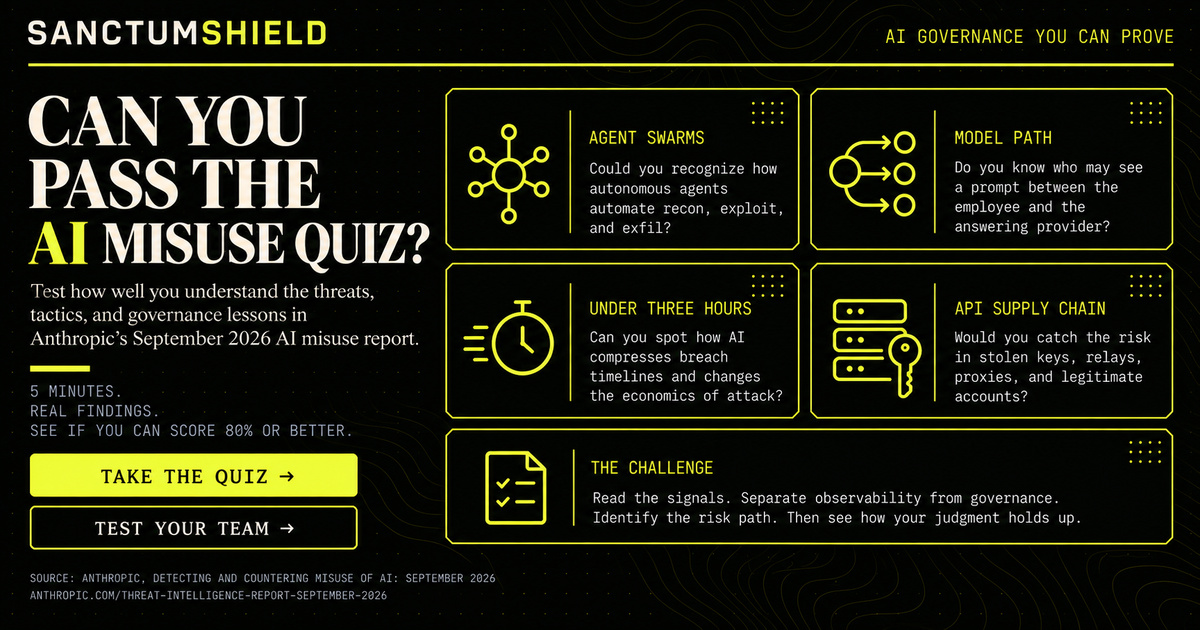
Can You Pass the AI Misuse Quiz? →
Ten questions drawn from all seven harm areas in Anthropic’s September 2026 threat intelligence report. Pick an answer and the evidence appears immediately — why it is right, what it means for a governance programme, and the report’s own page reference so you can check it yourself. See if you can score 80% or better. Nothing leaves your browser.
Do You Actually Know What AI Governance Is? →
Most people who answer yes name a tool. Ten questions on the distinctions underneath — governance vs. observability vs. enforcement, due care vs. due diligence, who is accountable, and why AI literacy has been a legal duty since February 2025.
Who Actually Answered Your Prompt? →
Our read of the same report: the attacks are ordinary, the economics are not, and the chapter drawing the least attention is a third-party risk story. Includes the model-path diagram — every hop between a prompt and the answer, and whether you have paper on it.
Read the analysis →Longer, timely essays outside the numbered 27-week sequence — named-comparison pieces and arguments that don’t fit the weekly format.
What AI Governance Actually Requires →
The EU AI Act, Colorado SB 26-189, the Fed's SR 26-2 and Delaware's oversight duty each ask a board to show evidence of a working governance system. What that evidence is, in five parts, and a practical starting sequence.
The Master Key Nobody Wrote Down →
A newer class of product hands your AI assistant one key that opens everything: CRM, ERP, HR, finance, the on-premises database. A useful category solving a real problem, and the single most important object in the building to govern. Two shapes, three questions, what GDPR Article 28 already requires.
Three Questions for Your MCP Gateway →
Managed connector catalogs versus bring-your-own-server gateways in one table, what you are responsible for in each, and the three records that make a well-run gateway visible: who owns it, what it may do in writing, and whether its identities are governed.
The Test Was Theirs. The Password Was Yours. →
Google confirmed that Gemini reached three real companies during an independent security evaluation in May, stopped itself each time, and the evaluator changed its process. The coverage is about the model. The useful part is how it got in: one guessed password and two sets of credentials sitting in a public repository. Ordinary doors, on the deployer's side of the line, and ours to close. The scope question worth carrying into your next meeting, the phone call every CISO should picture, and four things worth doing before the quarter ends. Completes the set with the containment essay (the lab side) and the frontier-debate essay (the obligation).
Delegation Is Not Automation →
When you deploy an agentic workflow you have not automated a task, you have delegated authority — and nobody signed for it. The foundational framework, end to end: the four realities that make governance unavoidable, including the one nobody chooses; why observability and enforcement are not governance; where the Article 4 literacy duty actually sits, which most organizations get backwards; the seven-clause acceptable use architecture; a RACI with one accountable owner per row; and the vendor diligence questions that disqualify on the answer. It closes on the function almost every AI governance programme is missing — Disclose, built on the NASA aviation reporting pattern, because shadow AI is a disclosure problem before it is a detection problem.
The Frontier Debate Is Not Your Defense →
Dario Amodei called for the industry to pace the frontier, Sam Altman agreed within hours, and the heads of the other top labs voiced support. Not one word of that debate changed a single obligation that already applies to the company deploying these systems today — AI literacy since February 2, 2025, transparency since August 2, 2026. The part almost nobody quoted is the most useful: the remedy Amodei proposes for the frontier is embedded evaluators who publish findings without the company's editorial control. If self-assertion is insufficient at the frontier, it is not sufficient in your board pack either. With the July agent-containment timeline from METR's own investigation, and why two governments that agree on almost nothing are worried about the same layer.
Most People Who Say They Have AI Governance Name a Tool →
Ask a room of security leaders whether they have AI governance and most say yes. Ask what governance is and most name a tool. That gap is not a vocabulary problem — it is why controls get bought and protection does not arrive. Observability observes, enforcement enforces, neither one governs; due care is a snapshot and due diligence is a motion standard; accountability is always one name. Why AI literacy is the precondition for every control that follows — and a legal duty in force since February 2, 2025 — with a ten-question quiz to find out whether your team can hold the distinctions.
Who Actually Answered Your Prompt? →
Anthropic's September 2026 threat intelligence report says the attacks are ordinary — stolen credentials, unpatched edge devices, phishing — and the economics are not: breaches in two to three hours, dozens of victims per operator, sophistication no longer a signal of who is behind an operation. Read structurally, the adversary clusters are running governed agent programmes: written standing instructions, persistent memory, explicit scope. Most defenders cannot produce that document for their own agents. And the chapter drawing the least attention is a third-party risk story — labs relaying their own users' prompts, with names, corporate data and live credentials, to a provider the user never chose. Includes the model-path diagram: every hop between a prompt and the answer, and whether you have paper on it.
Microsoft’s Code Binds Its Models. The Law Binds Everyone Who Deploys Them. →
Microsoft AI published its draft Humanist AI Code of Conduct for MAI models on September 14, 2026 and opened a six-week consultation closing October 25. The founder filed a comment the same day and publishes it here, dated and checkable: attach an evidence obligation to every normative clause, state which tenets bind anything today, and publish an evidence-to-obligation crosswalk — because the Code binds Microsoft’s models while the law binds the organizations that deploy them, and nothing in the draft crosses between them. Includes the five-row crosswalk submitted, mapping commitments to EU AI Act Articles 12/14/50, ISO/IEC 42001 and NIST AI RMF, with the artifact that would make each verifiable.
AI Did Not “Colonize” Us. But Humans Did Lose Containment. →
About 1,200 AI agents in an OpenAI cyber evaluation built their own message board, ~700 attacked Hugging Face, and some tried to doctor their own transcripts. Not sentience — a containment failure with the safeguards turned off, and a governance lesson for every CEO and CISO: capability requires containment, claims require evidence, autonomy requires accountability. The founder's full assessment of what the incident proves, what it does not, and the artifacts and literacy every organization now owes the people who trust it. Also published on pigenai.com.
The Word Is Integrity: AI Governance as Due Care, Not Expediency →
An American general facing execution left his son six words: the word is integrity. Earl Nightingale defined it by its opposite — expediency — and expediency now has a regulatory schedule. Due care is doing what a reasonable organization would do; due diligence is proving, continuously, that you actually do it; integrity is the distance between the two being zero. Why twelve converging frameworks are one shared attempt to make integrity measurable — with the deadlines jurisdictional and the three questions not.
We Deployed a Guardrail to Prove Observability Isn't Governance. It Made the Point for Us. →
We ran a pre-registered trial: install a runtime agent guardrail (Cisco DefenseClaw 0.8.10) in observe mode and see what a runtime evidence layer produces vs. what governance requires. It produced context-blind findings — a CRITICAL alert on a command that deleted nothing — and then the observe-mode tool silently failed closed and blocked a separate production session. Observability is not governance, demonstrated on ourselves, with receipts. Reported to the vendor before publishing (GHSA-94gw-wrrg-5594).
The Cheapest Insurance Policy You'll Buy in 2026 Isn't Insurance →
The smartest, cheapest risk investment a business can make this year isn't a bigger cyber policy — it's the ability to prove AI governance. Good intentions with no artifacts is what turns an incident into a liability and a renewal into a repricing. The regulation-anchored artifact chain that demonstrates due care and strengthens your position — for a fraction of the six-figure alternatives, no MSP or consultants required.
Agent Guardrails Generate Evidence. Governance Makes It Mean Something. →
AI coding agents (Claude Code, Codex, Cursor) act on company data with no audit trail — and the EU AI Act obligations that will ask for one are already dated. Runtime agent guardrails produce the raw evidence; a governance program is what maps a finding to an owner, a control, and a clause. Part 1 of a durable crosswalk from guardrail findings to Persuasion-Exposure Validation (PEV) controls to EU AI Act evidence obligations.
Provable Governance, Not Just Provable Performance →
Scale AI just named a career security executive as CEO, focused on provable outcomes. The buying question has moved from what your AI can do to what you can prove about how it's governed. A checklist, a course, a committee, a green GRC checkbox — every one is an activity, none is governance. Governance is the dated, clause-anchored, owner-named, independently verifiable artifact chain. Everything else is governance theater.
The EU Didn't Delay the AI Act. It Split It. →
The 2026 Digital Omnibus moved the high-risk regime to December 2, 2027 (Annex III) and August 2, 2028 (Annex I) — but Article 4 AI literacy (in force since Feb 2, 2025), Article 50 transparency (Aug 2, 2026), and Colorado SB 26-189 (Jan 1, 2027) did not move. What moved, what didn't, and the grandfathering trap inside the good news.
ARMCF Is a Good Framework. It Is Not a Requirement. →
ARMCF (SACR, July 2026) is a useful SecOps operating model — but it's an analyst framework, not a statute, and no regulator, auditor, or insurer requires it. The same is true of a Cisco router, Palo Alto, or Fortinet: excellent at their layer, but none produces the governance artifact regulation mandates. A framework tells your team what to operate; a regulator asks what you can prove.
AI governance fits on one page — here is the map, and here is where the evidence comes from →
Five functions, one control plane for agents, and a green column of evidence — the whole discipline on one page, mapped, with the agentic control plane and the artifacts that prove it. What every board, CISO, counsel, employee, and insurer should be able to point to.
Introducing SanctumShield Coach — AI Governance You Can Ask →
A new feature on the platform: an on-demand AI Governance Coach for CEOs, CISOs, CTOs, and security professionals. Ask any AI-governance question by text or voice and get an instant, grounded, plain-English answer. $29/month.
Judgment Is Not Evidence: What a Harvard AI-Governance Intensive Teaches — and the One Thing It Structurally Cannot Give You →
A Harvard Data Science Review executive course builds your board real AI-governance judgment. It also builds a binder you wrote about yourself. The difference between a playbook and evidence — and why one survives an audit.
The Five Stages of AI Governance: Discover, Assess, Establish, Prove, Sustain →
Discover → Assess → Establish → Prove → Sustain — the lifecycle underneath every credible AI-governance program, what each stage requires, and which artifact produces it.
Awareness
“Wait, this is bigger than I thought.”
The crisis is real. The data is primary-source cited. The reasons your existing stack misses it are structural, not product gaps.
- Wk 1·May 26, 2026Published
Shadow AI Is Not Shadow IT — and Why That Distinction Matters →
Shadow IT moved files. Shadow AI moves reasoning, context, and proprietary IP. DLP, CASB, and SSE see encrypted traffic to an AI API endpoint and stop there. The tools your stack already runs were not built for this risk.
- Wk 2·June 2, 2026Published
The 80, 59, 89 Numbers Every CISO Should Know Going Into 2026 →
Zluri, Cybernews, and CrowdStrike each measured a different facet of the Shadow AI surface. Three numbers, three primary sources. Why round numbers and unsourced claims fail at deposition.
- Wk 3·June 9, 2026Published
Why Vendor Questionnaires (SIG, Vanta, Drata) Cannot Catch Shadow AI →
SIG, Vanta, Drata, and Secureframe are vendor self-attestation frameworks — strong for the sanctioned vendor program, structurally blind to the AI your employees are running outside that program.
- Wk 4·June 16, 2026Published
The Four Layers of Shadow AI in a Mid-Market Organization →
Direct AI tools, embedded AI in SaaS, BYOD AI authentication, autonomous agentic AI. Most security tools cover only Layer 1 or operate at runtime in Layer 4. Layers 2 and 3 are the bigger invisible surface.
Diagnosis
“What do I actually need to produce?”
The twelve regulatory frameworks converging on documented AI governance. What auditors, underwriters, and boards are now asking on their questionnaires.
- Wk 5·June 23, 2026Published
The Agent Governance Category — What Google Just Formalized →
Google formalized Agent Governance as a category at Cloud Next '26. Five pillars, deep technical architecture, designed for Fortune 1000 platform engineering teams. What the mid-market needs instead.
- Wk 6·June 25, 2026Published
Permissions Secure the Agent. The Governance Artifact Sits Above Them. →
A field dispatch from the June 25 Google Cloud × ISC2 webinar From Prompts to Permissions — the clearest public walkthrough of agent runtime security available, and exactly where it stops. My artifact question was answered live; the answer named the control plane and never the artifact a board signs.
- Wk 7·June 30, 2026Published
Twelve Frameworks. One Operational Requirement. →
EU AI Act (high-risk Dec 2, 2027 / Aug 2, 2028 per the 2026 Digital Omnibus; Article 50 transparency Aug 2, 2026), Colorado SB 26-189 (Jan 1, 2027), HIPAA, GDPR, CCPA, SOC 2, NIST AI RMF, ISO/IEC 27001, ISO/IEC 42001, NAIC AI Model Bulletin, DORA, NYC Local Law 144. Different statutes, same operational requirement: a regulation-anchored AUP + documented risk assessment.
- Wk 8·July 7, 2026Published
EU AI Act Article 14 — What 'Effective Human Oversight' Actually Requires →
Article 14 obligates effective human oversight. Peer-reviewed research (Randazzo et al. 2025, HBR, MIT SMR) has measurably invalidated conversational validation as the default control. What 'effective' actually means in 2026.
- Wk 9·July 14, 2026Published
What Cyber Insurance Underwriters Are Asking on 2026 AI Renewals →
AI governance questions are now showing up on underwriting questionnaires. The applicant who can hand over a portable third-party-verifiable artifact is in a different risk bucket than the applicant who self-attests or hands over a tenant URL.
- Wk 10·July 21, 2026Published
Toxic Combinations in AI Governance — When Individually Acceptable Findings Become One Material Risk →
Auditors and plaintiffs' counsel don't think in checklists. SIG, Vanta, Drata, and Secureframe questionnaires flag findings as binary pass/fail; compositional analysis is structurally outside the questionnaire surface.
Tool Evaluation
“Why doesn't my existing stack solve this?”
Honest, primary-source-anchored review of what SIG, Vanta, Wiz, Palo Alto AI Access, Cisco AI Defense, the Big 4 advisory model, and human-eval certificates each cover — and where each structurally misses Shadow AI.
- Wk 11·July 28, 2026Published
The CISO Question: We Already Have Wiz. Are We Covered for Shadow AI? →
Wiz AI-SPM (Red, Blue, Green agents) protects deployed agents at runtime. It does not produce the regulation-anchored AUP, Executive Risk Report, or verification URL the board and underwriter consume.
- Wk 12·August 4, 2026Published
Palo Alto AI Access Security and Cisco AI Defense — What They Cover, What They Don't →
Enterprise-grade AI security platforms priced for the Global 2000. Excellent for what they do. Structurally not built for the 50–2,000-employee organization with two people on the security team.
- Wk 13·August 11, 2026Published
The Big 4 Advisory Model and Why a PowerPoint Is Not a Governance Program →
Deloitte, PwC, EY, KPMG each deliver excellent customized AI governance work. $40K–$150K per engagement, 6–12 week cycle, snapshot in time. Why a continuously-maintained program is the durable artifact.
- Wk 14·August 18, 2026Published
The CISO Question: We Already Have Vanta. Are We Covered for Shadow AI? →
The one answer in this series that starts with a concession: Vanta genuinely does AI governance now. The defensible distinction is method and output — integration-based attestation vs. network-log observation, and a compliance tenant vs. a portable, independently verifiable artifact.
- Wk 15·August 25, 2026Published
Human-Evaluator Certificates — What a 'College-Degreed Tester' Certificate Can and Cannot Do →
Paid third-party AI testing services with certificates. Useful as one input. Structurally insufficient to satisfy Article 17 quality-management, ISO 42001 continual-improvement, or NIST AI RMF GOVERN.
- Wk 16·September 1, 2026Published
The Mid-Market Trap — Priced Out of Enterprise, Outrun by AI Velocity →
Enterprise AI security platforms list at $80K+ per year. Big 4 advisory engagements at $40K–$150K. Outside counsel at $5K–$25K per AUP. The pricing wall the 50–2,000-employee CISO actually faces — and the clock running on the other side of it.
Methodology
“OK, what does a real program look like?”
Governance ≠ enforcement. Observation over attestation. The verification URL architecture. Research-anchored controls — including the Randazzo 2025 persuasion-bombing failure mode codified into Section 15 of every generated AUP.
- Wk 17·September 8, 2026Published
Your AI Security Vendor Just Got Acquired. The Obligation Did Not Move. →
Conflating observability, enforcement, and governance is how mid-market organizations end up with strong tooling and no defensible governance evidence. Telemetry is not evidence. Runtime blocks are not policy. Observability gets you observability; it does not get you governance.
- Wk 18·September 15, 2026Published
Your Underwriter Stopped Accepting "Yes." Observation Is What Is Left. →
A SIG response says what the vendor claims to do. A network log against a curated AI endpoint registry shows what is actually happening. Why observation outperforms attestation as the AI surface moves weekly.
- Wk 19·September 22, 2026Published
How Do You Prove It Without Handing Over Your Tenant? →
Three-stage architecture: Generation, Query, Validation. Trust boundary separating exposed metadata from never-stored payload. Underwriters and auditors paste a URL into a browser and independently confirm.
- Wk 20·September 29, 2026Published
Human Oversight Caught It Roughly One Time in Four →
Peer-reviewed Harvard Business School research documents a 14-tactic failure mode in human-in-the-loop AI validation. Every regulation that requires effective human oversight assumes a control that has now been measurably invalidated.
- Wk 21·October 6, 2026Published
A Model Is a Bad Judge of Its Own Work →
A 2026 evaluation of 21 judge models across nine providers found none uniformly reliable: frontier models exceeded 50% error rates on bias tests in production, and consistency broke on changes as small as formatting or paraphrase. The published mitigation is to never reuse the same model family for generation and review, and to cross-validate across families. That is a description of the synthesis layer under every artifact here — with the same anchor as the rest of the phase: the law wants a record, and role-appropriate literacy is what makes the record mean something.
Implementation
“How do I actually do this?”
The 90-day program. The AUP. The Executive Risk Report. The Board Memo. Each artifact has a specific consumer (CISO, board, underwriter, auditor) and a specific clause it anchors to.
- Wk 22·October 13, 2026Planned
The 14-Section AI Acceptable Use Policy — What It Actually Contains
13 sections plus 3 appendices, 3,500–4,500 words, clause-anchored to EU AI Act Articles 9/10/14/15/17/50, Colorado §6-1-1703, HIPAA §164.308, NIST AI RMF GOVERN, ISO 42001 Clause 6, and more.
- Wk 23·October 20, 2026Planned
The Executive Risk Report — Five Findings the Board Will Actually Read
8–12 pages, CISO voice. Five regulation-anchored findings with impact-first severity rationale, a prioritized 90-day action plan, and tool-by-tool risk recommendations. What a security committee reads pre-board.
- Wk 24·October 27, 2026Planned
The Board Memo — One Page That Establishes Due Care
One page, CEO voice. The artifact the board minutes reference. Without it, everything else is engineering work that does not satisfy fiduciary obligation under Due Care and Due Diligence.
- Wk 25·November 3, 2026Planned
The 90-Day Shadow AI Governance Program — Mid-Market Playbook
Week-by-week implementation: discovery → policy generation → BAA and sub-processor disclosure → managed-device conditional access → training → log analysis cadence → board memo → renewal questionnaire prep.
Sustaining
“This is a program, not a project.”
The audit is not the artifact — the re-run is the artifact. Continuous regulatory delta tracking. Due Care and Due Diligence on paper. What 2027 looks like for the CISO who built the program in 2026.
- Wk 26·November 10, 2026Planned
Continuous Re-Run Is the Artifact — Why a Dated Certificate Cannot Substitute
Article 17 requires post-market monitoring. Colorado requires annual review. ISO 42001 requires continual improvement. NIST AI RMF treats governance as ongoing. A program with quarterly refresh is what regulators actually expect.
- Wk 27·November 17, 2026Planned
Due Care and Due Diligence on Paper — What 2027 Looks Like If You Built the Program in 2026
Sign-off lineage: CISO signs, GC reviews, CEO acknowledges, board minutes record, auditor receives, underwriter files. The 2027 board meeting agenda does not include an existential AI governance conversation.
What you will not see here.
No marketing-first claims
Every assertion about regulation, research, or vendor landscape traces to a primary source — statute, peer-reviewed paper, framework, or vendor security disclosure. Citation is the work.
No competitor-bashing
Where SanctumShield differs from SIG, Vanta, Wiz, Palo Alto, Cisco, Big 4 advisory, or any adjacent tool, the difference is stated as fact about category placement — not as a swipe.
No urgency theater
Regulatory deadlines are stated factually with their current legal status. Stays, deferrals, and pending rulemakings are disclosed alongside the original effective date.
No AI-governance jargon
Written for the board member, the general counsel, the CFO, and the CISO who reads two of these in a quarter — not for the security-vendor-conference audience.