The Standard Information Gathering (SIG) questionnaire is the industry’s most-used third-party risk assessment — 21 risk domains, 133 to 810 questions depending on edition, mapped to NIST CSF 2.0, HIPAA, GDPR, SOC 2, ISO 27001, EU AI Act, and 30+ frameworks. Vanta automates the same vendor-attestation pattern continuously: 16,000+ customers, 400+ tool integrations, hourly automated control tests. Drata, Secureframe, and OneTrust do the same. Each is a strong tool for the sanctioned vendor risk-management job it was built for.
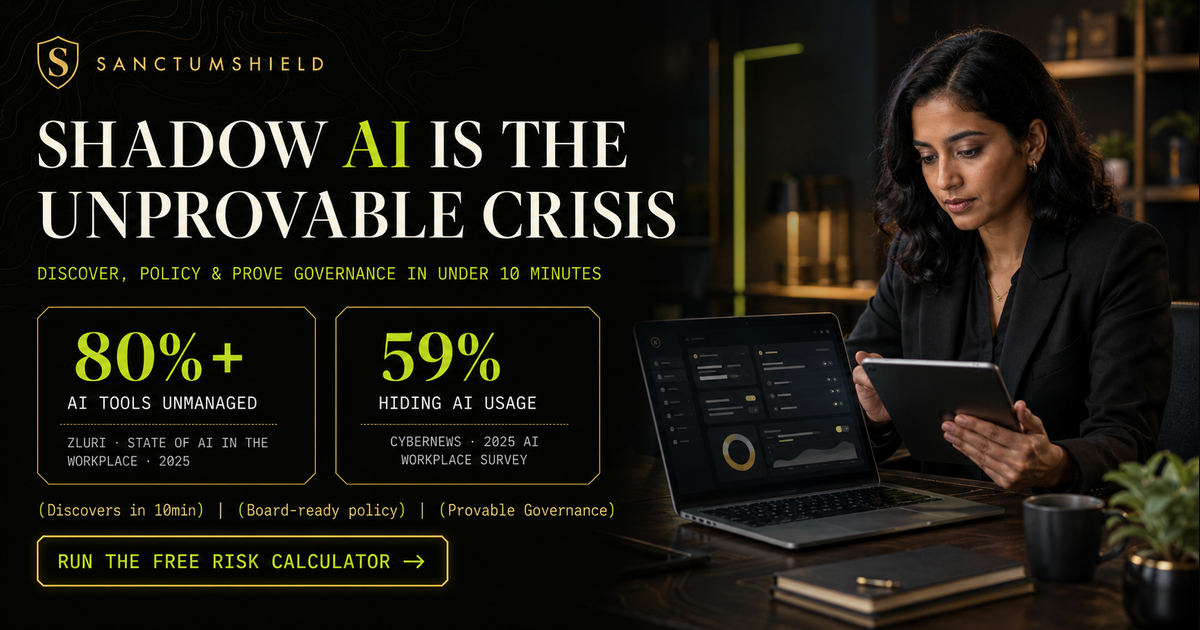
Each is also, structurally, a vendor self-attestation framework. SIG, Vanta, Drata, and Secureframe all see the AI tools your security team has onboarded. None of them can see the consultant who pastes a customer contract into ChatGPT, the engineer who installs an AI browser extension on a managed laptop, or the analyst who authenticates to Claude or Gemini with personal credentials outside IT. The 80%+ of enterprise AI usage that is unmanaged is the AI these tools were never designed to detect — because Shadow AI is not a vendor relationship, it is an employee behavior. See the SIG entry in the glossary for the parent acronym, and /beyond-sig for the full structural critique.
What to do. Keep your vendor-attestation tools — they are doing the vendor-risk job correctly. Layer Shadow AI governance alongside them. SanctumShield runs observation against network logs (paste any firewall, proxy, or DNS export — no integration, no agent, no platform engineer required), matches outbound traffic against 82 continuously-refreshed AI endpoints via multi-LLM agentic synthesis (Claude + Gemini), generates a regulation-anchored AUP, and produces a board-ready Executive Risk Report with a 5-year verifiable URL that underwriters and auditors can independently confirm. SIG and Vanta cover the vendor program. SanctumShield covers the employee program. Next step: see how SanctumShield layers under Vanta at /vs-vanta.