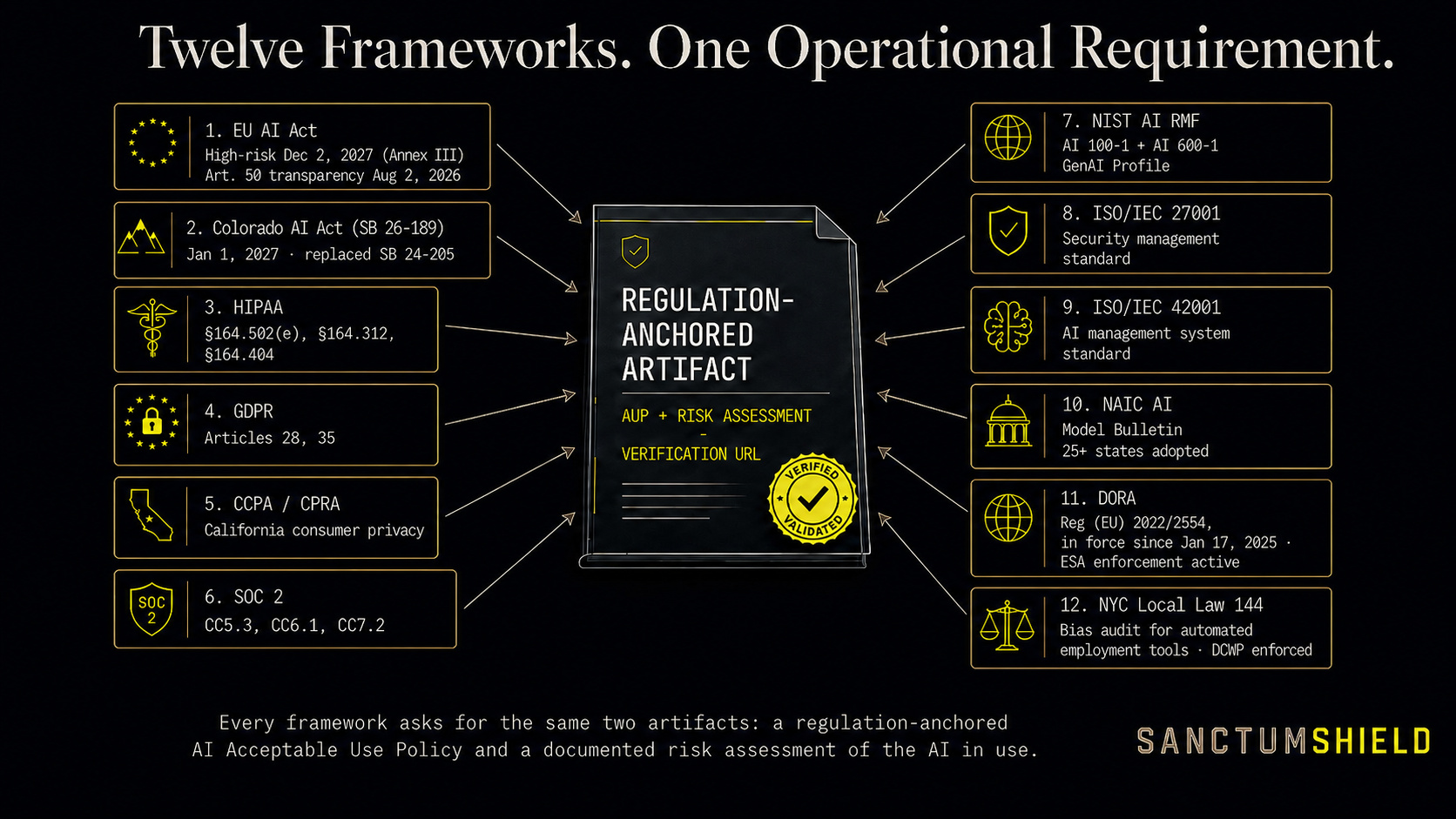
Twelve regulatory frameworks now converge on documented AI governance. EU AI Act (Articles 9, 10, 14, 15, 17 high-risk obligations now December 2, 2027 for Annex III / August 2, 2028 for Annex I per the 2026 Digital Omnibus; Article 50 transparency August 2, 2026; Article 4 literacy in force since February 2, 2025). Colorado SB 26-189 (which repealed and replaced SB 24-205; signed May 14, 2026) — effective January 1, 2027, applies to consequential decisions made on or after that date. HIPAA Security Rule (§ 164.308 administrative safeguards) GDPR (Articles 28, 35). CCPA/CPRA. SOC 2 (CC5.3, CC6.1, CC7.2). NIST AI RMF (GOVERN, MAP, MEASURE, MANAGE functions). ISO/IEC 42001 (Clauses 6, 8.3, 10). ISO/IEC 27001. NAIC AI Model Bulletin (adopted in 20+ U.S. states). DORA (Reg. (EU) 2022/2554, ESA enforcement active since January 2025). NYC Local Law 144 (bias audit for automated employment decision tools, DCWP-enforced since July 5, 2023). Different statutes, jurisdictions, and industries. Same operational requirement.
Every one of them asks for the same two artifacts: a regulation-anchored AI Acceptable Use Policy and a documented risk assessment of the AI in use. Generic AUP templates that are not clause-anchored cannot satisfy any of them at audit level — the auditor’s question is not “do you have an AUP” but “show me the section that satisfies Article 17(c).” Per-framework consulting engagements ($40K–$150K each from the Big 4 advisory firms) cover one framework at a time and produce snapshots that drift the moment a regulator amends a clause. Vendor self-attestation tools (SIG, Vanta, Drata) cover the controls side of these frameworks at the vendor program level but cannot generate the regulation-anchored documented evidence the frameworks require as artifacts.
What to do. Produce one artifact that anchors to all twelve frameworks at clause level — and refresh it as the landscape shifts. SanctumShield’s multi-LLM agentic synthesis layer (Claude + Gemini) maps each generated AUP section to the specific clauses it satisfies across the twelve frameworks, refreshed monthly as regulators amend obligations and as new state and sectoral bulletins land. Next step: see the framework mapping in a real Acme Health audit at /sample-outputs.