Insurers are asking on 2026 renewals now. What will you hand them? See what the law expects →
Why underwrite AI risk blind?
By Lindsay Hiebert · Founder · CISSP
Renewal questionnaires now ask about AI governance — and a self-attested checkbox is all most applicants can offer. SanctumShield gives you an artifact instead: a dated, third-party-verifiable risk assessment and acceptable-use policy you can confirm in one click — no tenant access, no report contents exposed, metadata only. Require it before you bind; verify it again at every renewal.
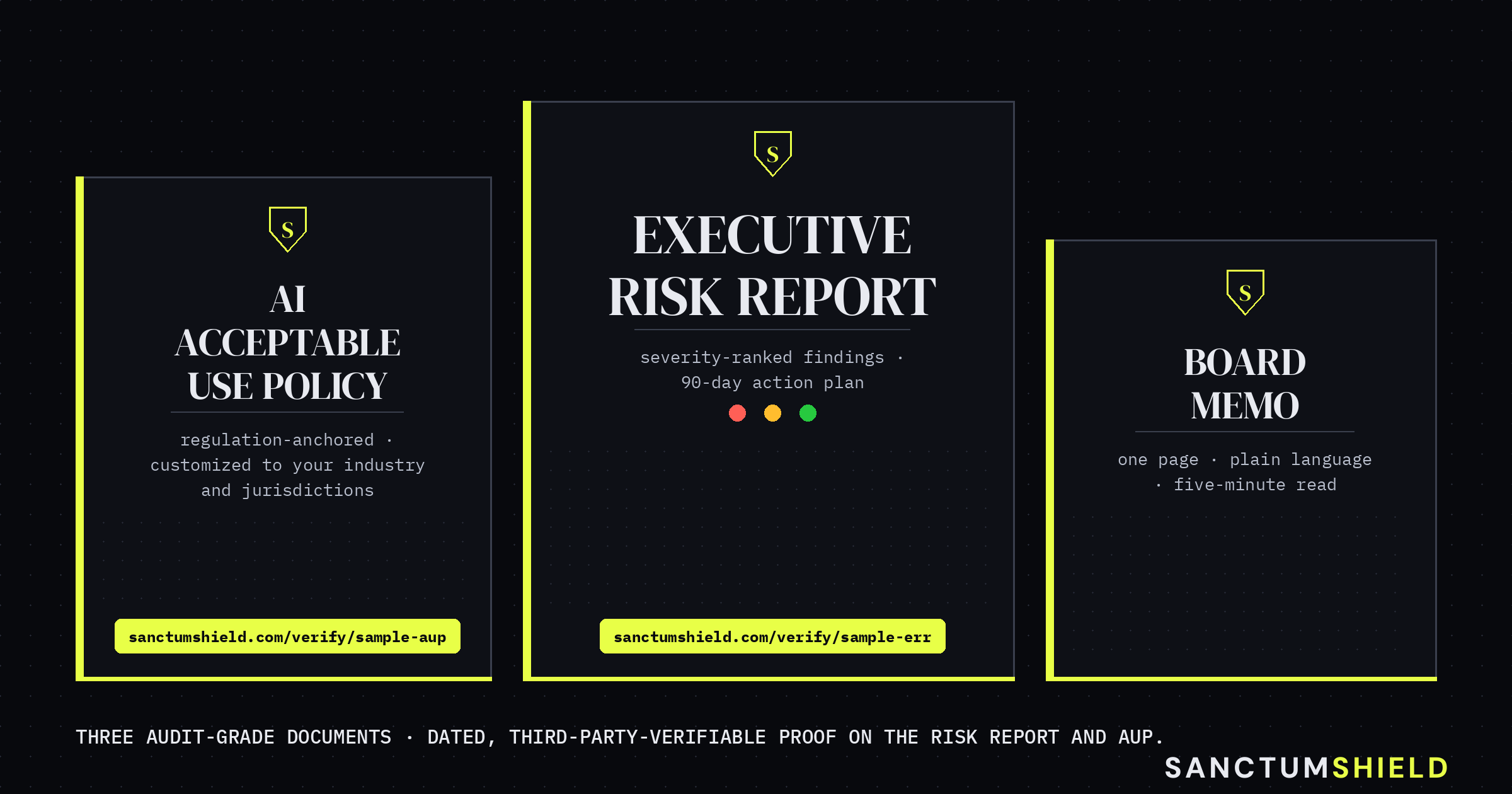
Four artifacts, underwriting-grade: the applicant’s AI Acceptable Use Policy, their Executive Risk Report, their Board Memo — and, on the Policy and the Risk Report, a Verification URL your desk can paste into a browser to confirm the assessment is genuine and dated. Evidence you verify, not a promise they make.
An artifact dated last March tells you what was true last March. The cadence — re-run, re-dated, re-verifiable — is what turns governance from a one-time exhibit into a condition you can attach to eligibility.
Lower your cyber insurance bills and liabilities.
Lower the risk of the customers you insure.
The SanctumShield / cyber insurance channel is one of the rare strategies where the same artifact creates economic value on both sides of the table. The report that saves the applicant money is the same report that reduces loss exposure for the carrier. Here is the math for each side.
Lower your premium. Lower your retention.
Lower your exposure.
Cyber insurance premiums are priced off risk signals. Every carrier underwriting discount you earn — for MFA, for EDR, for phishing training, for an IR plan — exists because the control reduces loss frequency or severity. AI governance is the newest risk signal and the first one in a decade without a standardized measurement. A SanctumShield Executive Risk Report gives your broker a concrete artifact to walk into the renewal with and ask for:
- Premium reduction — a documented AI governance program with observed evidence is a rating factor. Even a 3–5% discount on a $40K premium pays for seventeen months of SanctumShield
- Lower retention — self-insured retention (the deductible before the policy pays) often trades off against control maturity. Better controls, lower retention
- Narrower AI carve-outs — many 2025–2026 cyber policies are adding AI-risk exclusions. A carrier with an underwriting artifact has less reason to exclude
- Reduced personal liability — D&O exposure for “failure to supervise AI use” is rising. A regulation-anchored AUP and a risk assessment on file is the most defensible posture a CISO / GC can have
- Audit-ready evidence — the same report that reduces premium satisfies SOC 2, HIPAA, and enterprise procurement AI governance requirements. One artifact, five downstream wins
For a $40K–100K annual cyber premium, a 3–5% rating improvement is $1,200–$5,000 per year. SanctumShield is $1,188 per year. The arithmetic answers itself.
Lower loss ratio. Lower claims severity.
Lower the risk of the book you’re writing.
You are pricing AI risk right now without actuarial data. Every policy you write has an implicit AI exposure — shadow AI data exfiltration, prompt injection, AUP violations, regulatory penalties under the EU AI Act and state AI disclosure laws — and your loss reserves are sized against a risk you cannot yet observe. SanctumShield inverts that:
- Observed-network evidence — not applicant self-reporting. Log-matched hits against a 71-domain AI endpoint registry. You see what the applicant actually uses, not what they claim
- Standardized risk score — a numeric output your actuaries can weight in existing rating models without a six-month data science project
- Regulation-anchored findings — five findings per report, each mapped to a real clause in HIPAA, SOC 2, GDPR, or EU AI Act. Supports denial-of-claim defensibility and post-loss subrogation
- Loss ratio improvement — applicants who complete a SanctumShield assessment self-select into better governance posture. Lower loss frequency, lower severity, healthier book
- Differentiated product — first-mover carriers that reference SanctumShield in underwriting get a marketing edge in the mid-market: “our AI governance underwriting is quantitative, not vibes”
- Regulatory defensibility — when a state insurance commissioner asks how your underwriting rationally distinguishes AI risk, a standardized third-party assessment is the answer they accept
One carrier that writes 1,000 mid-market cyber policies a year and shaves 2 points off their loss ratio via better AI governance selection recovers multiples of any assessment licensing cost, before the broker channel effects are counted.
In most security tool categories, better evidence means worse news for one side of the insurance transaction. An external security rating that uncovers new vulnerabilities raises premiums. A pen test that finds real weaknesses leads to carve-outs. SanctumShield is different because the work of generating the assessment IS the work of improving the governance program. The applicant who runs SanctumShield is, by the act of running it, adopting a regulation-anchored AUP, a continuous registry of their AI tools, and a prioritized 90-day action plan. Their risk actually drops. The carrier rewards the drop. Everyone wins. This alignment is the reason the channel exists in the first place.
One artifact. Three workflows.
Each one closes on its own merits.
Standardized AI risk input for underwriting.
The AI governance question already exists on most 2026 renewal forms as free text. SanctumShield converts that free text into a numeric risk score, five regulation-anchored findings, and a verification URL your underwriting team can paste to confirm authenticity. Reference it as a recommended input today; promote to required when your loss data supports it.
Precedent: BitSight and SecurityScorecard became standard external-security inputs by being adopted by data-driven carriers. AI governance is the next category that channel will colonize.
Differentiate your book on AI governance.
Brokers are where the channel actually moves — you have the volume, the carrier relationships, and the renewal-cycle leverage. Recommend SanctumShield to covered clients as the AI governance artifact to attach to their renewal application. The verification URL means your carrier can confirm authenticity without any back-and-forth, and your client gets a board-ready deliverable as a side benefit.
MSSP / vCISO / consultant variants of this conversation are equally welcome — reach the founder to discuss broker-channel pricing.
Walk into the renewal with the artifact.
Run SanctumShield. Download the Executive Risk Report. Attach it to your renewal packet. Hand the verification URL to your broker; the broker forwards it to the underwriter. The underwriter pastes the URL, sees a clean attestation page, and now your AI governance section has a standardized third-party signal — not a free-text paragraph someone in IT typed at 2am.
Optional: tell us if you’d like a one-page brief sent to your carrier or broker. The opt-in form is at the bottom of this page — courtesy notification, not a campaign.
Where SanctumShield fits for Colorado-regulated carriers — and where it does not.
The Colorado AI Act ( Senate Bill 26-189, which repealed and replaced SB 24-205, effective January 1, 2027) expressly safe-harbors insurers and entities subject to Colorado § 10-3-1104.9 (the existing insurance-AI rule) from Part 17 of CRS Title 6, Article 1 — in the practice of insurance. That means a Colorado-domiciled carrier’s actual underwriting, pricing, claims, and rating activities are governed by § 10-3-1104.9 and are deemed compliant with the new Part 17 obligations for those domains.
SanctumShield’s value to Colorado-regulated carriers is therefore not “we make you compliant with the AI Act for underwriting and pricing” — that domain is already addressed by the insurance rule. The live SanctumShield hooks for Colorado-domiciled insurers are the carrier’s non-insurance ADMT exposure — specifically:
- Employment-related ADMT use — AI tools used in candidate screening, performance management, or compensation decisions affecting Colorado-resident employees fall under SB 26-189’s employment-covered-domain obligations, regardless of the carrier’s insurance safe harbor
- Non-insurance consequential decisions — marketing AI, customer-service AI, vendor- onboarding AI, internal-decisioning AI outside the practice of insurance remain in scope for SB 26-189
- Documented scope-exemption AUP — generative-AI tools (ChatGPT, Claude, Copilot, etc.) that the carrier uses internally and that are governed by an AUP prohibiting consequential-decision use can rely on the SB 26-189 two-condition exemption. SanctumShield’s Section 16 codifies that exemption in audit-ready language
In short: SanctumShield’s value to the carrier’s own internal AI use is real (non-insurance domains). SanctumShield’s value to the carrier’s underwriting workflow — using the Executive Risk Report and verification URL as inputs to score the applicant’s posture — remains the bilateral value prop described above. The two value props are distinct and the insurer safe harbor applies only to the first.
This disclosure addresses a clarification raised in external review of the SanctumShield carrier positioning following the May 14, 2026 signing of SB 26-189. See the glossary entries for Covered ADMT, Consequential Decision, and ADMT Scope Exemption for the full statutory framing.
The tools cyber underwriting references today
were built for a different risk era.
When a cyber underwriter reaches for a third-party signal today, they reach for a vulnerability scanner, an external attack-surface rating, or a compliance-automation dashboard. Every one of those tools was built for a risk surface that predates generative AI — patches, exposed ports, TLS expiries, breach history. None of them see the AI risk surface. None of them were designed to. And a cyber insurance program that underwrites 2026 AI exposure using 2015 instruments is insuring against the wrong loss.
CVEs on operating systems, network services, and web applications. Patch-Tuesday reports for Microsoft servers. Compliance against CIS benchmarks. Useful for the 2005-era risk surface it was designed for.
Does not see AI endpoint traffic. Does not catalog AI tools. Does not map to AI governance frameworks (EU AI Act, NIST AI RMF). Does not produce an AI Acceptable Use Policy. Cannot distinguish between a vendor that trains on customer inputs and one that does not. Its entire mental model is 'does the binary have a CVE' — a question that does not apply to SaaS AI tools at all.
Unpatched hosts, exposed services, misconfigurations, known exploitable vulnerabilities on infrastructure you own. Strong at what it measures.
Shadow AI. Completely. These tools scan infrastructure; shadow AI lives on employee browsers accessing SaaS over normal HTTPS to domains the scanner has no registry for. An unpatched server is a managed-IT problem. A Cursor session sending your codebase to a model that trains on inputs is an AI governance problem. Different category.
Externally observable posture — DNS hygiene, certificate quality, leaked credentials, open ports, botnet activity, patching cadence inferred from HTTP headers. Valuable for procurement triage and insurance baseline.
Everything AI. These ratings look at the perimeter of a company, not at what the employees inside it are doing with generative AI. A company with a pristine BitSight score and nine unmanaged AI tools is exactly the profile that lands an AI-driven data exfiltration claim. The external rating says clean; the internal reality is catastrophic.
SOC 2 and ISO 27001 control inventories, evidence collection, audit preparation workflows. Invaluable for the audit they were built to accelerate.
Actual risk assessment. These tools are checklist engines — they track whether a control exists, not whether it is adequate for the organization's real exposure. They do not generate an AI AUP. They do not analyze observed AI traffic. They do not anchor findings to specific regulatory clauses. When the SOC 2 auditor asks about AI governance in the 2026 cycle, the Vanta dashboard will show a green check next to 'AI policy exists' and no underlying artifact.
SanctumShield is a formal, rigorous, recent, regulation-anchored AI risk assessment — not another monolithic platform that will “get to AI” someday.
Formal assessment. The Executive Risk Report is structured: score, headline, five findings, business impact, prioritized action plan with named owners and effort levels. Every finding cites a real clause — HIPAA §164.502(e), SOC 2 CC6.1, EU AI Act Article 5, NIST AI RMF GOVERN-1.4 — verifiable against source law. Not a compliance checklist. A defensible assessment.
Rigorous methodology. Inputs are company profile plus selected AI tools plus observed firewall/proxy/DNS traffic matched against a71-domain AI endpoint registry. Not self-reporting. Not vibes. Not “tell me about your AI program.” Observation over attestation.
Recency. The registry, the regulatory citations, the tools catalog, and the policy prompts are refreshed monthly — see /whats-new for the April 2026 changelog. Patch-Tuesday tools refresh against MSFT. SanctumShield refreshes against the AI landscape. Different clock, different risk.
Rescans are trivial. Because the methodology is pure-function on inputs, re-running the assessment with updated traffic, an updated tools list, or the latest monthly registry refresh takes minutes. No deployment cycle. No reassessment project. No change management.
Targeted, not monolithic. SanctumShield does one thing at $99/month. It does not try to replace your SIEM, your EDR, your DLP, your GRC platform, your compliance automation, or your vulnerability scanner. The other tools stay; SanctumShield fills the AI-risk gap they were never designed to close. A CISO does not need another monster platform. They need the specific artifact their board and their insurer are asking for.
Four reasons this is the next control cyber carriers will require.
Carriers are already seeing early AI-related claims — data exfiltration through LLM tools, prompt injection attacks, AUP violations that trigger regulatory exposure. Actuarial data is thin. The carriers writing cyber policies today are pricing AI risk without underwriting it. That gap closes fast in 2026, and the first standardized input wins.
Every major cyber carrier added an AI governance section to their 2025 or 2026 renewal questionnaire — typically free-text fields about AUP existence, AI tool inventory, and training policy. Free text is not actuarially useful. A standardized report with a risk score and regulation-anchored findings is. SanctumShield produces exactly that artifact.
MFA, EDR, backup/DR, phishing training, incident response plans — all became cyber underwriting requirements in the last five years. AI governance will follow the same path. The only question is whether carriers reference a standardized tool or try to invent their own. A tool that already exists, costs $99/mo, and produces a clean PDF wins that race.
The customer gets an answer to the board-pressure question for $99/mo. The carrier gets a standardized risk input they can price against. The broker gets a frictionless PDF they can attach to the application. Nobody loses. That rarely happens in insurance.
Every report comes with
a verification URL — the underwriter can confirm authenticity in one click.
Every paid SanctumShield report — both the AI Acceptable Use Policy and the Executive Risk Report — carries a unique verification URL printed in the document footer. Your underwriter pastes that URL into a browser and immediately sees a confirmation page showing when the report was generated, by whom, with which AI model, and against which endpoint registry version. The contents of the report are never exposed — verification only confirms the document is genuine and matches the hash recorded when it was generated. Records are kept for five years so the same URL works across multiple renewal cycles.
A unique verification URL is printed in the document footer when you download the .docx — for example, sanctumshield.com/verify/abc123xyz.
Attach the .docx (or PDF print of it) to your renewal application packet, your SOC 2 evidence folder, or your board memo — wherever it needs to go.
They open a browser, paste the verification URL, and see a clean attestation page showing the date, AI model, and registry version SanctumShield used to generate your report.
The underwriter knows the report is real — issued by SanctumShield on the date claimed — without ever seeing its contents and without needing access to your tenant.
No other tool in the AI governance, vendor risk, or compliance categories offers verifiable artifacts — because their outputs aren’t issued from a queryable system of record. A SOC 2 memo from Deloitte is a static PDF. A Vanta dashboard screenshot is just an image. A Wiz finding export lives inside the Wiz tenant. None of them give an underwriter a URL they can paste to confirm the document they’re holding came from the system that claims to have generated it.
- → Vendor risk platforms: Vanta, Drata, Secureframe, OneTrust, BitSight, SecurityScorecard, UpGuard, Panorays
- → AI-SPM tools: Wiz AI-SPM, Palo Alto AI Access Security, Cisco AI Defense, CrowdStrike, Netskope AI, Microsoft Purview AI, Zscaler ITM
- → Enterprise AI governance: Credo AI, Holistic AI, Fairly AI, SafeAI
- → Big 4 consulting: Deloitte, PwC, EY, KPMG (static PowerPoint deliverables)
- → Outside privacy counsel: static PDF policies with no issuer-side lookup
- → Questionnaire frameworks: SIG Lite, SIG Core, CAIQ — the questionnaire is self-attestation, not third-party-attestable
- → SanctumShield — every paid AUP and Executive Risk Report is issued with a verification URL printed in the document footer. Underwriter pastes the URL, confirms authenticity, decides on the application.
This is the structural moat that makes SanctumShield underwriter-channel-ready. Adding verification to a Big 4 PowerPoint or a Vanta dashboard would require rebuilding the product around an issuance model they weren’t designed for.
Want a one-page brief sent to your carrier or broker?
If you’d like SanctumShield to send a one-page briefing to your cyber insurance carrier or your broker — explaining what the artifact is and how verification works — drop your details below. This is opt-in only. There is no public counter, no “pledge wall,” no aggregate marketing. The form below routes directly to the founder and the outreach is tailored, not bulk. CISOs at insured organizations and brokers serving covered clients are both welcome.
If you underwrite cyber at mid-market scale,
we should talk this week.
What we’re offering
- An underwriter-format Executive Risk Report with a numeric risk score, five regulation-anchored findings, and a 90-day action plan — produced in under 30 seconds per applicant
- Coverage of seven frameworks (HIPAA, GDPR, CCPA, SOC 2, NIST AI RMF, EU AI Act, ISO 27001) with real clause citations, not generic controls
- Observed-network evidence via applicant-provided firewall / proxy / DNS logs, matched against a continuously-maintained 71-domain AI endpoint registry
- A verification URL so your underwriting team can confirm any report was genuinely generated by SanctumShield on the date claimed
- Per-assessment pricing, bulk licence pricing, or white-label options — we’ll structure whatever fits your underwriting workflow
- Direct technical access to the founder, a CISSP with fifteen years at Cisco and Intel
- Departmental and line-of-business assessment scoping — for larger insureds where AI risk varies materially across business units (clinical vs. corporate, retail bank vs. wealth management, federal vs. commercial), SanctumShield can produce unit-level reports that give underwriters granular visibility into where the actual AI exposure sits
What we’re asking
- A 20-minute call with the underwriter responsible for your AI governance questions on the cyber renewal form
- An honest evaluation of whether the Executive Risk Report would be useful as an underwriting input, a pricing signal, or a post-bind advisory artifact
- A no-commitment pilot on 5–10 applicants at renewal — we will run the reports on your request, you read them, you decide
- If the pilot works, a conversation about making the report a formal input to the AI governance section of your underwriting workflow
BitSight and SecurityScorecard became the cyber insurance industry’s standard external-security rating by being adopted as underwriting inputs by data-driven carriers. BitSight was acquired for $2.4B; SecurityScorecard is valued similarly. Neither of them sold directly into enterprise procurement — that path failed. The carrier channel made them. SanctumShield is the equivalent for AI governance specifically. The first carrier to adopt it gets the same category-defining positioning those two companies got a decade ago.
For coverage disputes, subrogation actions, and post-incident standard-of-care assessments where AI governance evidence is contested, SanctumShield’s founder Lindsay Hiebert (CISSP) accepts a limited number of expert witness and investigative consulting engagements. See Expert Witness & Investigative Consulting.