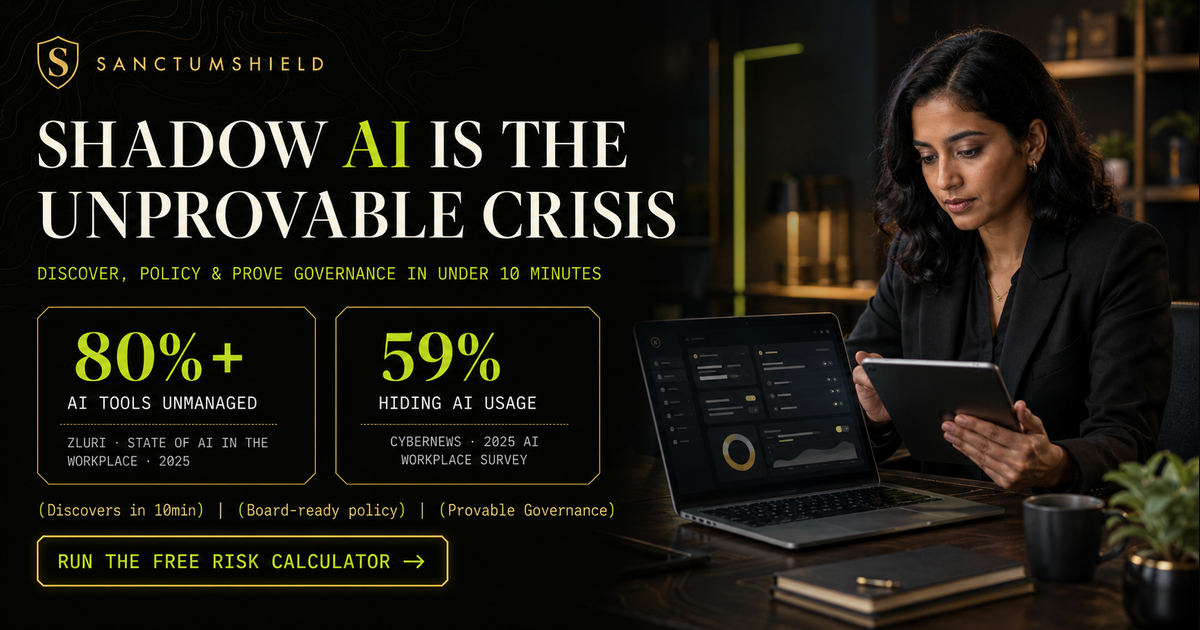
Three numbers frame the Shadow AI crisis. 80%+ of enterprise AI usage is unmanaged today — Zluri’s State of AI in the Workplace 2025. Most of the AI your organization runs on did not come through procurement, was not vetted by security, and is not visible to IT. 59% of employees actively hide their AI usage from IT — Cybernews’s 2025 AI Workplace Survey, corroborated by KPMG at 57%. The phenomenon is defined by invisibility, not intent — employees are trying to be productive, not malicious, but the data still leaves the building. 89% year-over-year increase in attacks by AI-enabled adversaries, with 82% of 2025 detections occurring without malware — CrowdStrike’s 2026 Global Threat Report. Three numbers, three primary sources, one story: governance, behavior, and threat-actor velocity have all aligned against the mid-market security team.
Most AI governance content circulating in 2026 cites these numbers second-hand or rounds them up without sourcing. Big 4 advisory deliverables and consultant checklists rarely link to the primary report — and the round numbers (“90%”, “60%”, “100x”) read as marketing rather than evidence. An auditor or regulator will ask where each claim traces to. A claim that does not trace to a primary source is not defensible at deposition or in a renewal questionnaire. Same problem applies to the vendor-questionnaire ecosystem (SIG, Vanta, Drata, Secureframe) when its AI-governance content cites second-hand statistics rather than primary research.
What to do. Every claim in your governance program needs a citable primary source. SanctumShield’s multi-LLM agentic synthesis layer (Claude + Gemini) cross-validates every citation at artifact-generation time, and the Research Foundations section publishes the canonical citation chain for every claim that appears in customer-facing artifacts — primary research papers, framework texts, vendor disclosures, threat reports. Next step: review the Research Foundations to see what defensible AI governance evidence actually looks like.
Addendum, October 2026: the fourth number.
The three numbers above measure the surface. IBM’s 2026 Cost of a Data Breach study measures what happened to the organizations that were breached through it. one in five organizations reported a breach targeting their own AI models or applications (more than 20%). Of those, 92% of organizations that suffered an AI-related breach lacked proper AI access controls; only 40% of organizations report using access controls on AI models and data (IBM Cost of a Data Breach Report 2026, as summarized by IBM (Limor Kessem, IBM Think, July 29, 2026)). The same point as above applies: the 2025 edition’s figures still circulate, so the edition year travels with the number, or the number fails at deposition.