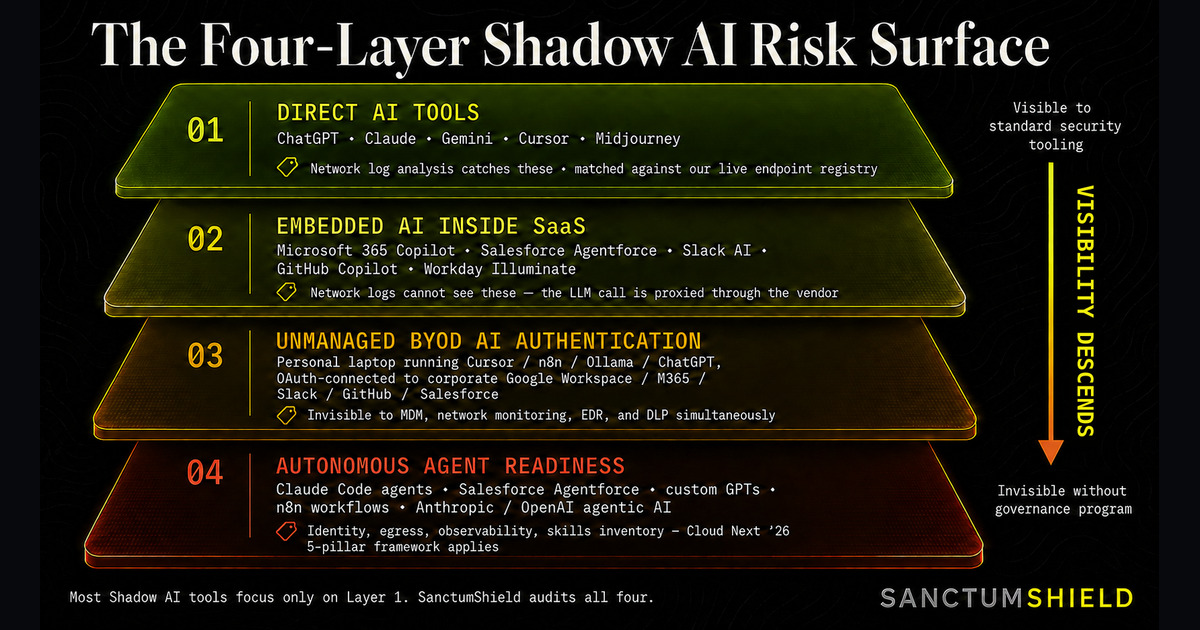
Google Cloud Next ’26 (April 2026) formalized a new category of enterprise software: Agent Governance. The category covers AI agents, MCP (Model Context Protocol) servers, A2A (agent-to-agent) discovery chains, and the autonomous AI tools increasingly acting on enterprise systems without continuous human oversight. Google’s five-pillar architecture — Agent Registry, Agent Gateway, Agent Identity, Pluggable Policies, Agent Observability — is the most thorough public articulation of how to govern this surface to date. It is also designed for the Fortune 1000 with a platform engineering team.
The existing security stack — IAM (Identity and Access Management), SIEM (Security Information and Event Management), GRC (Governance, Risk, and Compliance), CNAPP (Cloud-Native Application Protection Platform), and even AI-SPM (AI Security Posture Management) platforms like Wiz and Palo Alto AI Access — was not built for this category. It governs human accounts, not autonomous agent identities. It enforces network controls, not delegated-authority policies. It observes runtime telemetry, not the regulation-anchored AUP a board signs. The category is genuinely new, not a renamed AI-SPM, and the mid-market (50–2,000 employees) needs a companion to Google’s architecture that does not require a platform engineering team to deploy.
What to do. Treat Agent Governance as its own discipline. Understand the four-layer Shadow AI risk surface (Layer 4 is the agentic layer). Produce a regulation-anchored AUP that includes a Deployed Agent Policy section. SanctumShield generates that AUP — Section 14 explicitly covers agent registration, MCP server allowlisting, A2A discovery boundaries, agent identity and credentials, kill-switch procedures, and agent-authored code governance — in 10 minutes for $99/month with no platform engineering required. Multi-LLM agentic synthesis (Claude + Gemini) cross-validates every clause at generation time. Next step: see the Layer 4 audit in a real Acme Health artifact at /sample-outputs.