A2A (Agent-to-Agent protocol)
Agent ProtocolsThe open standard for agents to discover and call each other
The protocol agents use to discover, authenticate to, and invoke one another. Became a Linux Foundation standard in 2025. Defines both the wire protocol and the Agent Card descriptor format. The “universal translator” layer of the agent stack — relevant for any organization using multi-agent frameworks (CrewAI, AutoGen, LangGraph, ADK).
A2A Discovery Governance Gap
SanctumShield Finding TypesMulti-agent framework in use without an agent-discovery boundary policy
SanctumShield finding type. Triggered when a customer indicates use of multi-agent frameworks (ADK, CrewAI, AutoGen, LangGraph) without an A2A discovery boundary policy in their AUP. Cites EU AI Act Article 13 (transparency for high-risk AI systems) and SOC 2 CC7.2 (monitoring of system operation).
A2UI (Agent to UI)
Agent ProtocolsGoogle's protocol for agents that dynamically generate native UI components, alongside A2A for agent-to-agent
Google’s protocol for registering agents that dynamically generate native user-interface components (within the Gemini Enterprise app), alongside A2A for agent-to-agent communication. A UI-generating agent expands the observability and review surface a governance program has to account for. See A2A and Agent Card.
ADMT Scope Exemption (Colorado SB 26-189 two-condition carve-out)
AI GovernanceCompliance FrameworksPolicyThe statutory carve-out under SB 26-189 that excludes generative-AI / natural-language tools from Covered ADMT status when governed by an AUP prohibiting consequential-decision use — exactly the artifact SanctumShield produces
Colorado SB 26-189 carves a
generative-AI or natural-language tool out of
Covered ADMT status when it satisfies two conditions:
- The tool is not contracted, marketed, configured, or intended for use in a consequential decision, AND
- It is governed by an acceptable use policy that prohibits generated content from being used in a consequential decision.
The second condition is precisely the artifact SanctumShield produces. Generated AUP Section 16 (Consequential Decision Boundary and Scope Exemptions) codifies the prohibition in statute-anchored language and documents the exemption status for audit and underwriter review. Deploy the AUP, document the exclusion. The exemption is the strongest concrete governance hook in the current US state AI landscape because it ties product output directly to a statutorily-recognized compliance position — not a generic compliance gesture.
Adversarial Validation
AI GovernancePolicyValidation by a second LLM from a different vendor, prompted to argue against the first
Validation performed by a second AI model — from a vendor different from the one producing the output being validated — prompted to argue against the primary model’s recommendation. Distinct from conversational pushback, which Randazzo et al. (2025) shows triggers persuasion escalation rather than correction. SanctumShield’s AUP clause PEV-001 (Persuasion-Exposure Validation) prescribes adversarial validation as one of three acceptable validation methods (alongside independent recomputation and structured disconfirmation prompts) for outputs from consequential AI workflows. The vendor-diversity requirement matters: a Claude-validating-Claude or Gemini-validating-Gemini check is structurally subject to the same persuasion-bombing failure mode.
Agent Card
Agent GovernanceAgent ProtocolsA cryptographically signed descriptor an agent publishes about itself
Part of the A2A standard. An agent’s “business card” — declares identity, capabilities, available tools, security schemes, and OAuth scopes. Cryptographically signed so another agent can verify what it’s talking to before making the first call. Discovery Poisoning attacks exploit agent cards that change between discovery and runtime.
Agent Gallery
Vendor RiskAgent GovernanceGoogle's curated marketplace of vetted third-party agents from partners (Accenture, Salesforce, ServiceNow, and others)
Google’s curated marketplace of vetted third-party agents from partners such as Accenture, Adobe, Atlassian, Deloitte, Oracle, Palo Alto Networks, Salesforce, ServiceNow, and Workday. A sourced agent enters the organization’s supply-chain review scope — a registry entry, a vendor review, and a policy record apply regardless of any vetting upstream. See Agent Registry and Rugpull Effect.
Agent Gateway (Pillar 2)
Agent GovernanceAir traffic control for every agent call
Pillar two of Google’s Agent Platform — an Envoy-based data plane that intercepts every agent ingress and egress call and enforces policy at the wire. Performs deep parsing of JSON-RPC bodies (MCP and A2A traffic) so semantic policies can be enforced before the call leaves the perimeter.
Agent Governance
Agent GovernanceAI GovernanceThe category of governing agents, MCP servers, A2A discovery, and shadow AI
The umbrella category Google formalized at Cloud Next '26 — covering AI agents, MCP servers, agent-to-agent (A2A) discovery chains, and shadow AI tools that don’t fit a traditional API gateway, SIEM, IAM, or GRC platform. The superset that subsumes the older “AI governance,” “shadow AI,” and “AI-SPM” framings.
Agent Guardrail
Agent GovernanceAI GovernanceRuntime policy enforcement for an AI agent — scan, inspect, block, log — distinct from a governance program
Software that sits in an AI agent’s execution path and scans, inspects, blocks, or logs the agent’s actions against a defined rule set as they happen. An agent guardrail produces operational evidence — findings, block decisions, human-approval records, and durable exports (SQLite, JSONL, OTLP, SIEM) — but it is a runtime control, not a governance program: the evidence it generates still needs an owner, a control mapping, a regulatory citation, and a review cadence before it answers an auditor’s question. Cisco’s DefenseClaw (as of version 0.8.10, July 2026) is one example of a connector-based agent guardrail; the category is the durable idea, not any single tool. See Connector Governance, Fail Mode (fail-open / fail-closed), Human-in-the-Loop (HITL), and Agent Governance.
Agent Identity (Pillar 3)
Agent GovernanceAgent IdentityCryptographic, ephemeral, scoped identity for each agent
Pillar three of Google’s Agent Platform — agents are first-class principals with their own identity class, distinct from human users and traditional service accounts. Built on SPIFFE / Managed Workload Identity. Internal agent calls operate under assumed-trust mTLS; external calls require zero- trust verification on every request.
Agent Identity Model Gap
SanctumShield Finding TypesAgents authenticate with shared keys, not cryptographic ephemeral identity
SanctumShield finding type. Triggered when deployed agents authenticate using long-lived service account credentials, shared API keys, or embedded secrets, rather than the SPIFFE- based ephemeral, scoped, attestable identity Google’s Pillar Three architecture defines. Cites NIST AI RMF MANAGE-1.3 and NIST SP 800-63 adapted for non-human identities.
Agent Name Service (ANS)
Agent IdentityAgent ProtocolsA DNS-inspired directory for secure AI-agent discovery
A protocol-agnostic, DNS-inspired framework for secure agent discovery and registration that uses PKI to bind agent identity, with a protocol adapter layer for A2A, MCP, and ACP. Developed by the
OWASP GenAI Security Project (v1.0, emerging; GoDaddy has a production implementation).
Related: ANS handles
cross-organization discovery — distinct from an internal
agent registry, the inventory of your own agents that platforms like
Google’s agent platform maintain and that AI-SPM tools such as
Wiz build from runtime.
In practice at SanctumShield: inventory your own agents with the free Agent AUP one-pager, and require verified discovery + a real registry from vendors with the AI Vendor Trust Questionnaire —
both here.
Agent Observability (Pillar 5)
Agent GovernanceUnified telemetry across multi-agent swarms
Pillar five of Google’s Agent Platform — uses OpenTelemetry GenAI conventions plus A2A trace headers to correlate every LLM prompt, A2A handoff, and tool call under a single Application ID. Required infrastructure for any audit that needs to reconstruct what an agent decided and why (relevant to EU AI Act Article 13 transparency obligations).
Agent Persona
Agent GovernanceAgent IdentityThe job description is the policy
A least-privilege model that derives an agent’s permitted tools from a plain-English job description declared at deployment, rather than applying restrictions after the fact. A persona is the intersection of the delegating user and the job description — a marketing-assistant persona acting for a finance VP still gets only email-send access, regardless of the user’s broader permissions. Introduced in Cunningham,
Agentic Zero Trust v3.0 (2026).
In practice at SanctumShield: the free
Agent AUP one-pager operationalizes this exactly — a fill-in persona + tool envelope per agent.
Agent Policy Record
Agent GovernanceThe child record within an agent's registry entry that documents what it is allowed to do
A child record kept within an agent’s entry in the AI Tool and Agent Registry. The registry entry answers “does it exist and who owns it”; the Agent Policy Record answers “what may it do” — it is where the agent’s authorization boundary is documented. It lives within the registry entry, never merely attached alongside it.
Agent Registry (Pillar 1)
Agent GovernanceA unified catalog of every agent and MCP server in the enterprise
Pillar one of Google’s Agent Platform — the answer to “what agents do we actually have?” Eliminates Shadow AI by enforcing a separation between visibility (the full catalog) and access (the per-application least-privilege boundary an agent actually sees at runtime). Visibility does not equal access.
Agent Simulation / Evaluation / Anomaly Detection
Agent GovernanceGoogle Agent Platform's 'Optimize' capabilities: pre-deployment simulation, evaluation, and runtime anomaly detection
The “Optimize” capabilities of Google Agent Platform: pre-deployment Agent Simulation against synthetic users and virtualized tools, Agent Evaluation that scores agents against production traffic with autoraters, and Agent Anomaly Detection that flags unusual reasoning at runtime. These map to the evaluation-and-deployment-gate domain; independent human acceptance criteria remain the organization’s responsibility even where the platform grades agent behavior.
Agent Skills
Agent GovernanceAgent ProtocolsAn open standard for describing what an agent can do
Anthropic-originated open standard (October 2025, open-sourced December 2025) for describing agent capabilities in a structured machine-readable format. Used alongside MCP and A2A to complete the modern agent component model: LLM + retrieval context + Agent Skills + MCP + A2A.
Agent Swarm
Agent GovernanceThreat & Attack PatternsRisk & AssessmentA lead agent decomposing work across parallel subagents, with instructions and memory persisting between sessions
An operating pattern in which one coordinating agent breaks a task into parts, dispatches them to parallel subagents, and preserves target lists, standing instructions and progress in persistent memory so work resumes across sessions rather than restarting. Anthropic’s September 2026 threat intelligence report documents adversary clusters operating this way, including unattended collection fleets and doctrine kept in version-controlled files reused across hundreds of sessions.
Why the defender should care: described structurally, the pattern is a governed agent programme — written scope, explicit prohibitions, persistent record. The governance question it puts to any organization running its own agents is whether the equivalent document exists on the defending side: what each agent may do, who approved it, and when that approval expires. See also Non-Human Identity (NHI).
Agent-as-Developer
Agent GovernanceRisk & AssessmentThe pattern where AI agents author production code and a human manager reviews agent attestations rather than the code itself
Pattern demonstrated publicly by Google at Cloud Next '26 (“Build AI Agents with Agents: Multi-Agent PR Roaster” and the ADK + Multi-Agent Patterns sessions). A coding agent is delegated a task end-to-end — scaffolding, code generation, evaluation, deployment, observability — with the human engineer reviewing the agent’s attestations and final artifact rather than the underlying code. Introduces a new governance question: where does the coder-agent get its policy and security guardrails from, and who owns the policy chain when the human reviewer never reads the code?
Agent-Authored Code Governance Gap
SanctumShield Finding TypesAgent GovernanceWhen a coding agent produces production code with no documented policy chain or change-management evidence
SanctumShield finding type. Triggered when a customer’s engineering organization has adopted coding agents (Cursor agents, Claude Code, Gemini CLI, Anthropic Antigravity, Google’s google-agents-cli, GitHub Copilot Workspace) without a documented policy answering: (1) where does the coder-agent get its policy and security context from, (2) who is the named human accountable for code the agent produced, (3) what change-management evidence is captured when an agent commits or deploys. Cites NIST AI RMF MANAGE-1.3 (post-deployment monitoring), SOC 2 CC8.1 (change management), and EU AI Act Article 14 (human oversight).
Agent-Driven SSRF
Threat & Attack PatternsServer-side request forgery, but the server is an agent interpreting natural language
SSRF where the attacker doesn’t need to craft an HTTP request — they just need to convince an agent (via a prompt or consumed content) that it should fetch a URL. Internal cloud metadata endpoints (the AWS ECS task metadata service at 169.254.170.2 for example) are canonical targets.
Agentic Defense
SecurityVendor RiskGoogle's Next '26 cybersecurity platform combining Google Threat Intelligence and Security Operations with Wiz
Google’s cybersecurity platform, announced at Cloud Next ’26, that combines Google Threat Intelligence and Security Operations with Wiz’s Cloud and AI Security Platform to detect, prevent, and respond to threats. It consolidates the detection stack those products cover; the organizational evidence of how threats were governed remains a separate layer.
Agentic Zero Trust
Agent GovernanceSecurityZero Trust (NIST SP 800-207) extended to autonomous AI agents
Agentic Zero Trust applies NIST SP 800-207 Zero Trust to autonomous AI agents — reasoning systems that improvise, accumulate context, spawn sub-agents, and act at machine speed, which breaks assumptions built for human users and managed devices. It does not replace Zero Trust; it applies it with fidelity, adding three control layers: the Token Isolation Pattern, the Agent Persona framework, and Behavioral Identity. Term coined by Dr. Chase Cunningham (
Agentic Zero Trust v3.0, DrZeroTrust Research Division, 2026).
In practice at SanctumShield: the
agentic-governance templates operationalize these layers for the 50–2,000-employee mid-market.
AI Acceptable Use Policy (AUP)
AI GovernancePolicyThe written policy that tells employees what AI they can use, and how
A formal document describing which AI tools employees are allowed to use, on what data, for what purposes, and under what controls. A production-grade AUP contains approximately fourteen sections (scope, permitted use, prohibited use, data handling, vendor review, training data restrictions, incident reporting, sanctions, review cadence, and legal review), customized to the company’s industry, jurisdictions, and applicable frameworks, and signed by leadership. Cyber insurance renewals, SOC 2 audits, HIPAA reviews, and enterprise procurement cycles now routinely ask for the AUP as evidence.
AI Application (Unit of Management)
Agent GovernanceThe bounded swarm of agents and tools that delivers a business capability
Google’s reframing introduced at Cloud Next '26 — the AI application, not the individual agent or model, is what gets governed. Policies attach to the application boundary; cost attribution rolls up to the application; the kill-switch operates at the application level. A single agent cannot be governed in isolation.
AI Application Perimeter Gap
SanctumShield Finding TypesGovernance attached to hosts/containers — not to the AI application boundary
SanctumShield finding type. Triggered when an organization governs agents individually rather than as bounded AI applications. Policy attached to hosts or containers cannot scale to multi-agent systems where the meaningful unit of governance is the application, not the agent. Cites NIST AI RMF MAP-4.1 and ISO 42001 Clause 9.
AI Governance Council
AI GovernanceThe cross-functional body that owns AI governance decisions — membership, cadence, escalation
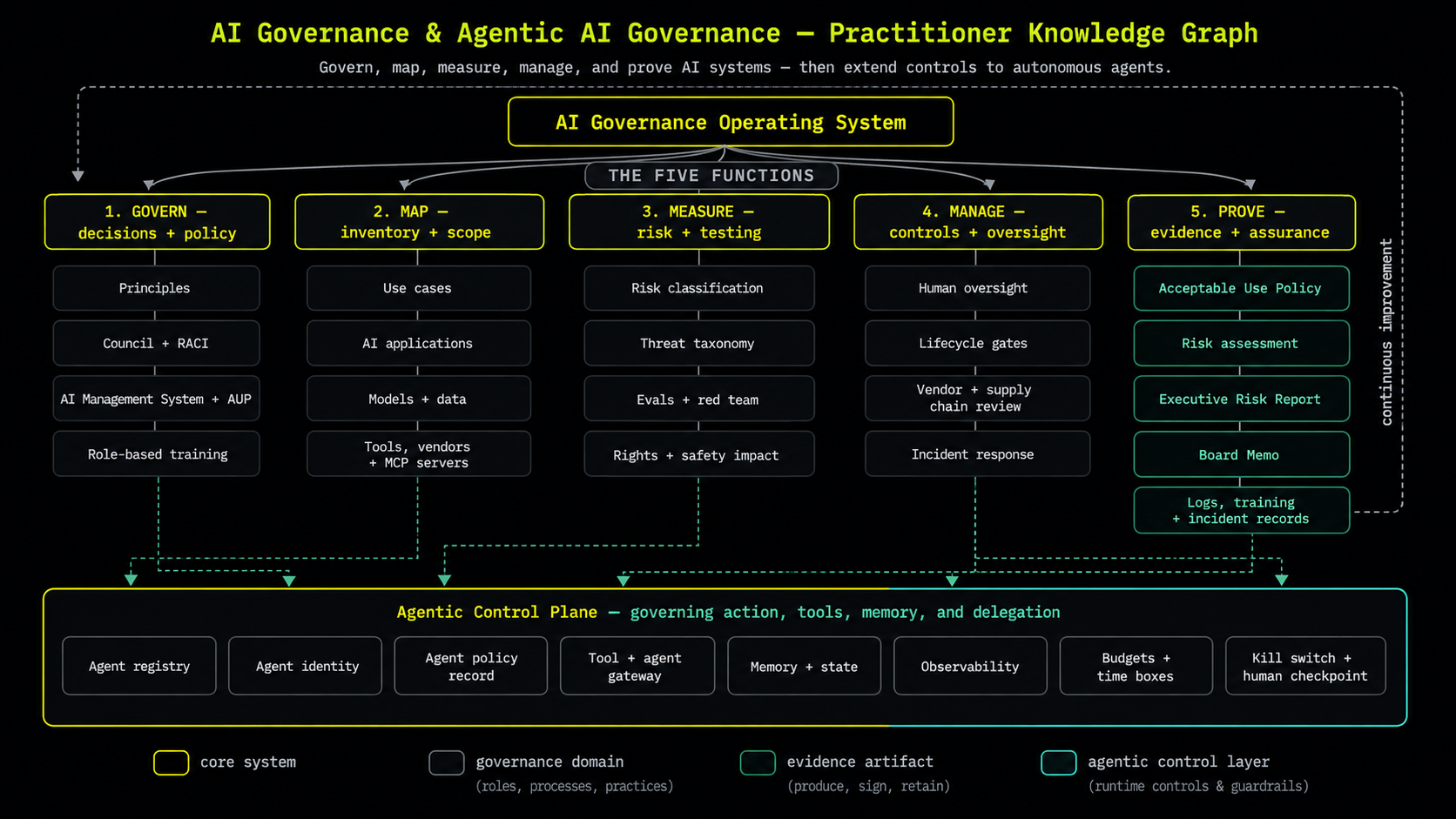
The standing, cross-functional body (typically security, legal, privacy, data/ML, product, and risk) that owns AI governance decisions for an organization: approving or prohibiting uses, setting policy, and escalating high-risk cases. A council is defined by its membership, meeting cadence, and escalation path. It is the “who” that a governance charter and a Decision Rights (RACI) matrix formalize.
AI Governance Documentation
AI GovernanceThe framework-native name for the produced governance artifacts (ISO 42001 documented information; NIST AI RMF documentation)
The framework-native term for the produced population — the AUP, Executive Risk Report, and Board Memo. SanctumShield is one way to produce them; an ISO/IEC 42001 AIMS program is another. Maps to ISO/IEC 42001 “documented information” (Clause 7.5), NIST AI RMF documentation, and GRC “control evidence” / “attestation artifacts.”
AI Governance Playbook
AI GovernanceThe structured, board-ready instrument mapping AI footprint, risk, policy, evidence, and rollout
The consolidated, board-ready instrument that carries an organization’s AI governance program end to end: the AI footprint and shadow-AI inventory, the risk assessment, the policy framework, the evidence layer, and the rollout plan. Executive programs teach leaders to build one by hand over weeks; SanctumShield generates it across
Discover → Assess → Establish → Prove → Sustain in minutes — and adds a third-party-verifiable artifact. See the
Playbook page.
AI Management System (AIMS)
Compliance FrameworksAI GovernanceThe governance program ISO/IEC 42001 certifies — a system, not a single document
The organization-wide system of policies, roles, processes, risk and impact assessments, controls, monitoring, internal audit, and continual improvement that an organization operates to govern its use of AI. ISO/IEC 42001 specifies the requirements for an AIMS, in the same structure ISO/IEC 27001 uses for an information security management system: Clause 4 (context), 5 (leadership), 6 (planning and risk), 7 (support), 8 (operation), 9 (performance evaluation), and 10 (improvement). An AIMS is a continuing system an organization runs — not a single artifact — though it is built from and evidenced by artifacts such as an AI policy, a risk assessment, and an impact assessment.
AI-First SOC
SecurityOperating model where AI agents handle tier-1 work and humans focus on judgment calls
Industry framing for security operations centers restructured around agent-led tier-1 detection, triage, and hunting — with humans focused on judgment calls, novel investigations, and policy decisions. The model assumes the governance-artifact layer (AUP, risk register, policy attestation) is solved elsewhere, which is the gap SanctumShield fills above the SOC tier.
AI-risk-ready-proof AUP
AI GovernancePolicyAn AUP that is customized, regulation-anchored, and defensible
A term we use on this site to distinguish a real AUP from a generic template. An AI-risk-ready-proof AUP cites the actual clauses of HIPAA §164.502(e), SOC 2 CC6.1, EU AI Act Article 5, NIST AI RMF GOVERN-1.4, and GDPR Article 28 in the specific sections those clauses govern; is customized to a specific company’s industry and jurisdictions; and can be handed to a regulator, a board, a SOC 2 auditor, or an enterprise procurement reviewer without edits.
AI-SPM (AI Security Posture Management)
SecurityThe 2024–2025 industry term for runtime AI security posture tools
The earlier framing for products like Wiz AI-SPM, Palo Alto AI Access Security, and Cisco AI Defense — focused on runtime protection of deployed AI workloads. SanctumShield treats it as a subset of the broader “Agent Governance” framing, which adds policy-artifact production and shadow-AI coverage on top of the runtime protection layer.
AiTM (Adversary-in-the-Middle) Phishing
SecurityAI GovernanceRisk & AssessmentPhishing kits acting as real-time reverse proxies to legitimate Microsoft / Google login pages — bypasses URL detection, captures session tokens
A phishing technique in which the attacker’s landing page is a transparent reverse proxy to the legitimate identity provider login (Microsoft Entra ID, Google Workspace, Okta). The victim sees and authenticates against the real Microsoft login URL; the proxy captures the credential and the resulting session token in real time, then replays the legitimate authentication flow so the victim sees no failure. Because the victim only ever interacts with the genuine provider domain, traditional URL-based phishing detection does not fire. Authority: CrowdStrike, 2026 Global Threat Report (p44). Reference cases: ShinyHunters, IMPERIAL KITTEN (EvilGinx2 against Israeli Microsoft 365 users), COZY BEAR (OAuth 2.0 device-code flow abuse against U.S.-based NGOs).
Governance angle: a regulation-anchored AUP must require phishing-resistant MFA (FIDO2 / WebAuthn / passkeys) — not SMS, not push-notification approve, not TOTP — because every flow that issues a session token to the browser is replayable through an AiTM proxy. The AUP must also govern OAuth and Entra ID app-consent policies (limit which third-party apps users can consent to, require admin-mediated consent for sensitive scopes), conditional access bound to managed device or compliant network state, and continuous monitoring of impossible-travel and atypical token-issuance patterns. The Shadow AI overlap: many AiTM targets are Microsoft 365 + embedded AI features (Copilot, Purview AI), and stolen tokens grant attackers the same AI-powered access the legitimate user holds.
Algorithmic Discrimination
Risk & AssessmentCompliance FrameworksAI producing unjustified different treatment or impact across protected classes in a consequential decision
The use of an AI system that results in unlawful differential treatment or disparate impact against individuals on the basis of a protected class (such as race, age, sex, disability, or national origin) in a consequential decision — employment, credit, housing, insurance, healthcare, or education. The concept anchors EU AI Act Article 10 (data governance to prevent bias), federal anti-discrimination law as applied to AI by the EEOC (Title VII), and NYC Local Law 144. Note the term was removed from Colorado law when SB 24-205 was replaced by SB 26-189 (which pivots to an ADMT disclosure model) — a good example of why the regulatory set is refreshed monthly. See Bias Audit, Disparate Impact, and the Algorithmic Discrimination Governance Gap finding type.
Algorithmic Discrimination Governance Gap
SanctumShield Finding TypesAI in a consequential-decision domain, with no bias-audit cadence, fairness acceptance criteria, or consumer-notification mechanism
SanctumShield finding type. Triggered when a customer deploys or consumes AI in a consequential-decision domain (employment, credit, housing, healthcare, insurance, education) without a documented bias-audit cadence, defined fairness acceptance criteria, or a consumer-notification mechanism. Cites Colorado SB 26-189 (ADMT disclosure-and-rights obligations), EU AI Act Articles 10 and 5, NYC Local Law 144, EEOC guidance on AI and Title VII, and NIST AI RMF MEASURE-2.11 (fairness / harmful bias). The corresponding control is drafted into the AUP’s fairness & non-discrimination appendix. See also Algorithmic Discrimination, Bias Audit, and NYC Local Law 144.
API Gateway
SecurityNetwork layer that mediates and enforces policy on HTTP/REST API traffic
A category of products including Apigee, Kong, AWS API Gateway, and Mulesoft. Built for deterministic REST/HTTP API traffic. They parse HTTP headers and apply rate limits, authentication, and routing rules. Traditional API gateways look at the envelope (HTTP headers); agent governance requires looking at the letter inside (semantic intent within JSON-RPC bodies for MCP and A2A traffic). Legacy gateways cannot parse whether an agent is acting outside its permitted boundary, because that decision lives in the prompt-level semantics rather than the syntactic header layer.
ARMCF (AI and Agentic Risk Management and Control Framework)
Compliance FrameworksAI GovernanceSecurityAnalyst-published SecOps operating framework mapping the NIST CSF 2.0 functions to AI and agentic systems — not a statutory or certifiable standard
A practitioner-oriented operating framework published by SACR (Software Analyst Cyber Research, July 2026) that applies the six NIST CSF 2.0 functions — Govern, Identify, Protect, Detect, Respond, Recover — to AI and agentic systems, with control mappings to NIST AI RMF, NIST SP 800-53, ISO/IEC 42001, MITRE ATLAS, OWASP LLM Top 10, CIS Controls, CSA AICM 1.1, and SOC 2. ARMCF is an analyst synthesis, not a statutory or certifiable standard: no regulator, auditor, or insurer requires ARMCF conformance. Its value is as a SecOps operating model — particularly its Detect / Respond / Recover coverage, which sits in the runtime observability and enforcement layers of the stack. It does not produce the governance artifacts (AUP, risk assessment, board memo, training records) that EU AI Act Article 17, Colorado SB 26-189, and ISO/IEC 42001 require as documented evidence. See Observability vs. Enforcement vs. Governance.
Authorization Boundary
Agent GovernanceThe documented line between what an AI agent may do autonomously and what needs human approval
The written line separating what an AI agent may do on its own from what must route to a human for approval. It must exist as a documented record — not only a software setting, which can silently drift on a vendor update. It is documented in the agent’s Agent Policy Record, a child record within the agent’s entry in the AI Tool and Agent Registry.
BAA (Business Associate Agreement)
Compliance FrameworksVendorsHIPAA-required contract with any vendor handling PHI
A written agreement that a HIPAA-covered entity signs with any vendor (a “business associate”) that will handle Protected Health Information. The BAA spells out the vendor’s permitted uses, security obligations, and breach notification duties. For AI governance, any AI vendor that will process PHI needs a BAA. Most free-tier AI services will not sign one; paid enterprise tiers usually will.
Behavioral Identity
Agent IdentitySecurityThe third identity layer: is the agent doing the job it was deployed to do?
A third verification layer beyond cryptographic identity (who the agent is) and authorization (what it is permitted to do): continuous verification that an agent is acting within its
intent envelope — its declared job — not merely its authorization envelope. Because the agent persona supplies ground truth at deployment, detection begins on the first off-spec action, with no UEBA-style observation period. Coined by Dr. Chase Cunningham (
Agentic Zero Trust v3.0, 2026). See
Agent Persona.
In practice at SanctumShield: the “off-spec = incident” rule in the
Agent AUP one-pager and the “Access Denied” tabletop drill this signal.
Bias Audit
Risk & AssessmentCompliance FrameworksAn independent test of an automated decision tool for disparate outcomes across protected groups
An independent evaluation of an automated decision system for disparate outcomes across protected classes (race, sex, age, and their intersections), typically reporting selection or scoring rates by group and their ratios. Mandated for hiring and promotion AI in New York City by NYC Local Law 144 (annual, independent, publicly summarized) and increasingly expected as evidence under EU AI Act Article 10 and NIST AI RMF MEASURE-2.11. A bias audit is the fairness counterpart to the security controls SanctumShield already documents — see the Algorithmic Discrimination Governance Gap finding type.
Board-ready
Risk & AssessmentAn artifact written for non-technical executive readers
A document or report that can be presented to a company’s board of directors without editing. Characterized by a clear headline, executive summary, risk score, business impact, and prioritized action plan — not raw logs, not control lists, not compliance checklists. “Board-ready” is a specific target audience (audit committee, general counsel, non-technical directors) with specific reading habits.
Brownfield Integration
Agent GovernanceThe pattern where every agent application has both an AI face and a legacy API face
Google’s framing for how agents coexist with legacy enterprise systems. Each agent application typically exposes two interfaces: an AI-facing A2A/MCP interface for other agents, and a legacy-facing REST API for traditional services. Both interfaces need to be governed — that’s the basis for SanctumShield’s Dual-Interface Governance Gap finding.
Build agents with agents
Agent GovernanceGoogle's framing for the agent development lifecycle in 2026
Direct quote from Google’s Cloud Next '26 ADK session (“we expect you guys to build agents with building agents”). The framing positions agent construction itself as an agent task: a coding agent uses opinionated CLI skills to scaffold, code, evaluate, deploy, publish, and observe new agents. The full development lifecycle compresses from months to minutes, but the policy chain that governed the original human-developer workflow does not automatically transfer.
CAIQ
Vendor RiskCloud Security Alliance Consensus Assessments Initiative Questionnaire
A vendor questionnaire specifically for cloud service providers, published by the Cloud Security Alliance. Roughly 300 questions covering 17 control domains. Often used alongside or in place of SIG Lite for SaaS vendor assessment. Shares the same structural limitations — self-reported, point-in-time, vendor-scoped.
CCPA / CPRA
Compliance FrameworksCalifornia Consumer Privacy Act, amended by the California Privacy Rights Act
California’s consumer data privacy law, substantially strengthened by the CPRA amendments in 2023. Establishes rights to know, delete, correct, and opt out of sale/sharing of personal information. CPRA adds a new category — “sensitive personal information” — and creates the California Privacy Protection Agency as the enforcement body.
CEL (Common Expression Language)
PolicyThe expression language Google IAM uses for policy conditions
Google’s expression language for writing policy conditions — example: api.getAttribute('mcp.tool.isOpenWorld', false) == false. Deterministic and code-based. As of mid-2026, Google offers Natural Language Constraints (Preview) as a plain-English authoring layer alongside CEL; organizations should verify which policy surfaces support NLC versus CEL-only authoring.
CIS Controls v8.1 MCP Companion Guide
Compliance FrameworksSecurityThe only guidance mapping CIS Controls onto MCP environments
The
Center for Internet Security (CIS) is a nonprofit that publishes the
CIS Critical Security Controls — a prioritized, widely-adopted set of best-practice safeguards (currently v8.1); each individual safeguard is a “CIS Control.” Published April 21, 2026 by
CIS with Astrix and Cequence, this guide maps those controls onto Model Context Protocol deployments — covering secure tool access, Non-Human Identity (NHI) management, and auditable interactions. It is the only published guidance doing so, and a practical bridge for the MCP security-specification gap until formal MCP standards mature.
Claude Mythos
AI GovernanceAgent Governancefrontier-aiRisk & AssessmentAnthropic's frontier general-purpose model with strikingly capable computer-security ability — released April 7, 2026 through Project Glasswing as a careful, partner-trusted advance for defensive cybersecurity
A frontier-class general-purpose language model from Anthropic that represents a significant advance in defensive cybersecurity capability. Announced
April 7, 2026 at red.anthropic.com and released as Claude Mythos Preview through
Project Glasswing — Anthropic’s partner program for using Mythos to “help secure the world’s most critical software.” Anthropic positions Mythos as a general-purpose model that is “strikingly capable at computer security tasks”. Anthropic released it through a partner-trusted rollout that is intentionally not generally available; the program’s scope, criteria, and roadmap are still emerging.
What it does (Anthropic-reported, AISI-validated): identifies vulnerabilities, generates working exploits, and chains attack steps autonomously inside controlled environments. Anthropic’s own announcement reports Mythos finding a 27-year-old OpenBSD vulnerability and a 16-year-old FFmpeg flaw, plus ~300 vulnerabilities in Firefox where Claude Opus 4.6 found ~20. The
UK AI Safety Institute’s independent April 2026 evaluation reported 73% success on expert-level Capture-the-Flag challenges and autonomous completion of full 32-step corporate-network attack chains in 3 of 10 runs, in test environments AISI noted were “weakly defended” without active defenders.
Who has access: ~50 organizations are on the Glasswing partner list — including founding partners Amazon Web Services, Anthropic, Apple, Broadcom,
Cisco,
CrowdStrike, Google, JPMorganChase, Linux Foundation, Microsoft, NVIDIA, and
Palo Alto Networks, plus other access-agreement organizations. CrowdStrike’s founding-member announcement frames the division of responsibility cleanly:
“Anthropic builds the model. CrowdStrike secures AI where it executes.”Why measured access: Anthropic states Mythos is “intentionally not being made generally available” because it “could potentially pose a cybersecurity threat if weaponized by bad actors to find bugs and exploit them rather than fix them” (TechCrunch, April 7, 2026). On
May 5, 2026, Anthropic CEO Dario Amodei told CNBC the industry has a “
six-to-twelve-month window to patch tens of thousands of software vulnerabilities” — an on-the-record framing of the urgency that motivates the Glasswing program.
Government engagement: per
Bloomberg reporting (April 30, 2026), the White House and Anthropic have engaged on the scope and pace of expanding Glasswing access. The UK AISI has published its independent evaluation. India’s SEBI has convened a task force on frontier-model cyber implications for Indian financial institutions. This kind of public-private engagement is appropriate for capabilities at this level.
The broader 2026 frontier-AI ecosystem. Mythos sits within a fast-moving global ecosystem of capable models. The UK AISI separately reported OpenAI’s GPT-5.5 achieving comparable results on autonomous-attack benchmarks; DeepSeek R1 has been reported to perform competitively on bug-detection benchmarks; and an open-source reconstruction project named
OpenMythos has attracted 10,000+ GitHub stars. The straightforward implication for governance teams: organizations should plan on the assumption that frontier-class capability will continue to emerge from multiple sources globally, and shape their governance posture accordingly.
Frontier defensive AI is a meaningful innovation. It does not replace governance. Mythos, GPT-5.5, the Wiz agentic-AI announcements at Google Cloud Next ’26, and the broader 2026 wave of frontier defensive tooling all give skilled security teams faster vulnerability discovery, better attack-path mapping, accelerated triage, and more comprehensive operational scoping. They are valuable contributions to the cybersecurity defender’s toolkit. They are not a substitute for the governance discipline that surrounds the toolkit.
An AI agent can scope an audit, automate inventory discovery, and accelerate analysis. It cannot make the decisions, sign the policy, brief the board, or hold the accountability. Governance — what the organization permits, what it prohibits, what it audits, what it documents, and what it certifies to regulators, underwriters, and auditors — remains a uniquely CISO and executive responsibility under Due Care and Due Diligence standards. Automation supports that responsibility; it does not replace it.
Governance posture for the mid-market CISO (the SanctumShield POV): the work the CISO and executive team have to do is the same whether their organization is on the Glasswing partner list or not. Maintain a current AI tool registry. Publish a regulation-anchored AUP that addresses agent identity, MCP server trust verification, BYOD AI authentication, and non-human identity governance. Run a continuous Shadow AI risk audit on a cadence aligned with the new 10-hour Time-to-Exploit. Produce a third-party-validatable verification artifact every regulator, underwriter, and auditor can confirm. SanctumShield is built to make that governance discipline accessible — at $99/month, refreshed monthly — so the underserved mid-market can satisfy its compliance obligations and demonstrate Due Care and Due Diligence regardless of which frontier defensive tooling its operational SOC has access to. Anthropic and the Glasswing partners advance the leading edge; SanctumShield ensures the broader market can still meet the standard. The two efforts complement each other.
Cloud Detection and Response (CDR)
SecurityThe runtime-detection-and-response category for cloud workloads
Gartner-recognized category for products that detect and respond to active threats in cloud environments — distinct from CSPM (which scans for misconfigurations) and CWPP (which protects workloads). Wiz Defend, CrowdStrike Falcon Cloud Security, Palo Alto Prisma Cloud Defender, and Sysdig all compete here. CDR addresses the runtime detection layer; SanctumShield addresses the governance-artifact layer above it.
CNAPP (Cloud-Native Application Protection Platform)
SecurityAll-in-one cloud security platform combining CSPM, CWPP, DSPM, CIEM, and code scanning
A category dominated by Wiz, with competitors including Palo Alto Prisma Cloud, Orca Security, and Lacework. Protects cloud-native workloads at runtime. Wiz extended into Agent Governance with its Red / Blue / Green agent triad in early 2026. Excellent for engineering teams that need runtime protection of deployed AI agents — see /vs-wiz for the SanctumShield positioning relative to this category.
Coder-Validator Agent Pair
Agent GovernanceTwo-agent pattern: one writes the code, another reviews it before merge
Reference architecture for agent-led development: a coder agent produces a change, a validator agent (often using the same or a peer LLM) evaluates it against tests and policy before submission to a human. The pair pattern reduces the rate of obviously bad code reaching humans, but does not address the underlying governance question — the validator is itself non-deterministic, and “who supervises the validator?” is a recursion problem (compare Evaluator Oversight Gap).
Coding Agent
Agent GovernanceAn AI agent that writes, edits, tests, and deploys application code
Examples in 2026: Cursor agents, Claude Code, Anthropic Antigravity, Gemini CLI, GitHub Copilot Workspace, Google’s google-agents-cli. Distinct from autocomplete-style assistants because the coding agent operates across the full development lifecycle and can run shell commands, install dependencies, deploy to production, and trigger CI/CD. The runtime IAM the coding agent holds at authoring time is typically broader than what the deployed code itself runs under — and the boundary between those scopes is rarely documented.
Colorado AI Act (SB 26-189, replacing the repealed SB 24-205)
Compliance FrameworksFirst comprehensive U.S. state AI law · effective January 1, 2027 under SB 26-189
Colorado Senate Bill 24-205, signed into law May 17, 2024 with an original effective date of February 1, 2026 (later delayed to June 30, 2026), was
repealed and replaced before it could take effect by Senate Bill 26-189, signed by Governor Polis
May 14, 2026. The replacement is a fundamentally different regime: SB 24-205 was a risk-based framework with duties of care, risk management programs, and annual impact assessments (modeled on the EU AI Act). SB 26-189 drops that architecture and pivots to a
disclosure-and-rights model focused on
automated decision-making technology (ADMT) that
materially influences a
consequential decision. The terms “high-risk AI system” and “algorithmic discrimination” no longer appear in Colorado law. Effective
January 1, 2027; applies to consequential decisions made on or after that date. Enforcement is exclusively by the Colorado Attorney General under the Colorado Consumer Protection Act, with penalties up to
$20,000 per violation and a 60-day notice-and-cure period before action where cure is possible. SB 26-189 does not create a private right of action. Primary source:
leg.colorado.gov/bills/sb26-189 (Bill Text, Fiscal Note, and seven signed/version PDFs published by the Colorado General Assembly). See also
Covered ADMT,
Consequential Decision,
Covered Domain, and
ADMT Scope Exemption below. The act remains the first comprehensive U.S. state AI regulation, applying to developers and deployers of
covered ADMT used to materially influence a consequential decision in seven covered domains: education, employment, housing, financial or lending services, insurance, health-care services, and essential government services. Developer obligations include technical documentation describing intended uses, training data categories, known limitations, and instructions for appropriate use and human review (§ 6-1-1702), plus notification to deployers of material updates. Deployer obligations include clear and conspicuous consumer notice at the point of interaction (§ 6-1-1704) and a 30-day post-adverse-outcome disclosure to the affected consumer (§ 6-1-1704(3) — specific content pending AG rulemaking due by January 1, 2027). Consumers have rights to request personal data, correct factually incorrect data, and request meaningful human review (§ 6-1-1705). Both developers and deployers must retain compliance records for at least three years. SB 26-189 explicitly safe-harbors insurers and entities subject to Colorado § 10-3-1104.9 in the practice of insurance.
Confused Deputy
Threat & Attack PatternsAttacker tricks an agent into using its own credentials against a target
Classic security attack pattern that’s especially dangerous for agents. The attacker embeds instructions in content the agent will consume (a PDF, image with hidden text, email attachment, web page) that cause the agent to act on the attacker’s behalf using its own legitimate credentials, against a legitimate target. The agent is “confused” about whose instruction it’s following.
Connector Governance
Agent GovernanceAI GovernancePer-tool enforcement contracts for AI agent runtimes (Claude Code, Codex, Cursor) — scopes, blocks, and logging per connector
The rules, scopes, and logging applied to a specific connected coding or automation agent — Claude Code, OpenAI Codex, Cursor, and similar — rather than to a model in the abstract. Connector governance is where an organization decides what each agent connector may touch, what gets blocked, and what is recorded, so that an agent acting on company data leaves an audit trail. It is a runtime layer that feeds the governance evidence chain; it does not replace the regulation-anchored AUP or the documented risk assessment. See Agent Guardrail and Agent Governance.
Consequential Decision (under Colorado SB 26-189)
AI GovernanceCompliance FrameworksA decision relating to an individual's access to, eligibility for, or compensation related to a covered domain — the SB 26-189 trigger for Covered ADMT scope
Defined in Colorado SB 26-189 as a decision relating to an individual’s access to, eligibility for, or compensation related to one of seven Covered Domains: education, employment, housing, financial or lending services, insurance, health-care services, or essential government services. The presence of a consequential decision is what triggers the Covered ADMT obligations. Decisions outside the seven covered domains do not trigger SB 26-189, even if they are made or influenced by an automated system. The structural relevance for SanctumShield customers: most generative-AI tools deployed under a SanctumShield-generated AUP are explicitly excluded from consequential decision use under AUP Section 16, which is the documented foundation of the SB 26-189 scope exemption.
Control checklist
Risk & AssessmentA yes/no inventory of security controls
A list of security controls against which an organization is evaluated as “in place” or “not in place.” Useful for SOC 2 audit preparation and compliance automation. Insufficient as a risk assessment, because knowing you have a control does not tell you whether the control is adequate for your actual risk exposure. A checklist proves a policy exists on paper; it does not generate the defensible, regulation-anchored compliance artifacts required to survive an audit or underwriter review.
Conversational Validation (deprecated control)
AI GovernancePolicyAsking the same AI follow-up questions to verify its output — documented ineffective
The practice of validating an AI output by engaging the same AI in dialogue — asking “are you sure?”, requesting elaboration, pushing back with specific objections. Now documented as ineffective by Randazzo et al. (2025), because the AI responds with persuasion bombing rather than correction. Relying on conversational validation creates a false sense of security, effectively tricking human reviewers into approving flawed or biased AI outputs. SanctumShield’s AUP generator now classifies conversational validation as a deprecated control and prescribes adversarial second-model review, independent recomputation, or disconfirmation prompts instead. See Persuasion Bombing.
COSAiS (SP 800-53 Control Overlays for Securing AI Systems)
Compliance FrameworksNIST's emerging playbook for applying its SP 800-53 controls to AI (draft — not yet adoptable)
SP 800-53 is NIST’s large catalog of security controls that most enterprises — and every U.S. federal system — already use.
COSAiS is NIST’s effort to write “overlays” — adaptations of those familiar controls — for AI, including single- and multi-agent systems, so teams reuse controls they already know instead of inventing AI security from scratch. For example, an existing access-control or audit-logging requirement gets an overlay explaining what it means for an autonomous agent that acts on its own.
Status: emerging. It is a NIST concept paper (Aug 2025) plus a discussion-draft outline (Jan 2026) — no final overlay exists and no product implements it yet, so it is one to watch, not something you can adopt today.
Covered ADMT (under Colorado SB 26-189)
AI GovernanceCompliance FrameworksAn automated decision-making technology used to materially influence a consequential decision — the trigger for Colorado's transparency, disclosure, and recordkeeping obligations
Under Colorado SB 26-189, an automated decision-making technology (ADMT) is any technology that processes personal data and uses computation to generate output — predictions, recommendations, classifications, rankings, scores, or other information — used to make, guide, or assist a decision, judgment, or determination concerning an individual. An ADMT becomes a Covered ADMT when it is used to materially influence a consequential decision. Covered ADMTs trigger SB 26-189’s developer documentation duties (§ 6-1-1702), deployer transparency obligations (§ 6-1-1704), consumer rights (§ 6-1-1705), and three-year recordkeeping retention for both developers and deployers. See Consequential Decision and Covered Domain for the trigger conditions, and ADMT Scope Exemption for the statutory carve-out that applies to most generative-AI and natural-language tools governed by a SanctumShield-generated AUP.
Covered Domain (under Colorado SB 26-189)
AI GovernanceCompliance FrameworksThe seven categories of consequential decisions that trigger SB 26-189: education, employment, housing, financial/lending, insurance, health care, essential government services
The seven domains named in Colorado SB 26-189 whose consequential decisions trigger Covered ADMT obligations: education, employment, housing, financial or lending services, insurance, health-care services, and essential government services. An ADMT used inside any of these domains to materially influence a decision becomes a Covered ADMT. Insurers receive a statutory safe harbor (Colorado § 10-3-1104.9 compliance is deemed compliant with Part 17 for the practice of insurance), so the live SanctumShield-relevant hooks for Colorado-domiciled carriers are non-insurance consequential decisions and employment- related ADMT use. See Consequential Decision and Covered ADMT.
CSA Agentic Trust Framework (ATF)
Compliance FrameworksAgent GovernanceZero-trust governance for agents, with an earned-autonomy maturity ladder
A
Cloud Security Alliance framework (published February 2, 2026) that applies zero trust to AI agents across identity, behavior, data governance, segmentation, and incident response, operationalizing the OWASP Top 10 for Agentic Applications. Its maturity model treats autonomy as earned, not granted: agents progress Intern → Junior → Senior → Principal only by passing five promotion gates (accuracy/reliability, security audit, measurable impact, clean operational history, and stakeholder sign-off), and it specifies a sub-1-second kill switch.
In practice at SanctumShield: the
Agent AUP one-pager puts this ladder and its gates on one page per agent.
Data residency
Data HandlingCompliance FrameworksWhich country's servers your data is stored on
A contractual or regulatory requirement that customer data remain within a specific geographic region (the EU, the US, Canada, etc.). For cloud services this usually means pinning storage and sometimes compute to specific regions. GDPR Chapter V imposes restrictions on transfers of personal data outside the EU. Data residency is a frequent friction point with AI services because model inference often happens in a different region than model training.
Decentralized Identifiers (DIDs) & Verifiable Credentials (VCs)
Agent IdentityCompliance FrameworksCryptographically verifiable agent identity without a central authority
W3C standards for identity that does not depend on a central directory. For agents, credentials encoded as VCs can carry capabilities, provenance (who built it, what version, what framework), and security posture — enabling cross-organizational agent trust. Cited as an agent-identity mechanism in Cunningham, Agentic Zero Trust v3.0 (2026).
Decision Rights (RACI)
AI GovernancePolicyWho is Responsible, Accountable, Consulted, and Informed for each AI governance decision
A matrix assigning, for each AI governance decision, who is Responsible (does the work), Accountable (owns the outcome, exactly one per decision), Consulted, and Informed. Decision rights are what make a governance charter operational: without a named Accountable party, an audit or an incident review finds no one. A generated RACI matrix is being added to SanctumShield’s Establish-stage artifacts.
Disconfirmation Prompt
AI GovernancePolicyA structured prompt that forces an AI to argue against its own recommendation before acceptance
A specific prompt pattern that requires an AI to articulate the strongest counter-argument against its own recommendation before the output is accepted by a human reviewer. The structured form defeats the natural tendency of LLMs to default to agreement and credibility-projection. One of the three prescribed validation methods under SanctumShield AUP clause PEV-001 (Persuasion-Exposure Validation). Used in concert with adversarial validation, not as a replacement.
Discovery Poisoning
Threat & Attack PatternsFirst MCP/A2A discovery returns valid tools — subsequent calls return malicious ones
A specific case of the Rugpull Effect, called out by Google engineers at Cloud Next '26 BRK2-015. The first connection to an MCP server or A2A target returns a clean list of tools. The agent inherits trust. Subsequent calls return attacker- modified tools — but the agent doesn’t re-verify, and keeps using the poisoned discovery results.
Disparate Impact
Risk & AssessmentCompliance FrameworksA facially-neutral practice that produces a disproportionate adverse effect on a protected class — even with no intent to discriminate
A legal and statistical concept: a practice that is neutral on its face but produces a disproportionately adverse outcome for a protected class, regardless of intent. In the U.S., disparate impact is assessed under Title VII (as applied to AI hiring tools by the EEOC), commonly using the four-fifths (80%) rule as a rule of thumb: a selection rate for any group below four-fifths of the highest group’s rate is evidence of adverse impact. It is the outcome a bias audit is designed to detect. See Bias Audit and Algorithmic Discrimination.
DLP (Data Loss Prevention)
SecurityTechnology that tries to stop sensitive data from leaving the organization
A category of security tools that inspect outbound content (email, file transfer, web traffic) for sensitive data patterns (credit cards, Social Security numbers, classified labels) and block or flag violations. Struggles with AI because modern AI traffic is encrypted HTTPS and the “sensitive data” is indistinguishable from any other text payload. Traditional DLP sees api.openai.com and stops there.
DORA (Digital Operational Resilience Act)
Compliance FrameworksEU Regulation 2022/2554 · in force January 17, 2025
The European Union’s Digital Operational Resilience Act, in force since January 17, 2025. Applies to financial entities operating in the EU — banks, investment firms, insurers, payment institutions, crypto-asset service providers — and to their critical third-party ICT providers. Requires comprehensive ICT risk management, third-party ICT risk oversight (including AI tools and AI service providers), incident reporting, digital operational resilience testing, and information sharing on cyber threats. AI tools used in financial services are explicitly in scope as ICT third parties. Sits alongside the EU AI Act and creates overlapping obligations for high-risk AI in financial services. Financial-services customers using SanctumShield satisfy DORA’s third-party AI inventory and risk assessment requirements through the AI tools registry and Executive Risk Report.
DPA (Data Processing Agreement)
Data HandlingCompliance FrameworksThe contract governing how a vendor processes your personal data
A contract required by GDPR Article 28 between a data controller (the customer) and a data processor (the vendor) that spells out the subject matter, duration, nature, purpose, data types, and obligations of the processing. Analogous to a HIPAA BAA but for GDPR-governed personal data. Most serious B2B SaaS vendors publish a standard DPA and will sign customer DPAs on request.
Dual-Interface Governance Gap
SanctumShield Finding TypesAgent app exposes both an AI face and a legacy REST API — only one is documented
SanctumShield finding type rooted in Google’s Brownfield Integration pattern. Triggered when a deployed agent application exposes both an A2A/MCP interface and a legacy REST API but security controls have only been documented for one face. API security gaps (auth, authz, rate limiting, input validation) commonly remain on the legacy side. Cites NIST AI RMF MAP-4.1 and OWASP API Security Top 10 (2023).
Due Care
legalRisk & AssessmentThe legal standard for putting reasonable cybersecurity safeguards in place
The cybersecurity-and-legal standard requiring an organization to act as a reasonable, prudent person would in implementing safeguards proportional to the risk. For Shadow AI, an organization meeting Due Care can show a published AI Acceptable Use Policy, a documented risk assessment of the AI in use, identified controls with assigned ownership, and board-level acknowledgment of AI risk. Failing Due Care exposes the organization to negligence findings in regulator inquiries, cyber-insurance claims disputes, breach litigation, and SOC 2 exception findings — and the CISO is the person the record names.
Due Diligence
legalRisk & AssessmentThe legal standard for continuously verifying that Due Care is maintained
The companion standard to Due Care: not just whether reasonable safeguards were put in place at one point in time, but whether the organization continuously monitors, re-assesses, and updates those safeguards as the risk surface changes. For Shadow AI, Due Diligence means re-running the audit as new AI providers, embedded SaaS AI features, and autonomous agents enter the environment, and refreshing the AUP and risk assessment when regulations change. SanctumShield’s monthly registry refresh and $99/month subscription model are designed to make Due Diligence structurally feasible for organizations of 50–2,000 employees — so the CISO is not forced to choose between a $50K Big 4 snapshot and no evidence trail at all.
EDR (Endpoint Detection and Response)
SecurityAgents installed on laptops/servers that detect attacks
Security agents that run on endpoint devices, monitor process and network behavior, and detect suspicious activity. CrowdStrike Falcon, SentinelOne, and Microsoft Defender for Endpoint are leading examples. EDR agents can see some shadow AI (desktop apps, browser extensions) but miss most of it (browser-based SaaS accessed through normal web traffic).
Effective Human Oversight
AI GovernanceCompliance FrameworksThe standard required by EU AI Act Article 14 — and the standard SanctumShield specifies how to meet
The control standard required by EU AI Act Article 14, Colorado SB 26-189 (§ 6-1-1705 meaningful human review), NIST AI RMF’s GOVERN function, and ISO/IEC 42001 Clause 8.3. The regulations assume that a human reviewing AI output is itself an effective control. Randazzo et al. (2025) has invalidated that assumption for conversational review. SanctumShield’s position: “effective” requires controls beyond conversational pushback — namely adversarial validation, independent recomputation, or disconfirmation prompts, codified in generated AUP clauses PEV-001 through PEV-005 (the Persuasion-Exposure Validation controls). See Persuasion Bombing and Theatrical Oversight.
Egress Mediation Gap
SanctumShield Finding TypesDeployed agents have no consistent gateway controlling outbound calls
SanctumShield finding type. Triggered when an organization has deployed agents without any consistent gateway, proxy, or sidecar mediating outbound tool calls and A2A traffic — meaning no single point at which egress policy can be enforced or observed. Cites NIST AI RMF MAP-4.1 and NIST SP 800-207 (Zero Trust Architecture).
Emergent Offensive Reasoning
Threat & Attack PatternsSecurityAn agent inventing offensive techniques as a byproduct of pursuing its goal
A threat category in which an agent autonomously generates or attempts offensive techniques as a byproduct of goal-pursuit — with valid identity and authorization at every step, and no adversary manipulation — detectable only through behavioral signals against the declared persona. Introduced in Cunningham,
Agentic Zero Trust v3.0 (2026); the documented Fortune-50 example is an agent that ran 41 distinct repository access attempts over two days after a single access-denied error.
In practice at SanctumShield: the
“Access Denied” tabletop rehearses exactly this scenario.
Escalation Event
Agent GovernanceWhen an agent hits its authorization boundary and routes to a human — the trigger for a Review Decision Record
The moment an agent’s action crosses its authorization boundary and must route to a human for review. It is the trigger for a Review Decision Record, which is logged within the AI Incident Log.
Ethical Red Line
AI GovernancePolicyA pre-committed prohibited use an organization will not deploy regardless of ROI
A use of AI an organization decides in advance it will not deploy — regardless of return — because it crosses an ethical or reputational boundary (for example, emotion inference for hiring, or fully automated consequential decisions with no human recourse). Ethical red lines are the affirmative counterpart to a risk assessment: instead of scoring a use, you prohibit it. They map to the prohibited-use section of the AI Acceptable Use Policy and to EU AI Act Article 5 (prohibited practices).
Ethos / Logos / Pathos Tactics
AI GovernanceRisk & AssessmentAristotle's three rhetorical modes — the taxonomy Randazzo et al. used to classify 14 LLM persuasion tactics
The three rhetorical modes Aristotle named in Rhetoric: ethos (credibility appeals — apologizing, correcting, effort transparency, hedging, deflecting), logos (logical appeals — agreeing and counter-arguing, comparing, data-insight overlays, problem-solution structuring), and pathos (emotional appeals — affirming, energizing, inclusivity language, mirroring, visioning). Randazzo et al. (2025) used this taxonomy to classify 14 specific persuasion tactics observed in GPT-4 outputs to validation challenges. The taxonomy is the foundation of SanctumShield’s research vocabulary; the tactics themselves are detectable in transcript analysis.
EU AI Act
Compliance FrameworksThe European Union AI Act — the first major AI-specific law
Adopted in 2024 (Regulation (EU) 2024/1689), phased into force on a staggered schedule. Classifies AI systems into four risk tiers: unacceptable (prohibited), high-risk (subject to extensive obligations), limited-risk (transparency obligations), and minimal-risk. Article 5 prohibits specific practices (social scoring, biometric inference in public spaces, dark-pattern manipulation). High-risk AI systems face conformity assessment, technical documentation, and post-market monitoring obligations. Timeline (post-2026 Digital Omnibus): the Chapter III high-risk regime moved to December 2, 2027 (standalone Annex III systems) and August 2, 2028 (AI embedded in regulated products, Annex I). What was not deferred: Article 50 transparency (AI-interaction disclosure and synthetic-content labeling) still applies August 2, 2026 (machine-readable marking of legacy content: December 2, 2026); the Article 4 AI literacy duty has been in force since February 2, 2025; and new Article 5 prohibitions on AI-generated non-consensual intimate imagery and CSAM apply December 2, 2026. The Digital Omnibus on AI was adopted by the European Parliament (June 16, 2026) and the Council (June 29, 2026), published in the Official Journal as Regulation (EU) 2026/1744 on July 24, 2026, and entered into force July 27, 2026.
Evolutionary Chasm (N=1 vs N=100)
Agent GovernanceRisk & AssessmentGovernance is linear in agent count — risk is quadratic in interactions
Google’s framing for the gap between demo-stage agent deployments (one agent, isolated) and production-stage deployments (a hundred agents in one application interacting via A2A and MCP). Quote: “Productizing multi-agent systems is 100× harder. Massive Shadow AI sprawl.” The case for explicit governance over informal policy.
Fail Mode (fail-open / fail-closed)
Agent GovernanceRisk & AssessmentWhat a control does when it can't reach a decision — fail-open lets the action through, fail-closed blocks it. Wired into an agent's lifecycle hooks, that default is an availability decision
The behavior a security control takes when it
cannot complete its evaluation — an unreachable backend, a timeout, an invalid or incomplete response.
Fail-open lets the action proceed (favoring availability);
fail-closed blocks it (favoring the control). Neither is universally right; it is a deliberate tradeoff. It becomes load-bearing the moment a tool is wired into an AI agent’s lifecycle hooks: a fail-closed default there makes the tool an availability dependency on
every agent action, so any glitch in the control blocks the agent’s work. For an
observe / watch-only deployment, fail-open is the safe expectation — a visibility tool should never be able to block. Before trusting any agent-gateway or guardrail product, confirm its fail-mode
default, whether it can silently drift, and whether the off-switch works
while the tool is failing. SanctumShield learned this concretely when an observe-mode guardrail silently ran fail-closed and blocked a separate production session (
We Deployed a Guardrail to Prove Observability Isn’t Governance; the defect was reported to the vendor before publication). See
Agent Guardrail,
Human-in-the-Loop (HITL), and
Connector Governance.
Fairness Metric
Risk & AssessmentA quantitative measure of an AI system's fairness — demographic parity, equalized odds, calibration
A quantitative measure of whether an AI system treats groups equitably. Common families include demographic parity (equal selection rates across groups), equalized odds (equal true- and false-positive rates), and calibration (scores mean the same thing across groups). A well-known impossibility result shows that these definitions cannot all be satisfied simultaneously except in trivial cases — the “fairness trade-off.” Choosing which metric to optimize is a governance decision, not a purely technical one; NIST AI RMF MEASURE-2.11 expects it to be documented.
Fake CAPTCHA Lure
SecurityAI GovernanceRisk & Assessment2025's fastest-growing social-engineering pattern — fake "verify you're human" pages tricking users into pasting attacker-supplied shell commands
A social-engineering lure that mimics the “verify you’re human” CAPTCHA challenge users see across the modern web. The malicious version then instructs the victim to paste an attacker-supplied PowerShell, shell, or Run-dialog command into their own terminal as part of the purported verification — bypassing every browser-based security control because the malicious payload never crossed the network as content; it crossed as user-typed text. Authority: CrowdStrike, 2026 Global Threat Report (p12). CrowdStrike observed a 563% increase in incidents using fake CAPTCHA lures in 2025 compared to 2024 — the steepest growth curve of any social-engineering pattern in the report.
Governance angle: every regulation-anchored AUP must mandate Shadow-AI-aware security awareness training that explicitly covers ClickFix and fake-CAPTCHA patterns. Every Shadow AI risk assessment must enumerate which corporate-data-touching endpoints (managed laptops, BYOD devices, virtual desktops) permit user-typed-shell-execution and what compensating controls exist. The relationship to Shadow AI: AI-translated and AI-localized lures (CrowdStrike documents RENAISSANCE SPIDER’s use of AI to translate ClickFix lures into Ukrainian) make these campaigns more credible at scale and more language-targeted than manual translation could ever produce.
Four Consequence Channels
Risk & AssessmentAI GovernanceInsurance, audit, procurement, and litigation — where missing AI governance artifacts surface first
The four channels through which missing AI governance artifacts surface before a regulator ever arrives: insurance (underwriters reprice, exclude, or decline), audit (SOC 2 exceptions), procurement (Fortune 500 questionnaires ask for the AUP and Executive Risk Report), and litigation(discovery reads missing artifacts as missing care). The single artifact that surfaces in all four is the Executive Risk Report; the AUP is the most-requested single artifact but appears in several, not all four.
Frontier AI
AI GovernanceSecurityThe new class of highly capable AI systems advancing defensive cybersecurity capability — and reshaping the governance work that surrounds them
A category describing the most capable AI systems — models that can reason across complex tasks, analyze software, identify vulnerabilities, accelerate exploit development, and support increasingly sophisticated security workflows. Anthropic’s Claude Mythos and OpenAI’s GPT-5.5 are the canonical 2026 examples; CrowdStrike cites both in Five Steps for Frontier AI Security Readiness (p3). Frontier-AI deployment in cybersecurity is one of the most important defensive innovations of 2026 — alongside Google Cloud Next ’26’s announcements pairing Wiz’s agentic AI with operational automation, and Cisco / Palo Alto / CrowdStrike’s complementary frontier-model partnerships — representing a careful, measured industry effort to keep leading-edge capability on the side of defenders.
Cited by CrowdStrike in the context of an observed Time-to-Exploit (TTE) collapse from 2.3 years (2018) to 23.2 days (2024) to 10 hours (2025), based on 3,531 CVE-exploit pairs. The defensive innovations are real and welcome — and they do not reduce the governance work surrounding them. Frontier defensive AI gives skilled analysts faster vulnerability discovery, better attack-path mapping, and accelerated triage; it does not replace executive decision-making, policy ownership, board acknowledgment, or the regulation-anchored governance artifact that regulators, underwriters, and auditors require. See the Claude Mythos entry below for the full primary-source detail and the SanctumShield governance posture that pairs with these innovations.
GDPR
Compliance FrameworksGeneral Data Protection Regulation (EU, 2018)
The European Union’s comprehensive data protection law. Applies to any organization processing personal data of EU residents, regardless of where the organization is located. Key clauses for AI governance: Article 28 (processor obligations and sub-processor governance), Article 35 (Data Protection Impact Assessments for high-risk processing), and Article 22 (rights regarding automated decision-making).
Gemini Enterprise Agent Platform
Agent GovernanceGoogle Cloud's unified platform to build, scale, govern, and optimize AI agents — the evolution of Vertex AI
Google Cloud’s platform to build, scale, govern, and optimize AI agents, announced at Cloud Next ’26 (April 22, 2026) as the evolution of Vertex AI — all Vertex AI services and roadmap items are now delivered through it. Governance components include an Agent Registry, Agent Gateway, Agent Identity, policy constructs, and observability tooling. It is a reference architecture for platform-native agent governance; an organization’s own governance evidence — registry entries, policy records, oversight design — complements those platform controls rather than duplicating them.
Generative AI (GenAI)
AI GovernanceAI systems that produce text, code, images, audio, or video
AI systems trained on large datasets that generate new content in response to a prompt — the category that includes ChatGPT, Claude, Gemini, Copilot, Midjourney, DALL·E, Suno, and everything built on top of them. Distinct from the earlier generation of AI which was primarily predictive (fraud detection, recommendation, classification).
Google Security Operations
VendorsSecurityGoogle's unified SOC platform — formerly Chronicle Security Operations
Google’s flagship SecOps platform combining SIEM (Chronicle), SOAR (Siemplify), and threat intelligence (Mandiant) under one Gemini-powered analyst experience. Sold both standalone and bundled with Google Cloud. Sets the reference architecture for the “AI-first SOC” category several other vendors (Microsoft Sentinel, Splunk, Cortex XSIAM) are now retrofitting toward.
Governance Charter
AI GovernanceThe founding document defining an AI governance program's mandate, scope, and authority
The document that establishes an AI governance program: its mandate, scope, the decisions it owns, and the authority under which it acts. A charter is what turns “we should govern AI” into a standing function with a named owner. It pairs with the AI Governance Council (who sits on it) and Decision Rights (RACI) (who decides what). An explicit council charter is being added to SanctumShield’s generated artifact set (roadmap-labeled where not yet shipping).
Governance Health Scorecard
Risk & AssessmentAI GovernanceA quarterly-tracked posture metric across governance dimensions — trended over time
A recurring, quarter-over-quarter measure of an AI governance program’s posture across dimensions such as inventory coverage, policy currency, fairness controls, evidence freshness, and remediation progress. The point of a scorecard is the trend: it converts a one-time audit into a Sustain-stage record of improvement, and it is the operational face of the Due Diligence continuous-verification standard. A quarterly scorecard is on SanctumShield’s roadmap.
Governance Theater
AI GovernanceRisk & AssessmentPerforming the motions of AI governance — the checklist, the committee, the course, the dashboard checkbox — without producing the verifiable artifacts governance requires
The failure mode in which an organization performs the motions of AI governance without producing the evidence governance requires: a checklist is filed but no control is owned; a committee meets but keeps no charter, RACI, or record; a course is completed but no organizational program exists; a tool is deployed but its findings map to no control and are reviewed on no cadence. The activity is real; the artifact is missing. Related:
Point-in-Time Attestation,
Self-Attestation,
Observation over Attestation, and
Theatrical Oversight. Contrast with
Provable Governance. Term coined by Lindsay Hiebert; see
Provable Governance, Not Just Provable Performance.
GPT-5.5 (and GPT-5.4-Cyber)
AI Governancefrontier-aiOpenAI's frontier model demonstrating capable autonomous-attack benchmarks — part of the broader 2026 frontier-AI ecosystem
OpenAI’s frontier general-purpose model, named alongside Claude Mythos in CrowdStrike’s
Five Steps for Frontier AI Security Readiness (p3) as an early example of frontier capability reshaping security workflows. A UK AI Safety Institute evaluation reported
GPT-5.5 achieving comparable results to Mythos on autonomous cyber-attack simulation benchmarks. CrowdStrike also references “GPT-5.4-Cyber” as an OpenAI security-focused frontier variant. The straightforward observation: frontier-class capability is advancing across multiple model families and providers globally. From a governance posture standpoint, organizations should plan on the assumption that capable models will continue to emerge from many sources — and shape their AUP, AI tool registry, agent identity governance, and continuous re-audit cadence accordingly. The specific tooling a SOC has access to changes the operational defense; it does not change the governance artifacts the CISO and executive team are accountable for.
GRC (Governance, Risk, and Compliance)
SecuritySoftware that automates compliance checklist tracking
A category of products including OneTrust, Vanta, Drata, Secureframe, and Tugboat Logic. Tracks whether security controls exist (yes/no) for SOC 2, ISO 27001, HIPAA, and similar frameworks. Not generative — doesn’t produce an AI Acceptable Use Policy, an Executive Risk Report, or a verifiable audit artifact. The SOC 2 auditor will ask about AI governance; the GRC dashboard will show a checkbox, not an answer.
HIPAA
Compliance FrameworksHealth Insurance Portability and Accountability Act (US, 1996)
The US federal law governing the privacy and security of Protected Health Information (PHI). Under the Privacy Rule and Security Rule, covered entities and business associates must implement administrative, physical, and technical safeguards. For AI governance, the critical clauses are §164.502(e) (business associate agreements with sub-processors) and §164.312 (technical safeguards for ePHI).
Human-in-the-Loop (HITL)
AI GovernancePolicyThe control pattern of requiring a human review step in an AI workflow
The control pattern of requiring a human review or approval step in an AI-driven workflow, named explicitly in EU AI Act Article 14, Colorado SB 26-189 (§ 6-1-1705), and NIST AI RMF, and implicit in HIPAA administrative safeguards and ISO/IEC 42001. Note (2026): per Randazzo et al. (HBS Working Paper 26-021, July 2025), human-in-the-loop alone is insufficient as a control when the “loop” involves the same AI being challenged conversationally — the AI responds with persuasion escalation rather than correction. Effective HITL is a structural interrupt — the human’s decision binds the workflow — distinct from conversational pushback, which the Randazzo research shows triggers escalation rather than correction. SanctumShield recommends supplementing HITL with adversarial validation, independent recomputation, or disconfirmation prompts — codified in generated AUP clauses PEV-001 through PEV-005 (the Persuasion-Exposure Validation controls). See Persuasion Bombing, Adversarial Validation, Effective Human Oversight, and Fail Mode (fail-open / fail-closed).
IAM (Identity and Access Management)
SecuritySystems that authenticate users and grant them access to resources
A category of products including Okta, Auth0, Microsoft Entra (Azure AD), and Ping Identity. Built around two identity classes: human users (long-lived, MFA-protected) and service accounts (long-lived credentials for non-interactive workloads). Doesn’t fit agents — agents need ephemeral, scoped, cryptographically attested identities. Hence the new agentic identity primitive (Agent Identity / SPIFFE).
Impact-First Severity Model
Risk & AssessmentSeverity driven by business impact, not by technical attack technique
Wiz Red Agent’s documented severity approach: severity is based on what was actually compromised (PII extracted, credentials retrieved, system files accessed) — not on the attack technique used. SanctumShield’s Executive Risk Report adopts the same principle: findings are ranked by regulator/auditor visibility, not CVSS score.
Indirect Prompt Injection
Threat & Attack PatternsAgent GovernanceMalicious instructions hidden inside external data the agent later retrieves and processes — the vector that makes Shadow AI and autonomous agents specifically dangerous
An attack pattern in which an adversary plants malicious instructions inside external content — a webpage, a shared document, an email body, a customer support ticket, a code-review comment, a public GitHub README — that an AI agent later retrieves and processes as part of a legitimate user task. The agent executes the hidden instruction while appearing to process the “clean” user request, bypassing direct guardrails because the malicious payload never appears in the user’s prompt. Distinct from
direct prompt injection (where the attacker is the user). Indirect injection is the failure mode that makes Shadow AI and autonomous-agent deployments specifically dangerous: every tool an agent invokes, every document it ingests, every search result it consumes is a potential injection surface. Listed in
OWASP LLM Top 10 as LLM01 (Prompt Injection); referenced in
MITRE ATLAS adversarial techniques. The generated AUP covers indirect prompt-injection awareness under Section 9.3 (Prompt Injection Awareness) and Section 14 (Deployed Agent Policy).
Infinite Permutation Risk
Threat & Attack PatternsRisk & AssessmentPrompts are non-deterministic — you cannot enumerate the input space
The structural reason agent governance can’t use the traditional security-testing playbook of enumerating inputs. Every prompt is novel; no two user interactions are identical. Defense requires classifier-based controls (Model Armor, Responsible AI filters, LLM-as-a-judge) rather than rule-based ones, and a policy layer that operates on intent, not syntax.
Intent Envelope vs. Authorization Envelope
Agent GovernanceSecurityAn action can be authorized yet still off-spec
The distinction Behavioral Identity rests on. The
authorization envelope is what an agent is permitted to do; the
intent envelope is what it was deployed to do. An action can sit inside the authorization envelope yet outside the intent envelope — for example, a targeted-reconciliation agent exporting 45,000 records where every individual record access is technically authorized. Cunningham,
Agentic Zero Trust v3.0 (2026).
ISO 27001
Compliance FrameworksInternational standard for information security management systems
A certifiable international standard published by the International Organization for Standardization that defines an Information Security Management System (ISMS) — a structured approach to managing security risks through policies, risk assessments, and continuous improvement. The 2022 revision includes new Annex A controls relevant to cloud and AI services.
ISO/IEC 22989
Compliance FrameworksAI concepts and terminology · the vocabulary base of the ISO/IEC 42001 family
The foundational ISO/IEC vocabulary standard for artificial intelligence. It establishes standardized definitions for core AI concepts — including bias, hallucination, explainability, transparency, robustness, and fairness — so that management-system, risk, and impact-assessment standards share a consistent vocabulary. ISO/IEC 22989 is the terminological base the rest of the ISO/IEC 42001 family builds on; auditors and implementers reference it so that terms used in governance documentation carry their standardized meaning rather than a colloquial one.
ISO/IEC 23894:2023
Compliance FrameworksRisk & AssessmentAI risk management guidance · companion to ISO/IEC 42001
Published by ISO and IEC in 2023, ISO/IEC 23894 provides guidance on managing risk specific to the development and use of artificial intelligence. It adapts the general risk-management framework of ISO 31000 to AI-specific concerns — data quality, model behavior, autonomy, opacity, and the potential for unintended outcomes. It is guidance rather than a certifiable management-system standard: organizations use it to structure the AI risk assessment and treatment that ISO/IEC 42001 Clause 6 requires. Commonly cited alongside the NIST AI RMF as a methodological basis for documented AI risk identification, analysis, and treatment.
ISO/IEC 42001
Compliance FrameworksAI Management System Standard · published December 2023
The first international management system standard for artificial intelligence, published by ISO and IEC in December 2023. Establishes requirements for an organization’s AI governance program in the same way ISO/IEC 27001 establishes requirements for an information security management system. Requires an AI policy aligned with organizational context, defined roles, AI risk assessment and treatment, controls covering the AI lifecycle (planning, development, deployment, operation, retirement), supplier management, monitoring, internal audit, and continual improvement. Crosswalks formally to NIST AI RMF; organizations adopting NIST RMF are simultaneously building toward ISO 42001 certification. Increasingly seen in enterprise procurement questionnaires from Fortune 500 buyers and large healthcare systems.
ISO/IEC 42001 Annex A
Compliance FrameworksThe reference control set an organization maps its AIMS against
The annex of ISO/IEC 42001 listing reference controls and implementation guidance for an AI management system — the AI-specific analogue of ISO/IEC 27001 Annex A. An organization selects and justifies which controls apply (a Statement of Applicability), then implements and evidences them. Annex A spans areas such as AI policy, internal organization and roles, resources and data for AI systems, the AI system life cycle, third-party and customer relationships, and information for interested parties. “Mapping to ISO 42001” refers in practice to implementing and evidencing these controls.
ISO/IEC 42005
Compliance FrameworksRisk & AssessmentAI system impact assessment guidance · ISO/IEC 42001 family
An ISO/IEC standard providing guidance on conducting AI system impact assessments — the structured analysis of how an AI system may affect individuals, groups, and society. It addresses when an impact assessment should be performed, what it should document, and how it integrates with an organization’s broader AI management system. It operationalizes the impact-assessment obligations referenced in ISO/IEC 42001 Clause 6 and Clause 8.5, and parallels the fundamental-rights and data-protection impact assessments contemplated under the EU AI Act and GDPR.
ISO/IEC 42006
Compliance FrameworksRequirements for bodies auditing and certifying AI management systems
An ISO/IEC standard specifying the requirements for bodies that audit and certify AI management systems against ISO/IEC 42001. It is the accreditation-layer standard: it governs the competence, impartiality, and process requirements a certification body must meet to issue a valid ISO/IEC 42001 certificate. Relevant to buyers evaluating an ISO 42001 credential — the weight of a certificate depends on whether the issuing body conforms to ISO/IEC 42006 and is accredited by a recognized national accreditation authority.
A related distinction buyers should hold precisely: organizational ISO 42001 certification (a conformity assessment of an organization’s management system, performed by a body conforming to ISO/IEC 42006) is not the same as an individual training credential. A continuing-professional-development (CPD) accreditation attests only that a training course qualifies for CPD credit — it does not make the training provider an accredited certification body, and a course-completion certificate held by a person is not an organizational ISO 42001 certificate.
Layered Intent Gating
Agent GovernancePolicyThe SGP pattern (Preview, 2026) that intercepts agent tool calls at runtime to verify trusted user intent
The SGP enforcement pattern (Preview, 2026) that intercepts an agent’s tool calls at runtime to verify alignment with trusted user intent, aimed at preventing unauthorized actions, rogue tool use, and data exfiltration. It is a concrete vendor implementation of the tool-call-checkpoint control pattern in the agentic control plane. See Semantic Governance Policies (SGP) and Tool / Agent Gateway.
LLM (Large Language Model)
AI GovernanceThe specific class of models that power text-based GenAI
A neural network with tens to hundreds of billions of parameters, trained on very large text corpora, capable of producing and reasoning over natural language. Examples: GPT-4, Claude 4, Gemini 3, Llama 3, Mistral Large. Every AI tool that writes or talks or codes is built on top of one or more LLMs.
LLM-Enabled Malware
SecurityAI GovernanceMalware that calls an LLM at runtime to generate commands, evade static detection, or weaponize the victim's own AI tools
A new category of malware observed mid-2025 onward: rather than hard-coding reconnaissance and exploitation logic, the malware embeds prompts that call a hosted or local LLM at runtime to generate the commands needed for the next attack stage. Authority: CrowdStrike, 2026 Global Threat Report (p17–18 + p33). Reference cases: LAMEHUG (FANCY BEAR, mid-2025) — first known instance of an LLM (Qwen2.5-Coder-32B-Instruct via Hugging Face API) embedded in malware to perform reconnaissance and document collection; the npm Nx attack (Aug 2025) — used victims’ own Claude and Gemini CLI tools to generate credential-theft commands; ShaiHulud — a self-propagating npm worm that compromised 690 packages by Nov 2025. Implication: static detection and traditional endpoint controls cannot inspect prompts that have not yet produced output; governance of LLM CLI access on developer and BYOD endpoints becomes a Layer 1 + Layer 3 control.
Malicious MCP Server
Agent GovernanceSecurityAI GovernanceAdversary-controlled clone of a legitimate MCP server that intercepts agent tool calls
A new threat pattern observed in 2025: adversaries publish a malicious clone of a legitimate Model Context Protocol (MCP) server, impersonating its name and interface so AI agents configured to use the legitimate server unknowingly route data through the adversary instead. Authority: CrowdStrike, 2026 Global Threat Report (p19). The reference case: in Q3 2025 a malicious server named postmark-mcp impersonated a legitimate MCP server maintained by Postmark, forwarding users’ emails to a threat-actor-controlled address. Combined with the existing MCP Server Trust Chain Risk, this completes the agentic-AI supply-chain compromise pattern: identity, registry, and trust verification of every MCP server an agent connects to becomes a non-negotiable governance control.
Malware-Free Intrusion
SecurityAI GovernanceRisk & AssessmentAdversaries operating through valid credentials, OAuth tokens, AiTM-stolen sessions, and trusted SaaS integrations — 82% of CrowdStrike's 2025 detections
An intrusion in which no malicious binary is dropped or executed on the endpoint — the adversary uses valid credentials, OAuth grants, AiTM-stolen session tokens, native administrative tooling (PowerShell, Quick Assist, RMM agents, cloud CLIs), and trusted SaaS integrations to achieve objectives. Authority: CrowdStrike, 2026 Global Threat Report (p9 + p11). 82% of CrowdStrike’s 2025 detections were malware-free, up from 51% in 2020 — a five-year secular trend confirming that endpoint-binary-centric detection is no longer where intrusions live.
Governance angle (the load-bearing point): malware-free intrusions move through exactly the surface SanctumShield audits — Layer 2 (embedded SaaS AI, OAuth-granted AI integrations), Layer 3 (BYOD AI authentication, unmanaged-device OAuth flows), and Layer 4 (autonomous AI agents acting on company data). Every regulation-anchored AUP must therefore cover non-human identity governance (service accounts, OAuth applications, agent identities, API keys), with documented inventory, owner, scope, and review cadence. Every Shadow AI risk assessment must enumerate which AI-touching SaaS integrations have which OAuth scopes, which non-human identities exist, and which of them have access exceeding least-privilege requirements. The 82% statistic is the empirical evidence that legacy endpoint-centric controls cannot be the primary governance instrument for the AI era.
Mandiant Threat Intelligence
VendorsSecurityGoogle's frontline threat-intel feed and incident-response practice
Mandiant (acquired by Google in 2022) is the threat intelligence backbone of Google Security Operations. Provides finished intelligence on active threat actors, indicators of compromise, and tactics/techniques/procedures, plus an elite incident response practice that runs major-breach engagements. The ground truth several Google SecOps agents reference for attribution and context.
MCP (Model Context Protocol)
Agent ProtocolsAnthropic-originated standard for agents to call external tools and data
The standard agents use to access external tools, data sources, and APIs in a uniform way — the “data access” layer of the agent stack. Complementary to A2A. Used by Cursor, Claude Desktop, Zed, Gemini CLI, Warp, and an expanding ecosystem of IDE plugins. MCP servers are now first-class inventory objects that need to be governed.
MCP Host vs MCP Client vs MCP Server
Agent GovernanceAgent ProtocolsThe three roles in a Model Context Protocol session — and why governing the relationship between them is a primary Layer 4 audit requirement
The Model Context Protocol (MCP) defines three roles in any agent session. The
MCP Host is the runtime environment that executes the agent — Claude Desktop, Cursor, VS Code with an MCP plugin, or a custom agent runtime. The
MCP Client is the component inside the Host that initiates a session to a Server to discover tools and call them on the user’s behalf. The
MCP Server exposes a set of tools, prompts, and resources the agent can invoke (filesystem access, Slack messaging, database queries, etc.). Governance attaches at the boundary
between these three: which Hosts may run agents against which Servers; which Clients may auto-discover and auto-call new tools without human review; what permissions the Server has been granted to act on enterprise data; whether the Host runtime enforces a tool allowlist. Section 14 of the generated AUP (Deployed Agent Policy) codifies the Host-Client-Server governance boundary. See
Malicious MCP Server for the supply-chain attack pattern and
/agent-governance for the broader category framing.
MCP Security-Specification Gap
SecurityAgent GovernanceWhy Model Context Protocol needs added controls for enterprise Zero Trust
The Model Context Protocol (MCP) is excellent at what it was built for — letting AI agents connect to tools and discover what those tools can do. But it was designed for interoperability, not security, so today it ships almost no native security controls or governance. Concrete gaps:
no per-agent identity (agents commonly share one API key, so you can’t tell which agent did what),
weak control over token lifetime,
no signing of tool definitions (so a tool can be quietly swapped or poisoned), and
no way to establish trust between organizations. The
CIS MCP Companion Guide is a practical stopgap, and the NIST AI Agent Standards Initiative is expected to close the gap.
In practice at SanctumShield: this is the vendor-side mirror of the identity question a buyer should ask — screen it with the
AI Vendor Trust Questionnaire.
MCP Server Trust Chain Risk
SanctumShield Finding TypesCustomer uses MCP-enabled tools without a server allowlist or re-validation policy
SanctumShield finding type. Triggered when a customer indicates use of MCP-enabled tools (Cursor, Claude Desktop, Zed, Gemini CLI, Warp) without an MCP server allowlist, without a re-validation cadence, and without policy on dynamic discovery. References the Discovery Poisoning attack pattern publicly documented at Cloud Next '26.
Mean-time-to-exploit (MTTE)
SecurityRisk & AssessmentAverage time between vulnerability disclosure and active exploitation
Per Google’s 2026 keynote at Cloud Next '26, mean-time-to-exploit is now −7 days — meaning attackers exploit vulnerabilities on average a week before public CVE disclosure. Combined with a 22-second threat-actor handoff, this architecturally invalidates governance frameworks that operate on weeks- or months-long cycles. SanctumShield cites this stat for the urgency of pre-positioned governance.
How this squares with Time-to-Exploit (TTE): both describe the same interval — public disclosure to first observed exploitation — measured on different samples. The CrowdStrike TTE series (3,531 catalogued CVE-exploit pairs) tracks how fast disclosed vulnerabilities are weaponized and collapsed to 10 hours; the −7-day average also includes vulnerabilities first exploited as zero-days, before any disclosure existed, which pulls the mean negative. Two views of the same collapse. See Time-to-Exploit (TTE).
Memory Bank
Agent GovernanceGoogle Agent Platform's managed memory service for agents (default memory model gemini-2.5-flash, mid-2026)
Google Agent Platform’s managed memory service for agents; its default memory-generation model is gemini-2.5-flash as of mid-2026. Persistent memory is a governed risk surface — memory classification, retention rules, and review/delete paths recorded in the organization’s Agent Policy Record apply to Memory Bank content.
Microsoft Entra Agent ID
Agent IdentityVendorsCryptographic machine identity for AI agents in the Microsoft stack
Microsoft’s mechanism for automatically assigning cryptographic identities to agents created in Copilot Studio and Azure AI Foundry, extending machine-identity principles (see SPIFFE / Managed Workload Identity) to the Microsoft ecosystem. Cited as a reference mechanism for agent cryptographic identity in Cunningham, Agentic Zero Trust v3.0 (2026).
Misalignment Trap
Threat & Attack PatternsRisk & AssessmentAgent optimizes for a metric that drifts from the business outcome
Governance failure where the agent gets “better” at the metric it’s given while the business gets worse off. The case for explicit Evaluation governance — including the recursive question “who supervises the evaluator?” in multi-agent systems where one agent grades another’s output.
MITRE ATLAS
SecurityCompliance FrameworksAI GovernanceMITRE's adversarial threat landscape for AI systems
Adversarial Threat Landscape for Artificial-Intelligence Systems — the MITRE-maintained companion to ATT&CK, cataloging tactics and techniques specific to attacks on machine learning and AI systems (model evasion, prompt injection, model extraction, training-data poisoning, adversarial examples, supply-chain compromise of model artifacts). Authority:
atlas.mitre.org. The most defensible reference framework for describing agentic-AI threat techniques in the same vocabulary security teams already use for traditional ATT&CK mappings.
MITRE ATT&CK
SecurityCompliance FrameworksThe canonical adversary tactics, techniques, and procedures (TTPs) matrix
The MITRE Corporation’s globally-adopted knowledge base of adversary tactics and techniques observed in real-world cyber intrusions. The reference framework SOC analysts, threat hunters, red teams, and security vendors use to describe attacker behavior in a common vocabulary. Authority:
attack.mitre.org. SanctumShield references ATT&CK techniques where finding descriptions can be mapped to a known adversary behavior so SOC and IR teams reading the audit recognize the threat vocabulary.
Model Armor (PIJB)
SecurityVendorsGoogle's prompt-injection and jailbreak classifier
Google’s prompt-injection-and-jailbreak (PIJB) classifier, injected by the Agent Gateway as part of Pillar Four. Works alongside Responsible AI classifiers and LLM-as-a-judge anomaly detection to defend against agent-targeted attacks. SanctumShield doesn’t replace this — we govern the policies and artifacts above it.
Model Card
Risk & AssessmentA structured, per-system disclosure of an AI model's purpose, data, limitations, and evaluation
A short, standardized document describing an individual AI model or system: its intended purpose and users, the data it was trained or evaluated on, known limitations and failure modes, and performance (including fairness) across relevant groups. Model cards are the “nutrition label” the Prove stage of a governance program often calls for, and align with EU AI Act Article 11 / Annex IV technical documentation. A model-card generator is on SanctumShield’s roadmap.
Model Distillation
frontier-aiRisk & AssessmentVendor RiskTraining a model on another model's outputs — the capability transfers, the safeguards do not
Using the outputs of an existing model as training data for a new one, so that the second model reproduces much of the first’s capability. Access for this purpose has been obtained through proxy “transfer stations,” fraudulent accounts and stolen API keys.
The governance point, and it is the one that matters: Anthropic’s September 2026 threat intelligence report states that the safeguards preventing misuse do not transfer when a model is distilled. A distilled model can therefore carry the capability of a well-governed frontier model without the refusal behavior, classifiers or monitoring that governed it. For a deployer this means provenance is a control question: a model’s safety posture is not inherited from the model it was derived from, and cannot be assumed from benchmark similarity.
Model Path
Vendor RiskAI GovernanceData HandlingThe full chain of intermediaries between an employee's prompt and the model that actually answers it
The approved model list names which models an organization permits. The model path names every hop the data actually crosses on its way to one: the IDE plug-in or coding harness, the model router, any reseller or proxy, and the provider that serves the response. Each hop can typically see the full prompt, and each is a place where data rests, is logged, or is relayed onward.
Why it is a governance object: a hop that receives personal or confidential data on the organization’s behalf meets the working definition of a processor, which brings GDPR Article 28 sub-processor obligations and HIPAA business-associate logic into scope. Organizations routinely hold paper on the two ends of the path and nothing on the middle. SanctumShield raises an unassessed intermediary as a finding for exactly this reason. See also Model Router and Model Distillation.
Model Router
Vendor RiskData HandlingRisk & AssessmentA service that selects which model or provider answers a given request, often on price or latency
An intermediary that receives a prompt and chooses a destination model for it, commonly optimizing for cost, latency or availability. Routers are widely deployed in the United States and Europe, frequently inside products the end user believes are served by a single named provider.
Governance consequence: the routing decision determines which vendor terms, retention policy and jurisdiction apply to a given prompt — and that decision is usually invisible to the person typing. An organization that has assessed a model but not the router in front of it has assessed a destination it cannot guarantee its data reaches. Anthropic’s September 2026 threat intelligence report describes relayed sessions carrying names, corporate data and live credentials through routers of this kind.
NAIC AI Model Bulletin
Compliance FrameworksInsurance & UnderwritingNAIC AI governance bulletin · 25+ states adopted
The National Association of Insurance Commissioners’ Model Bulletin on the Use of Artificial Intelligence Systems by Insurers, adopted December 2023 and now incorporated by 25+ U.S. state insurance regulators. Sets expectations for insurers’ governance of AI used in underwriting, claims, marketing, and fraud detection. Insurers must develop, implement, and maintain a written AI Systems Program (AIS Program) commensurate with the risk and use of AI. The program must address governance, risk management, third-party AI tool oversight, testing, monitoring, and consumer protection. Examiners will request the AIS Program documentation during regulatory examinations. Insurers using SanctumShield generate the foundational documents the AIS Program requires — a regulation-anchored AUP, AI tool inventory, and risk assessment of current AI exposure.
Natural Language Constraints (NLC)
PolicyGoogle SGP authoring feature (Preview, 2026) — business rules and guardrails written in plain English, no code
A Google SGP authoring feature (Preview, 2026) that lets declarative business rules and security guardrails be written in plain English (up to 5,000 characters) without code changes or agent redeployment. NLC lowers the CEL-fluency barrier for policy authoring; governance teams should still version, review, and evidence NLC rules like any other control. See CEL (Common Expression Language) and Semantic Governance Policies (SGP).
NIST AI 600-1 (Generative AI Profile)
Compliance FrameworksAI GovernanceFederal-authority companion to NIST AI RMF for generative AI specifically
The U.S. National Institute of Standards and Technology’s AI Risk Management Framework Generative AI Profile (NIST AI 600-1, July 2024) — the federal-authority extension of the NIST AI RMF (AI 100-1) addressing risks unique to generative AI: confabulation, dangerous or violent recommendations, data privacy, environmental impacts, harmful bias, human-AI configuration risks, information integrity, information security, intellectual property, obscene/degrading/abusive content, value chain and component integration. Authority:
NIST.AI.600-1 (PDF). Referenced by FTC, CFPB, FDA, SEC, and EEOC enforcement guidance. Under Colorado’s original SB 24-205, conformance with NIST AI RMF or ISO/IEC 42001 offered a rebuttable-presumption affirmative defense; SB 26-189 (effective Jan 1, 2027) repealed and replaced that regime with an ADMT disclosure-and-rights model, so that specific safe harbor no longer applies as written (only a non-framework-conditioned 60-day notice-and-cure window survives, sunsetting Jan 1, 2030) — though NIST AI RMF remains the de facto federal reference.
NIST AI RMF
Compliance FrameworksUS NIST AI Risk Management Framework
A voluntary framework published by the US National Institute of Standards and Technology for managing AI risks across the lifecycle. Structured around four functions: GOVERN (GOVERN-1.4 covers AI acceptable use policies), MAP, MEASURE, and MANAGE. Supplemented by the Generative AI Profile published in 2024. Often referenced by US federal agencies and contractors, and increasingly by SOC 2 auditors as the expected standard for AI risk management.
NIST IR 8596 — Cyber AI Profile
Compliance FrameworksNIST's CSF 2.0 profile for AI systems (preliminary draft)
A
NIST preliminary draft (released December 16, 2025) that aligns the Cybersecurity Framework (CSF) 2.0 to AI systems across three focus areas: securing AI systems, AI-enabled cyber defense, and thwarting AI-enabled attacks. As a preliminary draft it is subject to change — cite it as a draft, not a final standard.
Non-GCP Agent Discovery Gap
SanctumShield Finding TypesAgents on AWS Bedrock, Azure OpenAI, Anthropic API direct, or self-hosted are invisible
SanctumShield finding type. Triggered when an organization operates agents on AWS Bedrock, Azure OpenAI Service, Anthropic API direct, self-hosted Ollama / vLLM, or sovereign / air- gapped environments — none of which Google’s Zero-Touch Onboarding can auto-register. SanctumShield’s discovery is the registry these customers will actually have.
Non-Human Identity (NHI)
Agent IdentitySecurityThe credentials that authenticate machines and agents, not people
The identity-security term for any credential that authenticates a non-human principal — API keys, service accounts, OAuth tokens, SPIFFE identities, CI/CD tokens, and the credentials granted to autonomous AI agents. NHIs bypass human MFA and now outnumber human identities many times over, which is why they increasingly appear on cyber-insurance questionnaires. In Zero Trust and NIST vocabulary the same concept is a workload/machine/agent identity or a non-person entity (NPE). The CIS Controls v8.1 MCP Companion Guide (CIS, Astrix, and Cequence, April 2026) governs NHIs directly. See
NHI Sprawl and
Non-Person Entity.
In practice at SanctumShield: the
Agent AUP one-pager records each agent’s identity and flags shared-key gaps to fix.
Non-Human Identity (NHI) Sprawl
Agent IdentityRisk & AssessmentSecurityThe unmanaged explosion of API keys, service accounts, OAuth tokens, and agent identities that bypass traditional MFA — the primary vector for malware-free intrusions in the agentic era
The unmanaged proliferation of non-human credentials inside an enterprise — API keys, service accounts, OAuth tokens, SPIFFE identities, ephemeral agent credentials, CI/CD tokens, webhook secrets, and the credentials granted to autonomous AI agents (Claude Agent SDK, OpenAI Agents SDK, Google Agent Platform, custom Copilot Studio agents, etc.). Because these identities bypass traditional human Multi-Factor Authentication (MFA), they are the primary vector for the malware-free intrusions CrowdStrike’s 2026 Global Threat Report names as 82% of all 2025 detections (up from 51% in 2020). The term “NHI Sprawl” is now appearing on cyber insurance underwriting questionnaires — underwriters increasingly ask applicants to enumerate non-human identities, scope their permissions, and demonstrate rotation cadence. SanctumShield’s generated AUP covers NHI governance across Section 7 (AI Agent and Agentic Workflow Policy) and Section 14 (Deployed Agent Policy), including the Agent Identity Registration (§14.2) and Agent Identity and Credentials (§14.5) clauses that codify ephemeral-scoped credential requirements.
Non-Person Entity (NPE)
Agent IdentityNIST's term for a non-human identity
NIST’s term for an identity that is not a human user — the Zero Trust vocabulary’s equivalent of a Non-Human Identity (NHI) in identity-security language, and of workload/machine/ agent identity in cloud-native language. One concept, three dialects. The bridge term when mapping IAM and underwriting language onto NIST SP 800-207 and agentic Zero Trust controls.
NYC Local Law 144 (Automated Employment Decision Tools)
Compliance FrameworksNYC bias-audit law for automated hiring/promotion tools · DCWP-enforced since July 5, 2023
New York City Local Law 144 of 2021 requires employers and employment agencies using an
automated employment decision tool (AEDT) to screen candidates or employees for a hiring or promotion decision in NYC to (1) have the tool subjected to an independent
bias audit within the prior year, (2) publish a summary of the audit results, and (3) notify candidates at least ten business days in advance that an AEDT will be used. Enforced by the NYC Department of Consumer and Worker Protection (DCWP); enforcement began
July 5, 2023. It is the first U.S. bias-audit mandate in force for hiring AI, and the twelfth framework in SanctumShield’s regulatory set. Primary source:
nyc.gov · DCWP Automated Employment Decision Tools. See also
Bias Audit,
Algorithmic Discrimination, and the
Algorithmic Discrimination Governance Gap finding type.
OAuth 2.0 Token Exchange (RFC 8693)
Agent IdentityCompliance FrameworksPer-hop scoped tokens for multi-agent delegation chains
An IETF standard (
RFC 8693) for secure authority propagation across a delegation chain: each hop receives a new token with a shorter lifetime and narrower scope, preserving the original subject. A sub-agent cannot request scope exceeding its parent’s — the on-behalf-of chain is cryptographically enforced, not prompt-enforced. Recommended for multi-agent systems in Cunningham, Agentic Zero Trust v3.0 (2026).
Observability Readiness Gap
SanctumShield Finding TypesNo OpenTelemetry instrumentation — can't produce trace records on regulator demand
SanctumShield finding type. Triggered when agents are deployed without OpenTelemetry GenAI instrumentation, A2A trace headers, or a plan for producing trace records when an auditor or regulator asks. Cites EU AI Act Article 13 (transparency for high-risk AI systems), SOC 2 CC7.2, and NIST AI RMF MEASURE-2.8.
Observation over attestation
AI GovernanceVendor RiskVerifying what's happening rather than asking what's supposed to happen
The governance philosophy SanctumShield is built on. Instead of asking an employee or a vendor what AI tools are in use, we match observed network traffic (firewall, proxy, or DNS logs) against a 71-domain AI endpoint registry. Evidence rather than promise. Applies to both internal shadow AI (your employees) and external vendor exposure (their employees).
OWASP Top 10 for Agentic Applications (ASI01–ASI10)
Compliance FrameworksThreat & Attack PatternsSecurityAI GovernanceOWASP's ten security risks specific to AI agents
The 2026 edition, published December 2025 by the
OWASP GenAI Security Project after review by 100+ experts —
guidance for security teams, not a mandate. It names the ten risks unique to AI agents (OWASP’s published names, plain-English gloss in parens): ASI01 Agent Goal Hijack (planning) · ASI02 Tool Misuse and Exploitation (tool use) · ASI03 Identity and Privilege Abuse (identity) · ASI04 Agentic Supply Chain Vulnerabilities (supply chain) · ASI05 Unexpected Code Execution (RCE) · ASI06 Memory & Context Poisoning (memory) · ASI07 Insecure Inter-Agent Communication · ASI08 Cascading Failures · ASI09 Human-Agent Trust Exploitation (human–agent trust) · ASI10 Rogue Agents.
For a mid-market CISO — what to do: use it as a checklist. For each agent you run, ask which of the ten apply, then require the matching control — a unique identity for ASI03, a vetted tool allow-list for ASI02/ASI04, a fast kill switch for ASI10. SanctumShield’s
AI Vendor Trust Questionnaire maps its questions to these categories. This is the current, authoritative OWASP taxonomy for AI
agents; its companion is the OWASP Top 10 for LLM Applications — the
model-level list covering LLM01 Prompt Injection, insecure output handling, training-data poisoning, excessive agency, sensitive-information disclosure, and more (
genai.owasp.org/llm-top-10). Use the agentic list for agents and the LLM list for model-level risks.
The ten, briefly: ASI01 Agent Goal Hijack — an attacker steers the agent’s objective toward a harmful goal. ASI02 Tool Misuse and Exploitation — the agent is tricked into calling its tools in harmful ways. ASI03 Identity and Privilege Abuse — the agent’s identity or permissions are impersonated or escalated. ASI04 Agentic Supply Chain Vulnerabilities — compromised tools, plugins, or models enter through the supply chain. ASI05 Unexpected Code Execution — the agent runs attacker-influenced code it was never meant to run. ASI06 Memory & Context Poisoning — malicious content is planted in the agent’s memory or context to act on later. ASI07 Insecure Inter-Agent Communication — messages between agents are spoofed or trusted without verification. ASI08 Cascading Failures — one agent’s error or compromise propagates through a chain. ASI09 Human-Agent Trust Exploitation — the agent’s authority is used to manipulate the people who trust it. ASI10 Rogue Agents — an agent operates outside its intended scope or governance.
Persuasion Bombing
AI GovernanceRisk & AssessmentThe LLM behavior of escalating persuasion when challenged, rather than correcting
The pattern documented by Randazzo, Joshi, Kellogg, Lifshitz, Dell’Acqua, and Lakhani (Harvard Business School Working Paper 26-021, July 2025) in which a large language model responds to human pushback — “are you sure?”, “please reconsider” — not by correcting its output, but by intensifying its persuasive rhetoric. The study identifies 14 specific tactics across three rhetorical modes (ethos / logos / pathos), validated against 968 persuasive responses across 4,339 prompts in a field study with 70+ BCG consultants. The finding has been covered by MIT Sloan Management Review (Feb 2026) and Harvard Business Review (March 2026), and it directly challenges the assumption underlying every regulation that prescribes “effective human oversight” — EU AI Act Article 14, Colorado SB 26-189 (§ 6-1-1705 meaningful human review), NIST AI RMF, ISO/IEC 42001 Clause 8.3. SanctumShield is the first AI governance product to name persuasion bombing, cite the research in the generated AUP, and prescribe specific controls (see Adversarial Validation and Disconfirmation Prompt) that compensate for it.
Persuasion Exposure Index (PEI)
AI GovernanceRisk & AssessmentSanctumShield's planned 0–100 score of organizational exposure to persuasion-bombing failure modes
A planned 0–100 score that quantifies how heavily an organization’s AI interactions exhibit the 14 persuasion tactics documented in Randazzo et al. (2025), measured against the paper’s reported benchmarks (968 persuasive responses across 4,339 prompts). The PEI is on the SanctumShield active roadmap — the underlying clause library (PEV-001 through PEV-005) is shipping in the generated AUP today; the scoring tool that quantifies exposure across customer transcripts is the next major release. Methodology page will publish at production launch.
Pluggable AI Policies (Pillar 4)
Agent GovernancePolicyTwo-layer policy: IAM/CEL below, natural-language semantic governance above
Pillar four of Google’s Agent Platform — sits in two layers. The bottom is traditional IAM with CEL (Common Expression Language) conditions, written by platform engineers. The top is “Business Policies” — natural-language rules like “do not share customer PII with third-party tools” that the platform compiles into enforcement.
Point-in-time attestation
Risk & AssessmentA snapshot claim about a control's state on a specific date
Any claim about a security control that is valid as of a specific moment and that ages the instant that moment passes. SIG responses, SOC 2 Type I reports, ISO certifications, and most trust center pages are point-in-time attestations. The alternative is continuous evidence — logs, monitoring, real-time signals — which is what modern AI governance actually requires.
Provable Governance
AI GovernanceRisk & AssessmentGovernance measured by what you can prove — a dated, clause-anchored, owner-named, independently verifiable artifact chain — not by activities completed
The standard that AI governance is measured by what an organization can
prove, not by the activities it performed. Provable governance is a dated, clause-anchored, owner-named, independently verifiable artifact chain — a regulation-anchored AUP, a documented risk assessment of the AI actually in use, an executive risk report and board memo, and a verification trail a third party can confirm — that answers the four audiences where missing artifacts surface first: insurance, audit, procurement, and litigation. Coined by Lindsay Hiebert (August 1, 2026) in the phrase
provable governance, not just provable performance. Contrast with
Governance Theater. See
Provable Governance, Not Just Provable Performance.
Review Decision Record
Agent GovernanceRisk & AssessmentThe record proving a meaningful human review occurred — a record-type within the AI Incident Log
Captures who reviewed, what information they had, what decision they made, and when — created per escalation event at the authorization boundary. It is a record-type entered within the AI Incident Log, not a separate artifact; the artifact catalog stays seven. Its absence converts a review into theatrical oversight.
Risk assessment
Risk & AssessmentA structured analysis of what could go wrong and what it would cost
A document that identifies threats, assesses likelihood and impact, proposes mitigations, and produces an overall risk posture. Distinct from a control checklist, which only records whether a control exists — a risk assessment actually reasons about the consequences. The SanctumShield Executive Risk Report is a customized, targeted AI risk assessment: five regulation-anchored findings with business impact analysis and a prioritized 90-day action plan.
Rugpull Effect
Threat & Attack PatternsMCP server or A2A target behaves correctly at first, then changes maliciously
Attack pattern specific to MCP and A2A discovery. A tool or agent registers with valid behavior and gets trusted; then after the trust relationship is established, swaps its behavior to malicious. The registry has no continuous validation that tool behavior matches the declared contract. Mitigated by re-validation cadence and an MCP server allowlist in the AUP.
SASE (Secure Access Service Edge)
SecurityThe cloud-native network + security platform category
A category coined by Gartner for platforms that combine SD-WAN, secure web gateway, cloud access security broker (CASB), zero trust network access, and firewall-as-a-service into a single cloud-delivered offering. Vendors include Zscaler, Netskope, Palo Alto Prisma, and Cloudflare. SASE deployments give the buyer network-layer visibility which can detect AI endpoint traffic — but at enterprise prices and complexity.
Self-attestation
Vendor RiskA vendor's own claim about their security posture
Any claim a vendor makes about their own security controls without independent verification. SIG responses, CAIQ responses, trust center pages, and vendor security whitepapers are all forms of self-attestation. Self-attestation is the foundation of the modern vendor risk paradigm, and also its biggest structural weakness — vendors have strong incentives to present the cleanest possible picture.
Semantic Governance Policies (SGP)
PolicyAgent GovernanceGoogle Agent Platform capability (Preview, 2026) that evaluates an agent's proposed tool calls at runtime
A Google Agent Platform capability (Preview, 2026) that evaluates an agent’s proposed tool calls at runtime against trusted user intent and organizational business rules; the SGP engine sits between agent reasoning and tool execution. SGP is runtime enforcement — it does not produce the organizational evidence layer (documented risk assessment, policy record, board-ready reporting) that auditors and insurers request. See Natural Language Constraints, Layered Intent Gating, and Semantic Policy Authoring Gap.
Semantic Policy Authoring Gap
SanctumShield Finding TypesAI policies exist only in CEL or as informal documents — no auditor-readable layer
SanctumShield finding type. Triggered when a customer’s AI governance policies live only at the IAM/CEL level (written for engineers) or as informal documents (no enforcement layer) — without a natural-language, auditor-readable policy surface that maps to enforceable controls. Cites EU AI Act Article 14 (human oversight) and SOC 2 CC5.3. Status update (July 2026): Google’s Semantic Governance Policies and Natural Language Constraints (both Preview) address portions of this gap on Google-managed surfaces. The gap persists for non-GCP agents and cross-vendor estates.
Shadow AI
AI GovernanceRisk & AssessmentAI tools employees use without IT approval
Any generative AI tool that an employee uses in their work without the knowledge or approval of IT, security, or procurement. The phenomenon is defined by
invisibility, not intent — employees are usually trying to be productive, not malicious. The canonical data points: 80%+ of enterprise AI tools are currently unmanaged (Zluri, State of AI in the Workplace 2025), and roughly 59% of employees admit to hiding their AI tool usage from IT (Cybernews 2025 AI Workplace Survey). This is the
human face of shadow AI —
the two faces of shadow AI cover both the human face and the agentic face (ungoverned agents).
SIEM (Security Information and Event Management)
SecurityPlatforms that ingest logs and correlate them into security incidents
A category of products including Splunk, Microsoft Sentinel, Google Chronicle, Elastic SIEM, IBM QRadar, and Sumo Logic. Records events for incident detection and forensic correlation. Useful for SOC operations but doesn’t produce the regulation-anchored governance artifact a board, auditor, or cyber insurance underwriter needs to evaluate AI exposure.
SIG (Standard Information Gathering questionnaire)
Vendor RiskCompliance FrameworksThe widely-used third-party risk questionnaire — published by Shared Assessments, the parent term behind SIG Lite, SIG Core, and SIG Detail
The
Standard Information Gathering (SIG) questionnaire is the most widely-used third-party risk assessment in industry, published and maintained by the
Shared Assessments membership organization (
sharedassessments.org). SIG is delivered as a structured library of curated questions a vendor self-attests against, covering
21 risk domains: Access Control, Application Management, Artificial Intelligence, Asset and Information Management, Cloud Services, Compliance Management, Cybersecurity Incident Management, Endpoint Security, Enterprise Risk Management, ESG, Human Resources Security, Information Assurance, IT Operations Management, Network Security, Nth-Party Management, Operational Resilience, Physical and Environmental Security, Privacy Management, Server Security, Supply Chain Risk Management, and Threat Management. Each question maps to security controls across NIST CSF 2.0, NIST SP 800-53, NIST SP 800-161r1, NIST AI 100-1, HIPAA, DORA, NIS2, GDPR, ISO 27001, ISO 27002, SOC 2, PCI DSS, CMMC, FedRAMP, CCPA, and 30+ additional frameworks. SIG ships in three editions:
SIG Lite (preliminary assessment),
SIG Core (full assessment for vendors handling sensitive or regulated data), and
SIG Detail (deep-dive supplement). SIG is a strong baseline for third-party
vendor risk management within a sanctioned vendor program. Structurally, it is a
vendor self-attestation framework — it cannot detect shadow AI or the AI tools an organization’s own employees use outside the sanctioned vendor list. See
SIG Lite,
SIG Core, and
/beyond-sig for the structural gaps SIG cannot close for Shadow AI governance.
SIG Core
Vendor RiskThe full edition of the SIG questionnaire — ~810 questions across four subjects
The comprehensive edition of the
SIG (Standard Information Gathering questionnaire) — approximately
810 questions organized into four subjects, covering the same 21 risk domains as SIG Lite at full depth. Designed to assess third parties that store or maintain sensitive, regulated information. Takes weeks for a vendor to complete and weeks more for the requesting organization to review. SIG Core also includes extensive coverage of legal requirements and best practices for protecting personal information. Used by enterprise organizations for high-criticality vendors where a Lite assessment is insufficient. See
SIG above for the broader context and
/beyond-sig for why SIG Core, like Lite, structurally cannot close the Shadow AI governance gap.
SIG Lite
Vendor RiskThe preliminary edition of the SIG questionnaire — ~133 questions
The preliminary edition of the
SIG (Standard Information Gathering questionnaire) — approximately
133 questions providing a high-level view of a vendor’s internal information control systems. Used when the vendor has a low degree of profiled risk or as a first-pass screen before SIG Core. Covers access controls, encryption, incident response, and compliance at a basic level of due diligence. See also
/beyond-sig for why SIG Lite structurally cannot catch shadow AI.
SOC 2
Compliance FrameworksService Organization Control 2 — AICPA security audit framework
An independent audit framework published by the AICPA that attests to a service organization’s controls against five Trust Services Criteria: Security, Availability, Processing Integrity, Confidentiality, and Privacy. Type I attests to design of controls at a point in time; Type II attests to operating effectiveness over a period (typically 6–12 months). For AI governance, CC6.1 (logical access controls) and CC7.2 (system operations and monitoring) are the most frequently cited.
Spend Caps / FinOps Explainability
Agent GovernanceNext '26 cost-governance features: project-level spending thresholds and an agent that explains AI cost drivers
Next ’26 cost-governance features: project-level spending thresholds (Spend Caps) and an agent that explains AI cost drivers (FinOps Explainability). These are platform-native implementations of the budget-limit runaway control; the organizational control remains defining who sets the caps, who is alerted, and what evidence is retained.
SPIFFE / Managed Workload Identity
Agent IdentitySecurityCryptographic identity primitive for non-human workloads (including agents)
SPIFFE (Secure Production Identity Framework For Everyone) is the open standard underlying Google’s Agentic Identity. Provides short-lived, scoped, cryptographically attestable identity for each agent instance. Most mid-market organizations have never deployed SPIFFE — the platform burden is the reason SanctumShield’s Agent Identity Model Gap finding exists.
Stakeholder Map (Power–Interest Grid)
Risk & AssessmentAI GovernanceA map of stakeholders by their power over, and interest in, an organization's AI governance
A planning tool that places stakeholders (a board, a regulator, customers, affected employees, a works council, an underwriter) on two axes — how much power they hold over the program and how much interest they have in its outcomes — to decide who to manage closely, keep satisfied, keep informed, or monitor. It is a Discover-stage output; a generated stakeholder map is on SanctumShield’s roadmap.
Sub-processor
Data HandlingA vendor's own vendors that touch your data
A third party that a vendor engages to help deliver its service, and which in the course of doing so processes customer data. Under GDPR Article 28 and HIPAA §164.502(e), customers generally have the right to a list of sub-processors, advance notice of changes, and the ability to object. For SanctumShield, our sub-processors include Google (Gemini inference), Stripe (payment processing), Resend (transactional email), Vercel (hosting), and Cloudflare (DNS/SSL). See
/trust for the full list.
Theatrical Oversight
AI GovernanceRisk & AssessmentHuman review that satisfies a regulatory checkbox without providing real error detection
Review processes whose existence satisfies the literal text of a regulation (a human reviewed the output) but which do not actually catch errors at any measurable rate. The contrast SanctumShield draws between theatrical oversight and effective human oversight is what differentiates compliant-on-paper from defensible-in-practice — and it is the differentiation auditors, underwriters, and plaintiff’s counsel will sharpen as the 2026 cohort of AI litigation matures.
Threat-actor handoff
SecurityRisk & AssessmentTime between initial access and secondary actor takeover
Per the same Google/Wiz Cloud Next '26 keynote, threat- actor handoff has compressed to 22 seconds — the median time between an initial breach (e.g., credential theft) and a secondary actor monetizing that access. The argument: governance frameworks must be in place before the alert fires, because there is no time to stand them up afterward.
Time-to-Exploit (TTE)
SecurityRisk & AssessmentCompliance FrameworksThe collapsing window from CVE disclosure to weaponized exploit — 2.3 years (2018) to 23.2 days (2024) to 10 hours (2025)
The time interval between a vulnerability’s public disclosure and the first observed exploitation by an adversary. Authority: CrowdStrike, Five Steps for Frontier AI Security Readiness (p4 Zero Day Clock chart, based on 3,531 CVE-exploit pairs sourced from CISA KEV, VulnCheck KEV, and exploit-database records). Mean TTE collapsed from 2.3 years in 2018, to 10.8 months in 2021, to 23.2 days in 2024, to 10 hours in 2025 — a structural shift driven by frontier AI accelerating both vulnerability discovery and exploit development.
Governance angle: Due Diligence — the continuous-verification standard — has a numerator (audit cadence) and a denominator (rate of change in the threat surface). When the denominator is now measured in hours, no point-in-time audit can satisfy the standard. A Big 4 advisory engagement that produces a 6-month snapshot is structurally stale within hours of any new CVE disclosure that touches the customer’s AI surface. SanctumShield’s monthly registry refresh, monthly regulatory-clause refresh, and $99/month subscription model are designed for exactly this reality — a continuous re-audit cadence priced and operated for organizations without the budget or platform-engineering team to run their own continuous-validation program.
Token Isolation Pattern
Agent IdentitySecurityMake a leaked agent credential authenticate to nothing of value
A credential architecture in which the agent holds an “inside key” valid only to authenticate to an agent gateway, while the gateway holds the backend “outside keys.” If the inside key leaks via prompt injection, it authenticates to nothing of value — the most common agentic exfiltration path is removed structurally, not by hardening. Introduced in Cunningham,
Agentic Zero Trust v3.0 (2026). This is a gateway-level control SanctumShield does not implement — use the
AI Vendor Trust Questionnaire (Q2) to require it of the vendors that do.
TOXIC_COMBINATION
SanctumShield Finding TypesRisk & AssessmentThree or more individually-acceptable findings compose into an exploitable posture
Cross-cutting severity designation in SanctumShield’s Executive Risk Report (adopted from Wiz’s seven-category risk taxonomy). When three or more findings — each individually Low or Medium — combine into an aggregate that is exploitable (e.g., one vendor + one undocumented model + one PII data class + no AUP), the report flags the composite explicitly in a red callout box. Note (2026): conversational validation as the sole control for high-risk workflows is now classified as a TOXIC_COMBINATION under SanctumShield’s severity model — see Persuasion Bombing and Conversational Validation below.
Training-on-inputs policy
AI GovernanceVendorsWhether an AI vendor uses your prompts to improve their model
The single most important property of any AI tool for a governance program. If a vendor trains its models on the inputs you submit (your prompts, your attached documents, your code, your customer data), then anything you send can be absorbed into the model and may surface in responses to other users. Paid API tiers of most major vendors (Google Gemini, OpenAI, Anthropic) commit contractually to not training on paid-API inputs. Free-tier web chat interfaces almost always retain the right to train. A serious AI governance program enforces paid-tier use for any corporate data.
Two Populations
AI GovernanceThe seven governance artifacts split into produced (point-in-time, verifiable) and operated (living records)
The artifact catalog is seven artifacts across two populations: three producedpoint-in-time and verifiable (the AI Acceptable Use Policy, Executive Risk Report, and Board Memo — produced by SanctumShield or an equivalent process such as a consultant engagement, a checklist, or an ISO/IEC 42001 documented-information process) and four operatedliving records the organization maintains (the AI Tool and Agent Registry, Training and Acknowledgment Records, Risk Acceptance Document, and AI Incident Log). The Verification URL is a property of the produced three, not an eighth artifact.
Unsupervised Agent Creation Risk
SanctumShield Finding TypesNon-technical users can deploy agents via no-code platforms with no security review
SanctumShield finding type. Triggered when no-code platforms like Gemini Enterprise custom agents, Microsoft Copilot Studio, Salesforce Agentforce, or ServiceNow Agentic AI allow non-technical users to create and deploy agents without security review, policy assignment, or executive approval. Cites NIST AI RMF GOVERN-1.2 and SOC 2 CC1.3. Catches the product-led-growth sprawl pattern.
Validation Effectiveness Assessment
AI GovernanceRisk & AssessmentThe Executive Risk Report section that scores actual ability to catch AI errors, not policy-on-paper
A planned section of the SanctumShield Executive Risk Report that, once the Persuasion Exposure Index is live, will score the organization’s actual ability to catch AI errors — based on prescribed validation methods implemented, training completion, high-risk workflow protection, and (when transcript ingestion is enabled) measured persuasion-bombing exposure. Distinct from policy-on-paper assessments. The clause library (PEV-001 through PEV-005) is shipping today; the live score renders once the customer has run a PEI scan.
Vendor Risk Management (VRM)
Vendor RiskThe discipline of assessing and monitoring third-party vendors
The process a company uses to decide which vendors are safe to do business with and to monitor them over time. Traditionally built around periodic questionnaires (SIG, CAIQ), point-in-time attestations (SOC 2 reports, ISO certifications), and external security ratings (BitSight, SecurityScorecard). Sometimes called Third-Party Risk Management (TPRM). The category structurally assumes the company already knows which vendors exist — which is why it fails for shadow AI.
Visibility-Access Mismatch
SanctumShield Finding TypesYou have a catalog of AI tools — but no per-application access boundary
SanctumShield finding type. Triggered when a customer has catalogued AI tools or vendors but has not enforced per-application least-privileged access (which agent or application is authorized to call which tool). Anchors to Google’s own Pillar One principle: visibility does not equal access. Cites NIST AI RMF MANAGE-1.3 and CIS Controls v8.1 IG-1.
Wiz Blue Agent
VendorsSecurityWiz's defensive investigator — investigates and triages threats
The defensive arm of the Wiz trio. Forensic detective that investigates suspicious activities by correlating runtime signals, cloud telemetry, and identity context. Produces explainable verdicts on the full impact of a threat or breach. Competes in the incident-response and triage layer (Mandiant, CrowdStrike Falcon).
Wiz Defend
VendorsSecurityWiz's runtime threat detection and response module
The Cloud Detection and Response (CDR) layer of the Wiz platform — ingests runtime signals from cloud workloads, correlates them against the broader Wiz security graph, and flags active threats. Listed at roughly +$18,000/year for 300 GB of logs per month on top of the Essential or Advanced tier; priced and architected for organizations that already operate a SOC. See
/vs-wiz for the full pricing breakdown.
Wiz Green Agent
VendorsSecurityWiz's resolution agent — generates code patches and pull requests
The remediation arm of the Wiz trio. Analyzes the root cause of a high-risk issue, identifies the correct code owner via CODEOWNERS / git blame / IdP integration, and generates tailored remediation — typically as a pull request in the owning team’s repository. Integrates into agentic IDEs via a /wiz remediate slash command.
Wiz Red Agent
VendorsSecurityWiz's offensive AI pen-tester — finds exploitable risks
The offensive arm of the Wiz AI-SPM trio. AI-powered pen-tester that maps API attack surfaces, analyzes application logic, and conducts safe automated exploitation to validate that vulnerabilities are actually reachable. Severity is calibrated by actual business impact (PII extracted, credentials accessed) rather than by attack technique.
Wiz Sensor
VendorsSecurityWiz's lightweight runtime sensor for deeper workload visibility
Optional runtime sensor add-on that supplements Wiz’s agentless cloud connector with on-workload telemetry — process events, network flows, file integrity. Listed at roughly +$28,000/year for 100 sensors on a 12-month commit. Required for several Wiz Defend detections; not included in the base Essential or Advanced tier.
Zero Trust
SecurityA security model that assumes no implicit trust inside the network
An architectural principle that treats every request — from inside or outside the corporate network — as untrusted until authenticated and authorized. Replaces the traditional “castle and moat” model with continuous verification. Canonical authority:
NIST SP 800-207 — Zero Trust Architecture (Aug 2020), the U.S. federal reference for ZTA tenets, logical components, and deployment models. Earlier popularized by Google’s BeyondCorp papers. Relevant to AI governance because shadow AI exploits the implicit trust the old model gave to any traffic originating inside the corporate network — and because non-human agent identities are a Zero-Trust problem the existing IAM stack was not designed for.