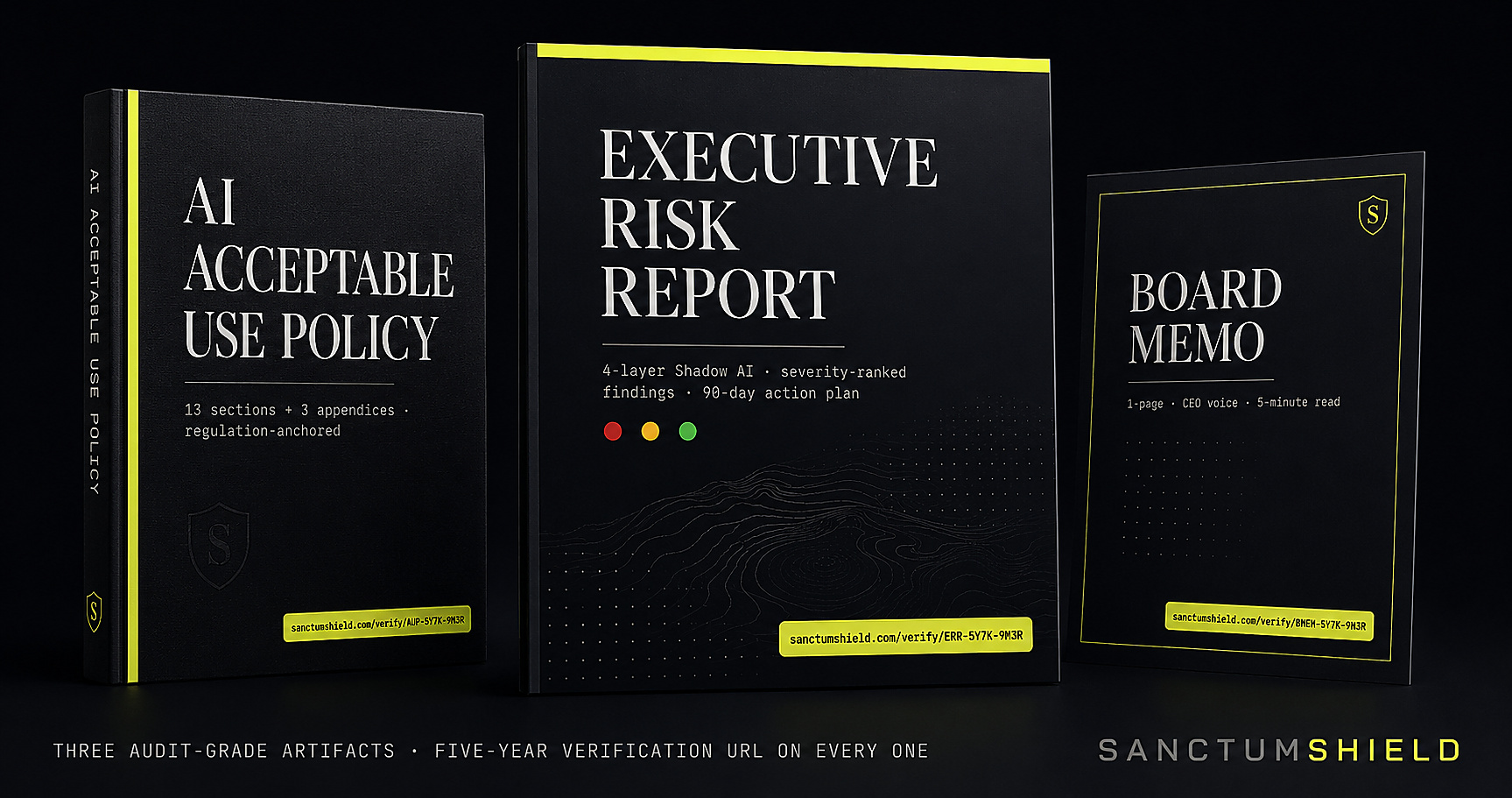
Cyber insurance underwriters are now asking AI governance questions on 2026 renewal questionnaires. The specific questions vary by carrier, but the pattern is consistent across the market: do you have a documented AI Acceptable Use Policy? have you conducted a risk assessment of AI tools in use? is the assessment dated and version-controlled? can you produce a third-party-verifiable artifact? The applicant who answers yes with primary-source-anchored evidence pays a different premium than the applicant who self-attests on a checkbox — and a meaningfully different one than the applicant who hands over a tenant URL the underwriter cannot independently query.
The structural problem with the default answers. A generic AUP from a template vendor is not regulation- anchored at clause level. A Vanta, Drata, or Secureframe tenant URL requires the underwriter to be granted access — and most underwriters won’t be, by either their own policy or operational constraint. A Big 4 advisory PowerPoint ($40K–$150K per engagement) is a snapshot in time that drifted the moment another framework amended a clause. A printed PDF on the CISO’s laptop cannot be queried later when the carrier is conducting subrogation analysis 18 months after the policy period started. None of these answer the underwriter’s actual question: can a third party verify, on the public web, that this artifact is what you say it is? The question is structural, not cosmetic.
What to do. Produce the artifact with a portable verification URL — one a third party can paste into a browser and independently confirm without tenant access, on a 5-year retention horizon. SanctumShield’s Verification URL Architecture (multi-LLM agentic generation underneath, cryptographic integrity hash, metadata-only confirmation page, trust boundary separating exposed metadata from never-stored payload) is the structural answer. Underwriters paste the URL, see generation date, model version, registry version, company name — no payload exposed, no tenant access granted, audit-grade attestation in seconds. Next step: see the verification flow at /insurers.