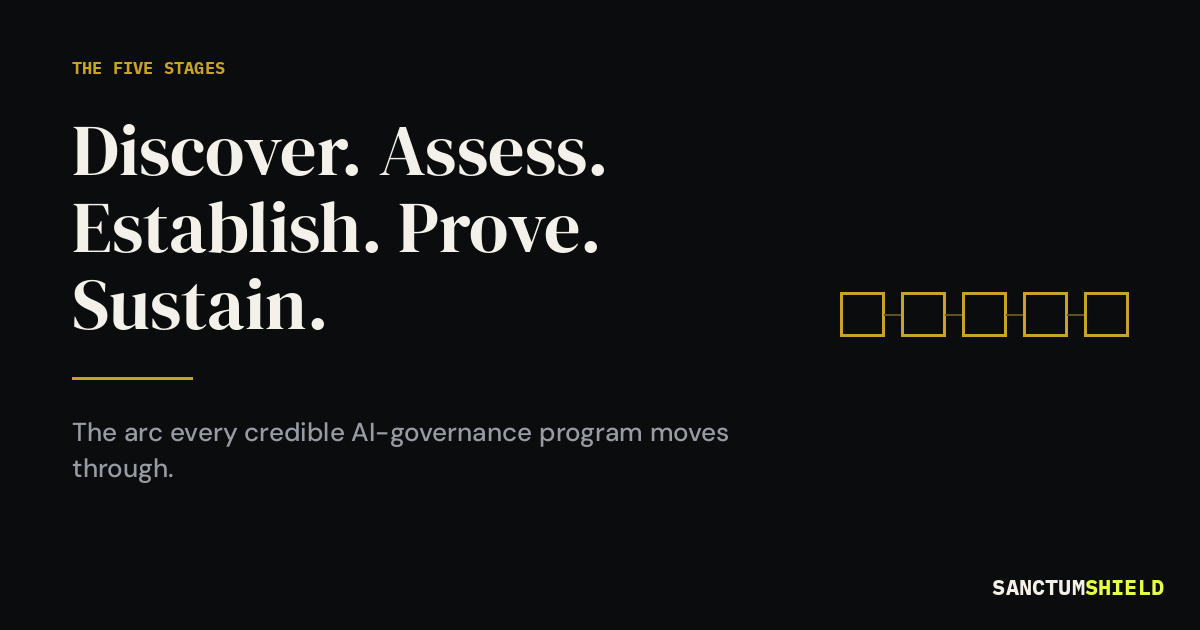
Strip the acronyms away and every serious approach to AI governance — the frameworks regulators publish, the standards auditors use, the curricula executive programs teach — moves through the same five stages. Not because anyone copied anyone, but because the work has a natural order: you can’t assess what you haven’t found, can’t establish rules for risks you haven’t weighed, can’t prove what you never wrote down, and can’t sustain a program that was only ever a snapshot.
SanctumShield uses its own neutral names for these stages — Discover, Assess, Establish, Prove, Sustain — and they map cleanly onto the phase structure of the NIST AI RMF (Govern / Map / Measure / Manage), ISO/IEC 42001, and the executive AI-governance curricula now emerging from academic institutions. Same arc, different labels. Here’s what each stage asks for — and, honestly, where SanctumShield is strong and where it’s still building.
1. Discover — see the whole AI footprint, not just the part you remember
What the stage needs: an AI footprint map, a shadow-AI inventory, a gap-priority matrix, and a stakeholder map — a real picture of where AI lives, including what nobody wrote down.
How SanctumShield produces it: the free Shadow AI Risk Calculator plus network-log analysis — observation over attestation — across the four-layer risk surface, matched against a 72-endpoint AI registry and an 80-plus-tool catalog, with gap findings ranked by impact in the Executive Risk Report. The log analysis works only on destination hostnames you choose to export and share — SanctumShield never reaches into your network.
Honest coverage: Strong on footprint, shadow-AI, and gap prioritization. The stakeholder map is on the active roadmap.
2. Assess — weigh the risk, including fairness
What the stage needs: a risk assessment plus a fairness / bias audit, pre-committed ethical red lines, and a non-discrimination check.
How SanctumShield produces it: the Executive Risk Report — five findings, impact-first severity, and toxic-combination analysis — anchored to real clauses.
Honest coverage: Strong on security and regulatory risk. Fairness / non-discrimination is the stage we are investing in most: a dedicated Algorithmic Discrimination Governance Gap finding type and an AUP fairness-controls appendix, anchored to Colorado SB 26-189, EU AI Act Article 10, NYC Local Law 144, EEOC guidance, and NIST AI RMF MEASURE-2.11. Some ships today; the full fairness appendix is on the near-term roadmap, labeled as such.
3. Establish — write the rules and name who decides
What the stage needs: a governance charter, an AI governance council, decision rights (a RACI matrix), and a policy framework.
How SanctumShield produces it: the AI Acceptable Use Policy — generated and clause-anchored, not started from a blank page — which is the policy framework, including a roles section.
Honest coverage: Strong on the policy framework. The explicit council charter + decision-rights (RACI) matrix are being added to the artifact set; roadmap-labeled where not yet shipping.
4. Prove — the part almost nothing else gives you
What the stage needs: model cards, decision logs, a regulatory compliance map, and an audit trail.
How SanctumShield produces it: a verification URL — third-party-queryable for five years — plus observation-over-attestation log analysis and a multi-framework clause map, delivered as the Executive Risk Report.
Honest coverage: This is where SanctumShield is stronger than a workshop or a consultant binder. A course teaches you to template evidence; SanctumShield produces evidence an outsider can independently verify. The one template-style item still on the roadmap is a model-card generator.
5. Sustain — governance is a film, not a photograph
What the stage needs: a vision statement, a 90-day plan with owners, quick wins, a communications plan, and a governance health scorecard.
How SanctumShield produces it: the Executive Risk Report's 90-day plan and quick wins, the Board Memo (a CEO-voice vision in one page), and a monthly registry + regulatory refresh that is the review cadence — the operational form of Due Diligence.
Honest coverage: Strong on plan, vision, and cadence. The quarterly governance health scorecard and a formal stakeholder comms plan are on the roadmap.
Why the parallel matters — and where the tooling fits. If you’ve taken (or are considering) an executive AI-governance course, you’ll recognize this arc — that’s the point. Executive education builds the judgment to lead governance and walks you through building the playbook by hand. SanctumShield generates and verifies that same playbook, across Discover → Assess → Establish → Prove → Sustain, in about ten minutes — and adds the one thing a workshop structurally can’t: a third-party-verifiable artifact that’s still true next quarter. Education and tooling are complementary; you want both. See the full stage-to-artifact mapping, read why judgment is not evidence, or run the free Shadow AI Risk Calculator to get an observed — not self-reported — picture of your exposure.