A decade ago, security teams chased Shadow IT — employees using Dropbox instead of SharePoint, Slack instead of email. They mostly won that battle. The tools moved files between known formats; controls like DLP (data loss prevention), CASB (cloud access security broker — platforms like Zscaler, Netskope, and Microsoft Defender for Cloud Apps), and SSE (security service edge — the cloud-delivered network-security category) were built to inspect those files and stop sensitive ones at the perimeter. Then generative AI arrived and reset the clock.
Shadow AI is structurally different. Shadow IT moved files. Shadow AI moves reasoning, context, and proprietary intelligence — the actual IP of the business — into unmonitored external systems. An employee pasting a customer contract into ChatGPT does not know they just trained a commercial model on confidential terms. A consultant authenticating to Claude with personal credentials does not surface to a DLP rule, an OAuth integration log, or a CASB allow-list. DLP sees an encrypted HTTPS request to an AI API endpoint and stops there. CASB sees the OAuth grant for the corporate ChatGPT tenant but not the analyst’s personal account. SSE sees the network egress but cannot inspect the prompt. The tools your stack already runs were not built for this risk.
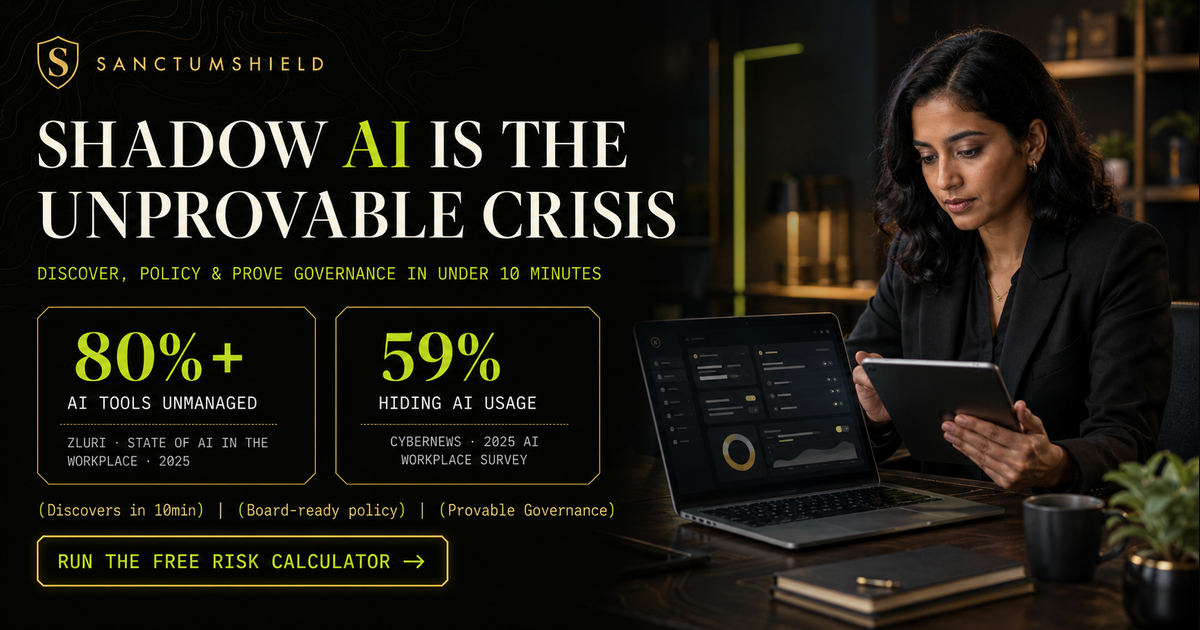
What to do. Treat Shadow AI as its own governance category, not as a Shadow IT subcategory. The first step is observation, not attestation — see which AI endpoints your network is actually reaching, then decide what to do about each. SanctumShield uses multi-LLM agentic synthesis (Claude + Gemini under the hood) to map your AI surface against a continuously refreshed registry of 82 verified AI endpoints, generate a regulation-anchored AI Acceptable Use Policy, and produce a board-ready risk report — in 10 minutes, $99/month, no integration project required. Next step: run the free Shadow AI Risk Calculator to see what your current stack cannot.