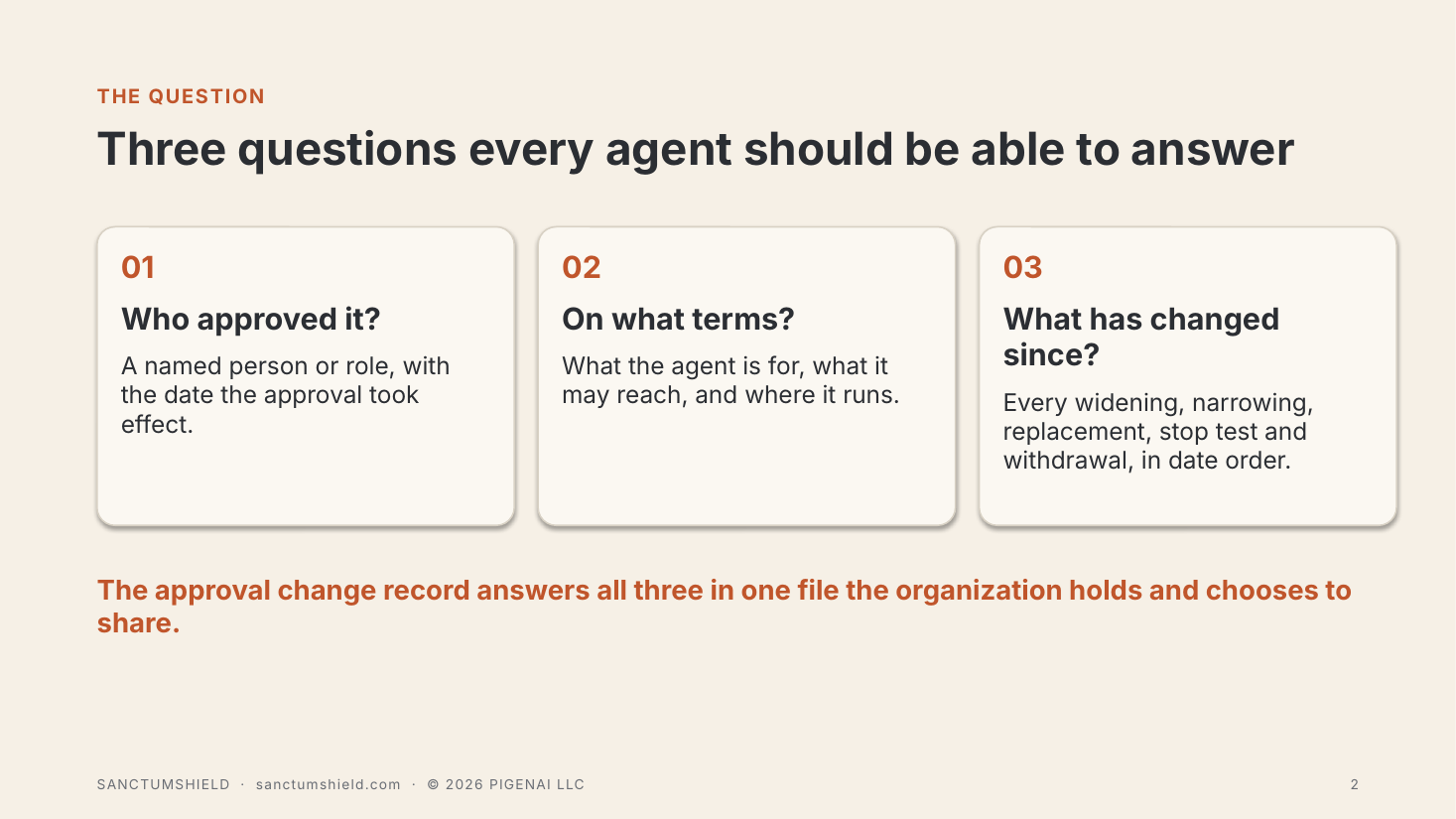
Most organizations can tell you which AI agents they run. Fewer can tell you who approved each one, on what terms, and what has changed since that day. The approval change record is a small file that answers those three questions.
Prefer to watch? Here is a short video.
Why it exists
The four SanctumShield records are written for people. A board member reads the memo. An auditor reads the risk report. Those documents do their work well.
Software needs the same facts in a different shape. A partner’s platform, a ticketing system or an internal dashboard cannot read a paragraph and know which agent it refers to. It needs a name, a date, a type of change and a stable identifier. The approval change record supplies exactly that, so another system can link to a decision and map it to its own data.
Where it sits
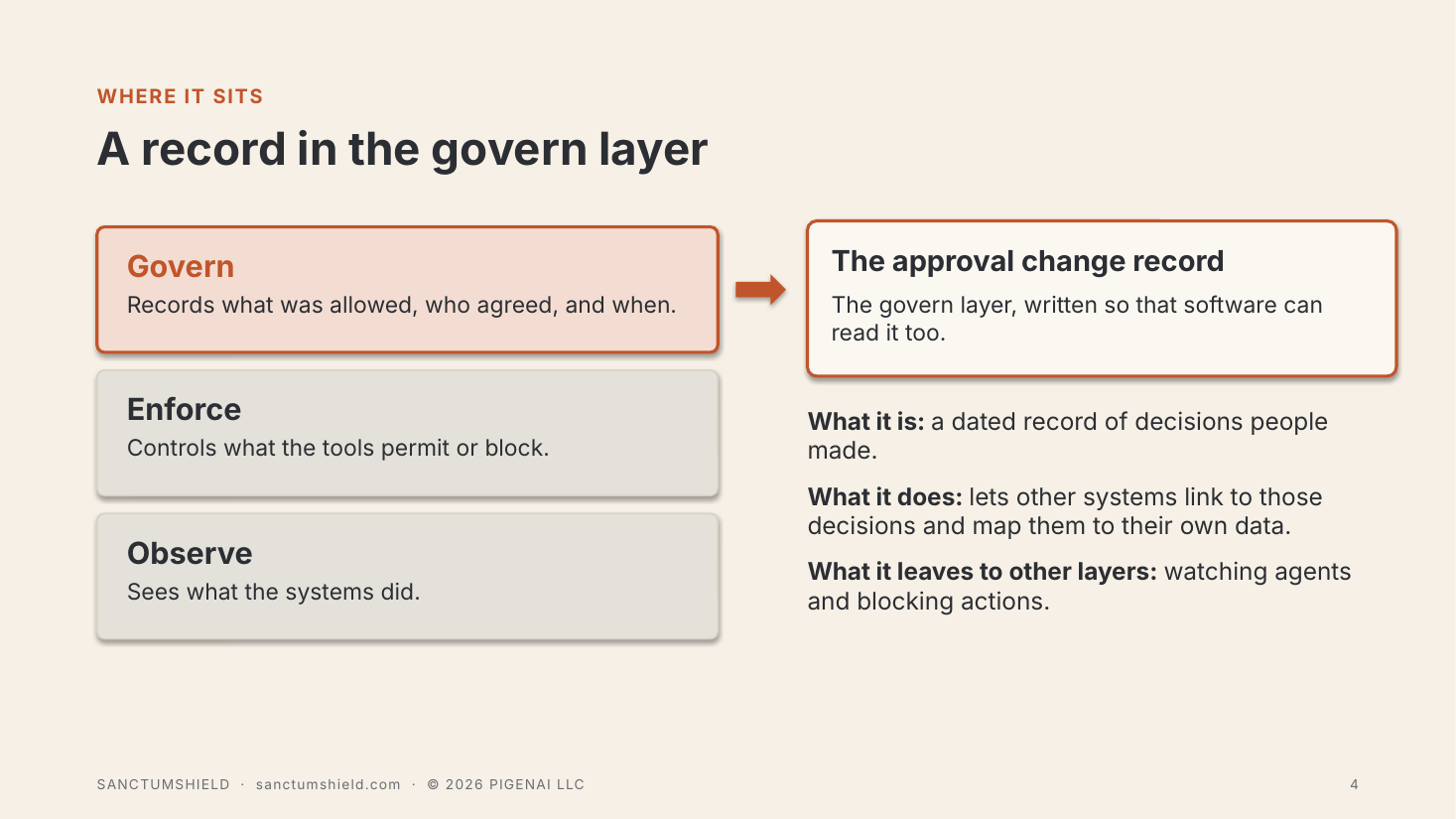
Every organization that uses AI already does two jobs. It observes, which means seeing what the systems did. It enforces, which means controlling what the tools permit or block. The third job is governing, which records what was allowed, who agreed, and when.
The approval change record belongs to the govern layer. It is a record that the other layers can read. It leaves watching agents to the observe layer and blocking actions to the enforce layer. Its contribution is to give those layers something dated and attributable to check against.
Where it comes from
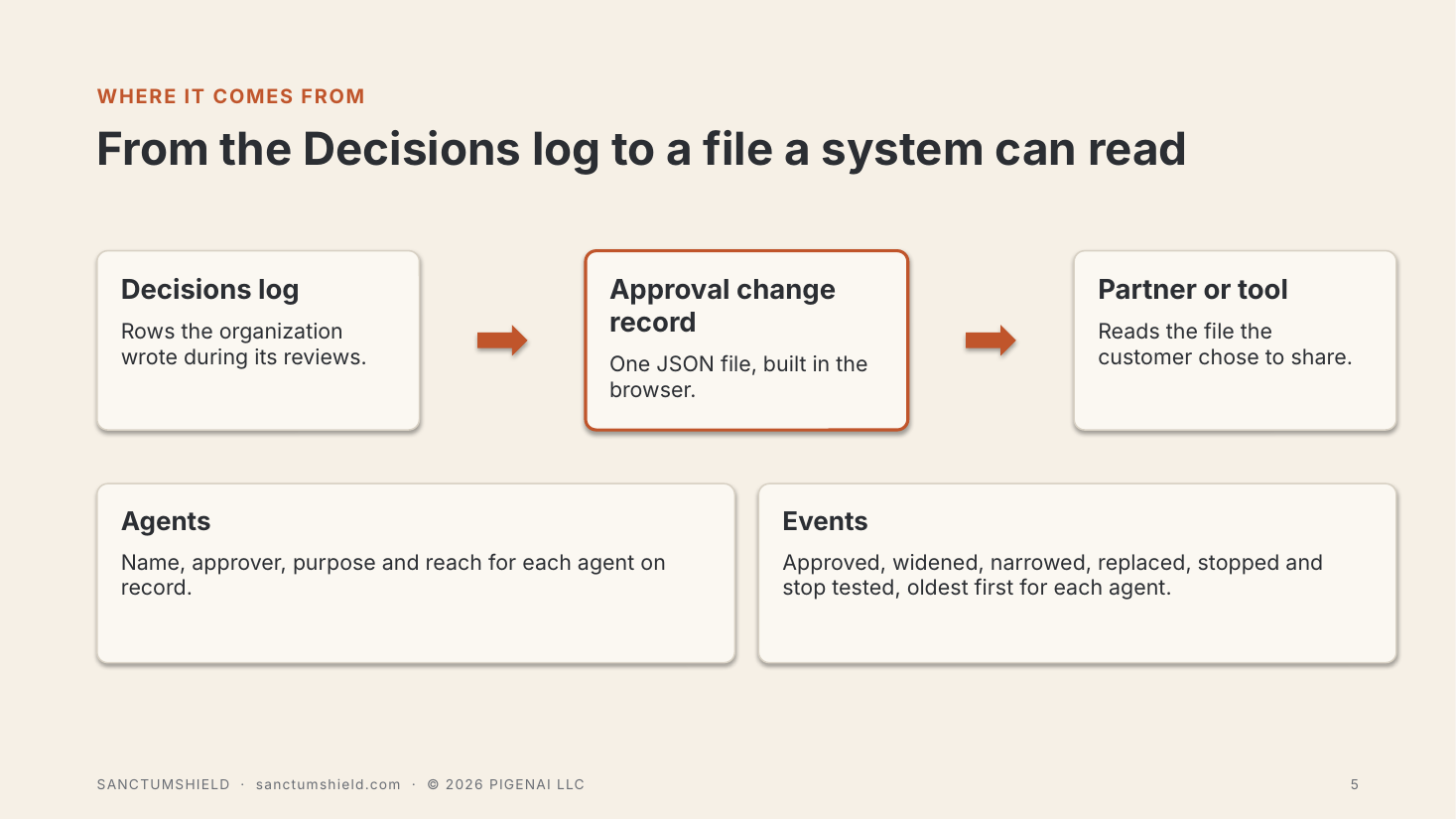
The record is the organization’s own dated account of who approved each agent, on what terms, and every change since. Each event in it is a row from the organization’s Decisions log. The browser builds the file, the customer downloads it, and the customer decides who receives it.
What one looks like
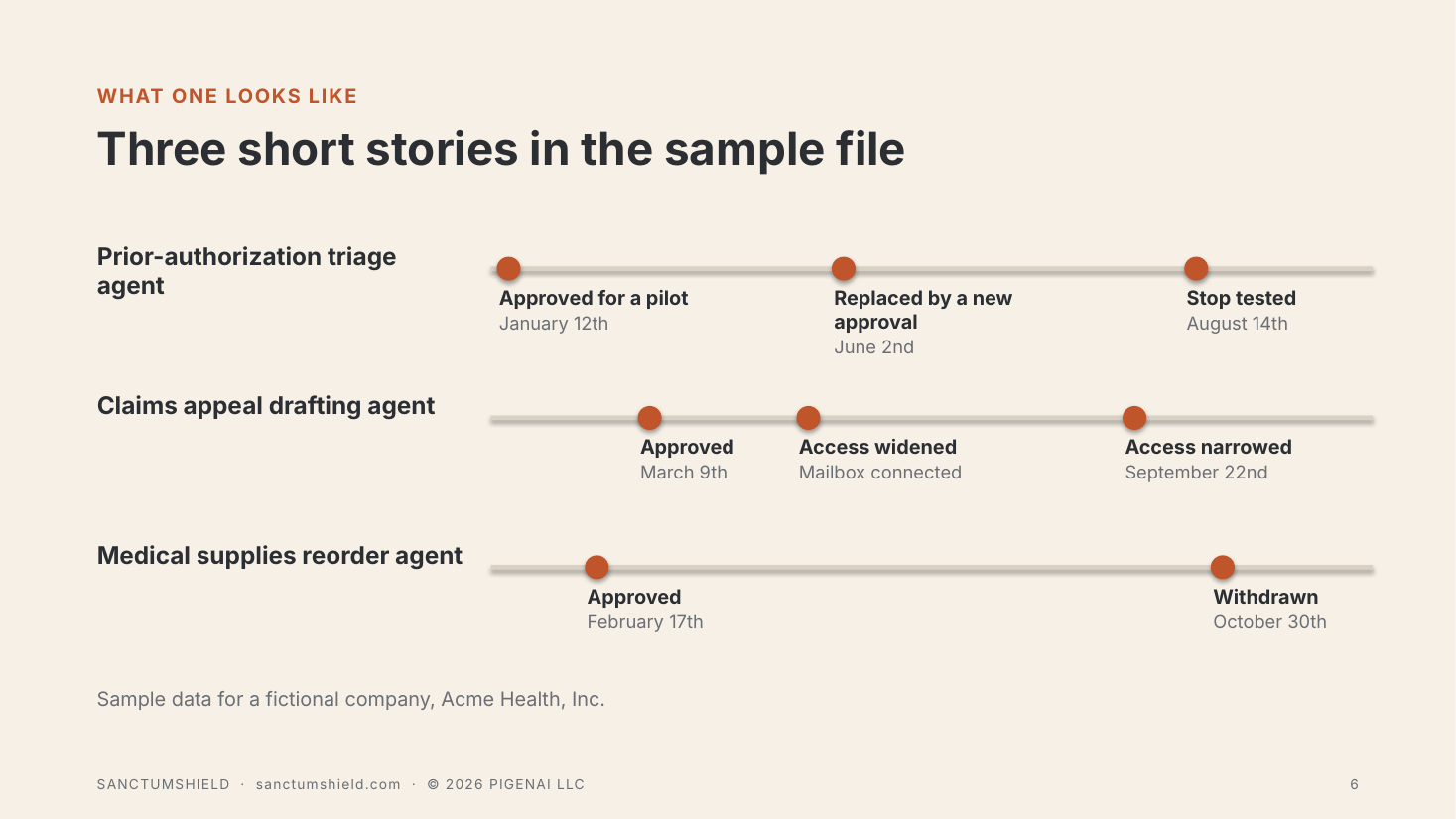
The sample on this site follows a fictional company, Acme Health, with three agents and nine events. Three short stories are inside it.
A pilot that became a standing approval. An agent that sorts prior-authorization requests was approved for a pilot in January. In June a new approval replaced the first one, with nurse review of every recommendation.
Access that grew, then shrank. An agent that drafts appeal letters gained a connection to a shared mailbox. The Privacy Officer later narrowed it and removed that access after a privacy review.
An agent that was retired. An agent that reorders medical supplies was withdrawn in October when the supplier contract ended.
Two dates for every change
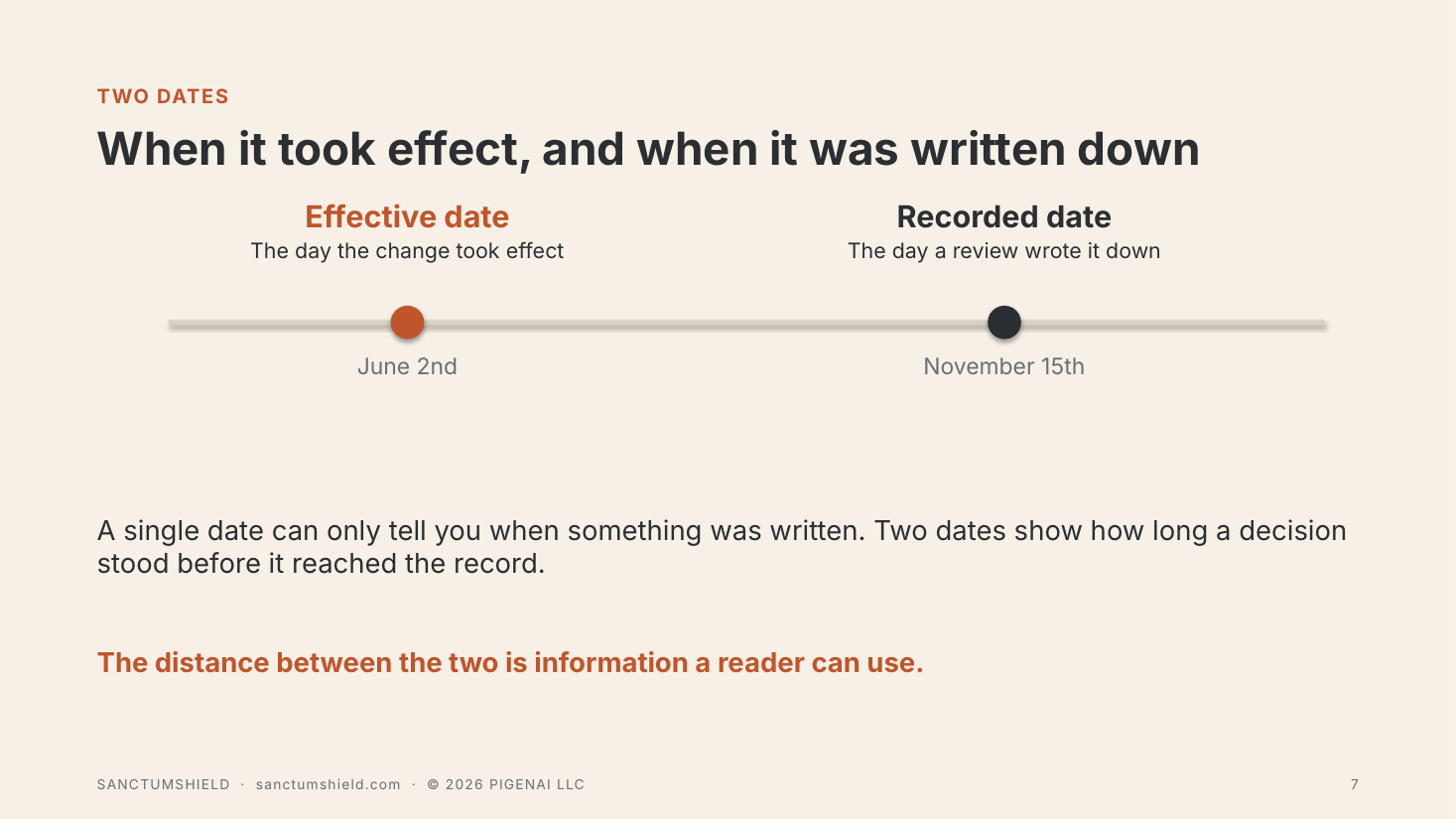
Each event carries the date the change took effect and the date a review wrote it down. The two are kept apart on purpose. A reader can see whether a change reached the record the same week or months later, and that distance is useful information.
It says what it does not know
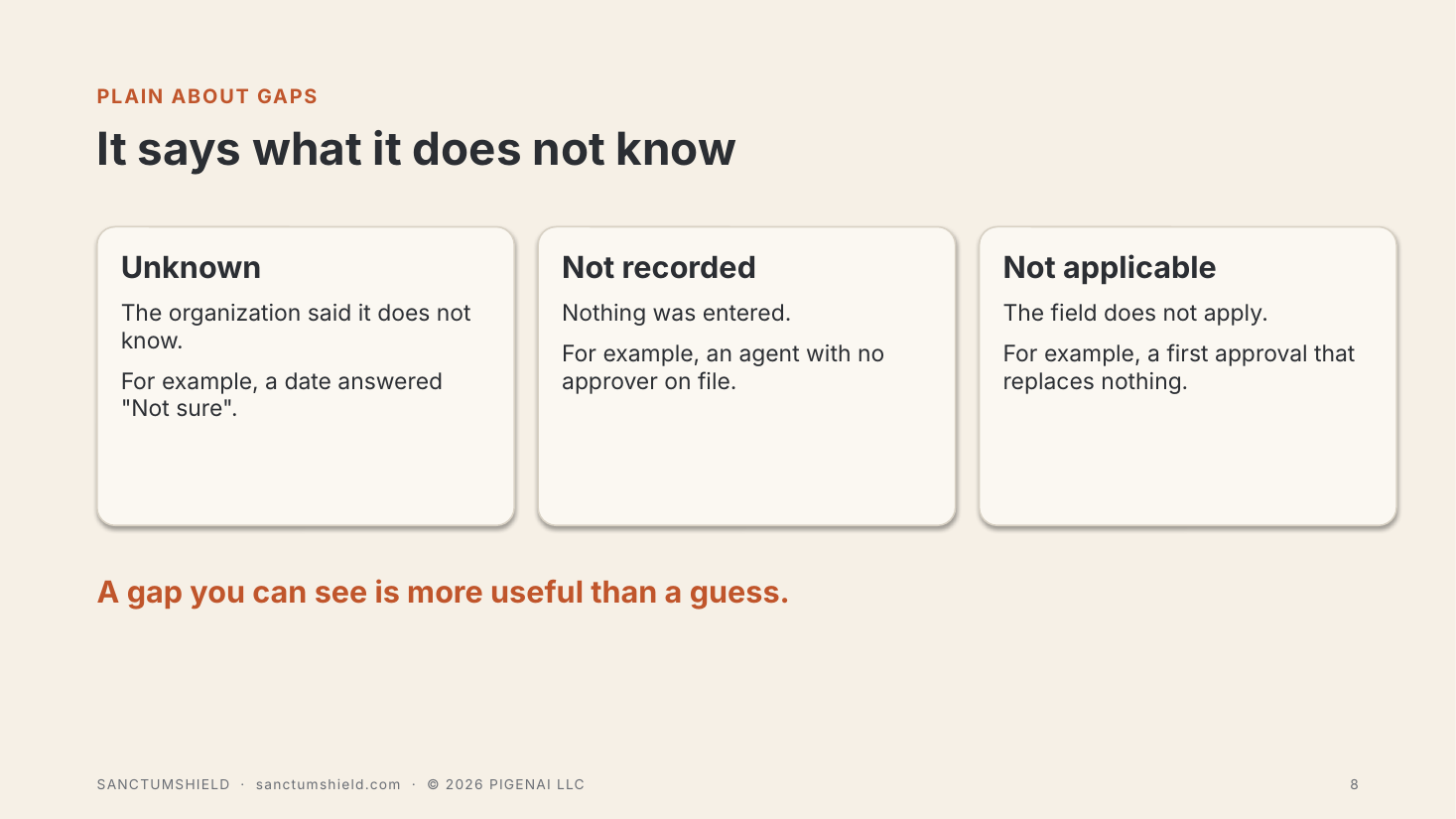
A missing value appears as empty, with a status beside it. The status tells you whether the organization did not know, entered nothing, or the field did not apply. The sample shows this on purpose. One agent has no approver on record. One change has an unknown effective date. A gap you can see is more useful than a guess.
What it establishes, and what it leaves open
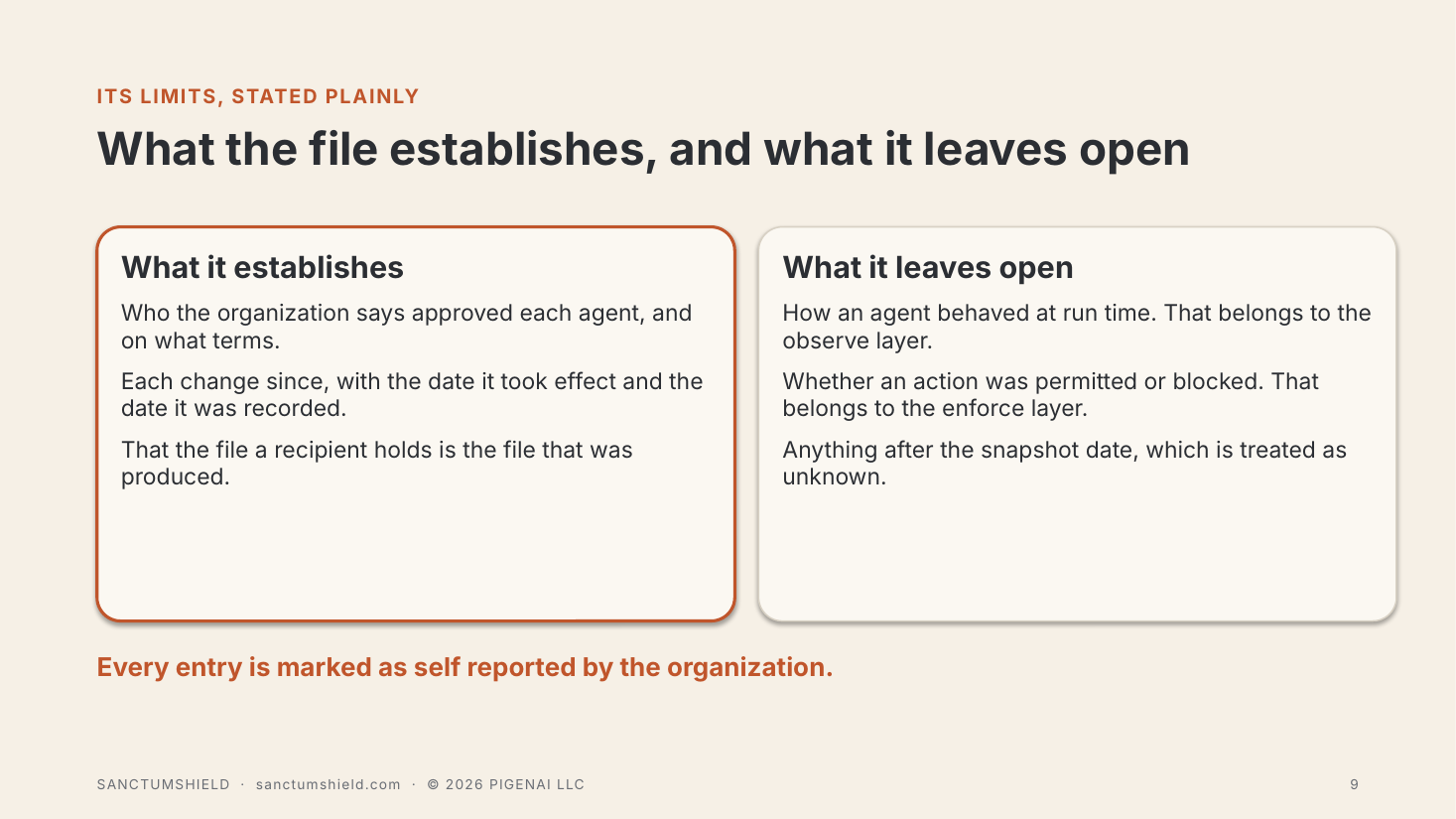
The file is the organization’s own statement, with dates. Every entry is marked as self reported. SanctumShield does not observe agents and does not confirm that an event took place.
What the file does establish is who the organization says approved each agent, each change since, and that the file a recipient holds is the file that was produced. Anything after the snapshot date is treated as unknown.
How it is kept safe
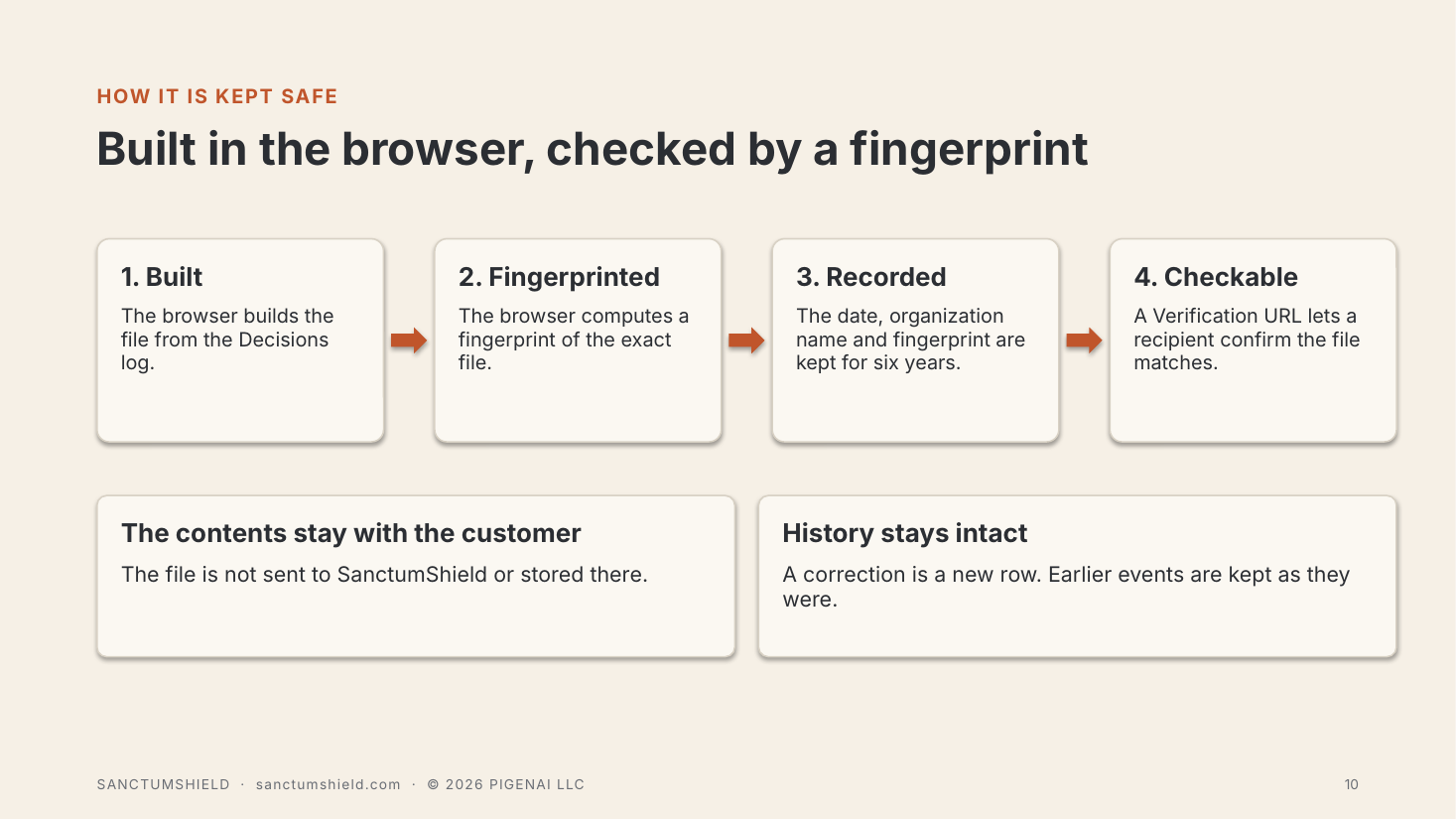
The browser builds the file and computes a fingerprint of it. SanctumShield records the date, the organization name and the fingerprint for six years and issues a Verification URL. The contents of the file are not sent to SanctumShield or stored there. A recipient can use the Verification URL to confirm that the file matches the recorded fingerprint.
Corrections are added as new rows. Earlier events are kept as they were, so the history stays intact.
What it enables
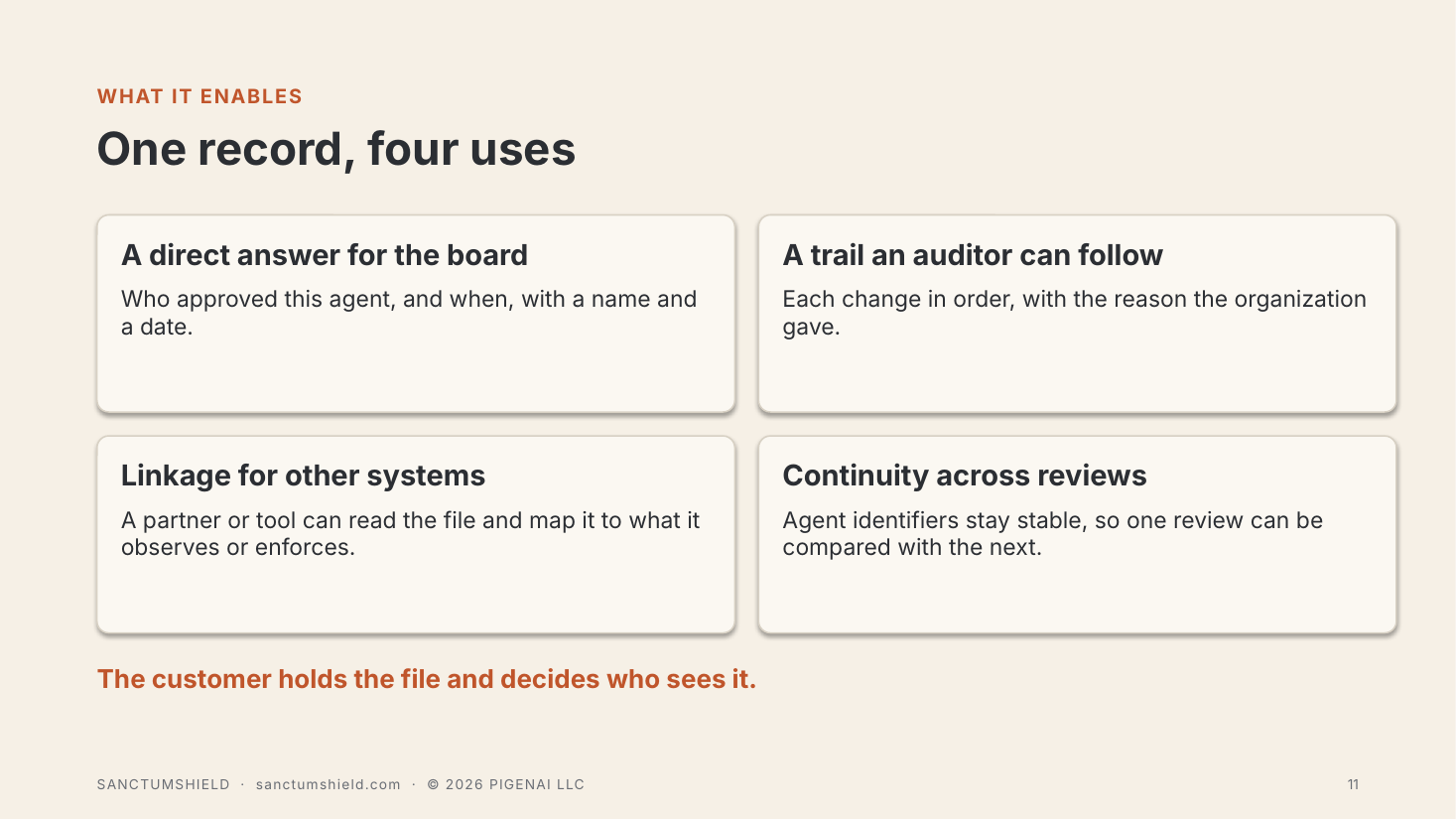
A board member can ask who approved an agent and receive a name and a date. An auditor can follow each change in order. A partner’s system can read the same file and link it to what that system observes or enforces. And because agent identifiers stay stable, one review can be compared with the next.
SanctumShield produces your AI governance records in plain English for your board, and the same decisions in a machine-readable file for your tools. Nothing is stored and nothing is connected. You hold the file and decide where it goes.
See it for yourself
An illustrative sample and the field list are public.
Illustrative sample: https://sanctumshield.com/samples/authority-record/sample-approval-change-record.json
Field list: https://sanctumshield.com/docs/authority-record-schema
Sample records: https://sanctumshield.com/sample-outputs
The slides